The Best Large 3D Printer
From cosplay armor to furniture prototypes, a large-format 3D printer unlocks bigger possibilities. We evaluated top models on build volume, speed, and reliability to help you choose.
 By Sharlene Rose
Updated September 11, 2026
By Sharlene Rose
Updated September 11, 2026
Large-format 3D printers open the door to ambitious projects that standard-sized machines can’t handle, from life-sized cosplay armor and architectural models to functional furniture and tools.
As the technology matures, today’s big printers combine generous build volumes with speed, precision, and multicolor printing that was once reserved for industrial systems.
Whether you’re a maker scaling up prototypes or a hobbyist tackling oversized creations, choosing the right machine matters.
We research and evaluate each model against consistent criteria, specifications, expert review consensus, verified buyer feedback, and published data, then score it on our 0‑to‑10 BP Score.
Below, you’ll find our top picks for the best large 3D printer you can buy in 2026.
Our list includes enclosed printers for stable ABS prints, multi‑material combos for vibrant projects, and high‑speed options that don’t sacrifice quality.
Every model here has been vetted for build volume, print reliability, ease of use, and overall value. Keep reading to compare the leading contenders for big‑scale printing.
| Award | Product | BP Score About BP ScoreThe BP Score is our own rating from 0 to 10, based on performance, design and build, ease of use, and value. It reflects independent research and is never influenced by manufacturers, retailers, or affiliate commissions. Learn more › | Price | |
|---|---|---|---|---|
 Anycubic Kobra X 4-Color 3D Printer
|
7.2/10 | $329.99 | Buy | |
 Bambu Lab P1S 3D Printer
|
8.9/10 | $399.00 | Buy | |
 Creality K2 Plus Combo 350mm Multi-Color 3D
|
6.8/10 | $1,199.00 | Buy | |
 Bambu Lab P2S Combo with AMS 2 Pro
|
8.7/10 | $769.00 | Buy | |
| Best Premium |
 Flashforge Creator 5 Pro 4-Toolhead 3D Printer
|
9.8/10 | $848.99 | Buy |
 Creality K2 Combo 3D Printer with Multicolor CFS
|
7.1/10 | $521.00 | Buy | |
| Best Overall |
 Bambu Lab P1S Combo with AMS Multi-Color
|
9.8/10 | $549.00 | Buy |
 QIDI Max4 Combo 390mm Build Volume 3D Printer
|
9.8/10 | $1,299.00 | Buy | |
| Best Budget |
 AOSEED AI 3D Printer for Kids, 400mm/s
|
9.6/10 | $329.99 | Buy |
 Flashforge AD5X Multi-Color 3D Printer
|
7.5/10 | $348.99 | Buy | |
| Best Value |
 Bambu Lab A1 Combo with AMS Lite Multi-Color 3D
|
9.6/10 | $419.00 | Buy |
 Bambu Lab A1 FDM 3D Printer
|
9.5/10 | $299.99 | Buy |
Anycubic Kobra X 4-Color 3D Printer
A multicolor 3D printer designed for users who want vibrant prints without the typical hassle of color swaps. The Kobra X ships with four colors built-in and can expand to 19 with additional modules, while its optimized purge system cuts material waste and print time roughly in half. Best suited for makers, educators, and hobbyists seeking faster multicolor output with minimal setup friction.
Pros
- Native 4-color capability with expandable palette up to 19 colors via ACE 2 Pro modules
- Significant time savings: 81.25% reduction in purge filament and travel path, doubling effective speed to 600mm/s
- LeviQ 3.0 auto-leveling with 49-point calibration ensures reliable first layer; ready to print within 15 minutes of unboxing
- Hardened steel nozzle and vibration compensation maintain smooth layer quality at high speeds
- Large 260mm x 260mm x 260mm build volume supports diverse project sizes
Cons
- ACE 2 Pro modules required for colors beyond the base four, adding to overall system cost
- Supports only ACE 2 Pro expansion; ACE Pro units are incompatible, limiting upgrade flexibility
Bambu Lab P1S 3D Printer
This enclosed FDM printer delivers production-speed output at 500mm/s with automatic bed leveling to minimize failed prints. Multi-color capability requires the separate AMS accessory, making it best for experienced makers who want fast iteration cycles without assembly headaches.
Pros
- Lightning-fast 500mm/s print speed and 20,000mm/s² acceleration reduce project turnaround time significantly
- Fully enclosed design stabilizes temperature for advanced filaments like ASA and PETG
- Automatic bed leveling removes a major source of print failures for beginners and professionals alike
- 15-minute setup means you start printing the same day, not hours later
Cons
- Multi-color printing requires purchasing the Bambu Lab AMS separately, adding to overall cost
- Cannot handle carbon or glass fiber reinforced polymers, limiting material versatility
Creality K2 Plus Combo 350mm Multi-Color 3D
Creality's flagship multi-color printer combines a generous 350mm cubic build volume with 600mm/s print speeds and intelligent color-switching via CFS units that support up to 16-color output. Dual AI cameras monitor print quality and chamber conditions, while dual independent Z-axis motors ensure consistent bed leveling. Best suited for makers wanting production-scale volume and material versatility without post-print painting.
Pros
- Large 350x350x350mm build platform handles bigger models and batch printing without partitioning
- Multi-color CFS system with RFID filament recognition automatically switches between up to four colors and can relay when filament runs low
- High-speed 600mm/s printing with 30000mm/s² acceleration from step-servo motors keeps production efficient for a larger format machine
- Dual AI cameras monitor spaghetti failures and flow rate optimization, reducing manual intervention
- Heated chamber maintains up to 60°C and nozzle supports 350°C for engineering materials like ASA and PPA with minimal warping
Cons
- Larger footprint and weight (70+ pounds) require dedicated workspace and may complicate relocation
- Premium price point reflects capabilities but represents significant investment for hobbyist users
Bambu Lab P2S Combo with AMS 2 Pro
This combo pairs Bambu Lab's high-speed P2S printer with the AMS 2 Pro multi-material system, enabling fast, precise prints up to 600 mm/s alongside seamless color-switching capability. The 15-minute setup and AI failure detection make it accessible to beginners, while the adaptive airflow system handles everything from flexible materials to engineering-grade filaments. Best suited for makers who want production-level speed without a steep learning curve.
Pros
- Prints at 600 mm/s with maintained precision and sharp layer consistency
- Ready to print in 15 minutes with automatic calibration and quick-swap nozzles
- AMS 2 Pro adds multi-color printing and built-in filament drying up to 65 degrees Celsius
- Adaptive airflow automatically adjusts cooling and heat retention for different materials
- Access to over one million models via MakerWorld with unified Bambu Studio workflow
Cons
- P2S printer alone does not support multi-color printing; combo purchase required for that capability
- Requires AMS 2 Pro module for multi-material functionality, adding to overall system cost
Flashforge Creator 5 Pro 4-Toolhead 3D Printer
This industrial-grade multi-material printer combines four independent toolheads with a 7-second nozzle swap system to eliminate purge waste and accelerate color printing by up to 5X. The active heated chamber reaches 65°C, enabling reliable printing in advanced materials like ABS, PC, and PA. Built for engineers and manufacturers who need precision, speed up to 600mm/s, and a closed-loop safety system with dual HEPA and carbon filtration.
Pros
- Zero-waste FlashSwap toolhead system cuts material costs and printing time significantly
- Active heated chamber and CoreXY architecture support industrial-grade materials and high-speed printing without ghosting
- Dual HEPA 13 and activated carbon filtration with continuous airflow creates a safe, odorless workspace
- Automated calibration, HD chamber camera, and remote control via Flash Studio simplify monitoring and operation
- Ultra-rigid integrated frame with precision linear rails and high-torque belts delivers stability at 600mm/s
Cons
- Premium pricing reflects industrial-class features, making it a significant investment for hobbyists
- Compact footprint of 16 x 14 x 18 inches still requires dedicated workspace for a multi-toolhead system
Creality K2 Combo 3D Printer with Multicolor CFS
The K2 Combo brings multicolor printing to the mainstream with its integrated CFS system, capable of producing up to 16 colors when multiple units are chained together. Its 95% pre-assembly and smart auto-leveling make it accessible for users new to 3D printing, while the step-servo motor system delivers both speed and precision without the noise typical of consumer printers.
Pros
- Multicolor capability with CFS system eliminates post-print painting for complex designs
- Exceptional quiet operation using step-servo motors and balanced fans, comparable to laptop keyboard noise
- Minimal assembly required with plug-and-play setup out of the box
- Smart auto-leveling targets only the print area, reducing calibration time and improving accuracy
- Fast 600mm/s print speed with stable frame and dynamic torque adjustment for consistent quality
Cons
- Multicolor printing requires purchasing additional CFS units separately to reach full 16-color potential
- Build volume of 260x260x260mm limits larger prototype or production-scale projects
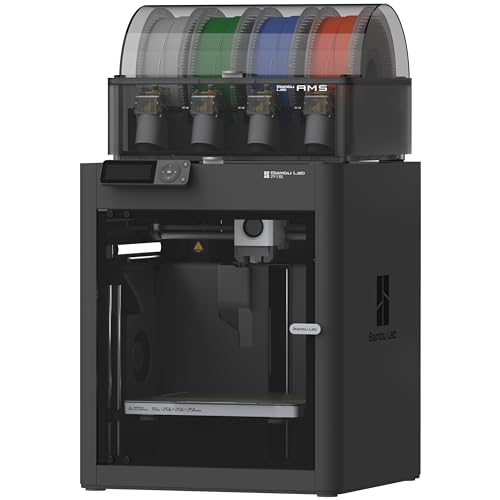
Bambu Lab P1S Combo with AMS Multi-Color
This enclosed 3D printer combines rapid 500mm/s printing speed with multi-color capabilities when paired to its Automated Material System. Setup takes just 15 minutes, and automatic bed leveling removes guesswork from the printing process. Best suited for creators who want speed and color versatility without extended calibration.
Pros
- Exceptional print speed at 500mm/s with 20,000 mm/s² acceleration cuts production time significantly
- Up to 16-color printing capability enables complex multi-material designs in a single print job
- Fully enclosed design stabilizes temperature for advanced filaments like ASA and ABS
- Auto bed leveling and 15-minute setup lower the barrier for beginners
- Supports diverse filament types including PLA, PETG, TPU, and flexible materials
Cons
- AMS unit is required for multi-color printing and sold separately, adding to overall cost
- Cannot handle carbon or glass fiber reinforced polymers, limiting material range
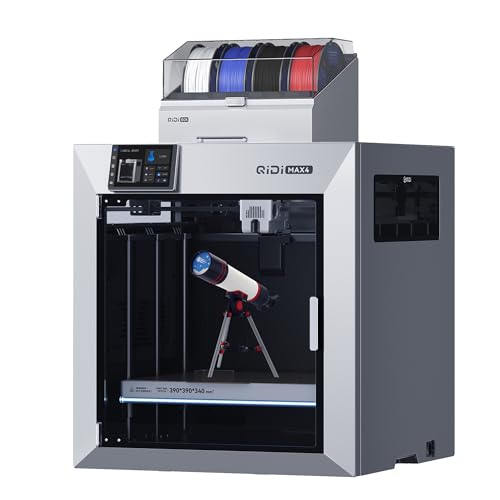
QIDI Max4 Combo 390mm Build Volume 3D Printer
This industrial-grade 3D printer delivers a 390x390x340mm build volume, making it 55% larger than its predecessor and capable of printing complex parts without splitting. Equipped with closed-loop motors, a 65°C heated chamber, and AI-powered failure detection, it handles both standard and high-temperature materials like carbon fiber-reinforced nylon and PC. Best suited for professionals and advanced enthusiasts who need precision, material versatility, and reliability.
Pros
- Ultra-large build platform enables printing industrial parts and complex prototypes in single runs
- High-precision closed-loop motors with 800mm/s max speed and anti-backlash Z-axis for smooth surface quality
- Heated chamber and hardened steel nozzle support wide material range including industrial-grade abrasive composites
- Built-in AI camera detects printing failures and pauses automatically to prevent material waste
- Expandable multi-color capability via QIDI BOX with real-time filament monitoring
Cons
- Polar Cooler system for optimal high-temperature material performance must be purchased separately
- Premium price point positions it for professional/serious hobbyist use rather than casual makers
AOSEED AI 3D Printer for Kids, 400mm/s
An enclosed 3D printer designed specifically for children, featuring AI-powered tools like voice and image-to-model conversion that eliminate the need for design skills. The starter kit includes eight PLA filament rolls and comes pre-calibrated for hassle-free setup, making it accessible for families new to 3D printing. Best suited for kids ages 8+ who want interactive STEM learning with guided creative projects.
Pros
- AI Doodle, AI MiniMe, and MINIMAKIE features let kids create custom models using voice, text, or photos without design experience
- Enclosed, pinch-resistant design with quiet operation and TÜV-certified PLA filament prioritizes child safety
- Leveling-free platform and one-tap app printing simplify the process for beginners
- Built-in camera with real-time monitoring and automatic time-lapse video creation lets families track progress together
- Complete starter kit includes 8 PLA rolls, tools, magnetic build plate, and access to 8,000+ pre-reviewed models across 17 themed categories
Cons
- Single-color printing only; multi-color designs require printing separate parts and manual assembly
- Actual print speeds (220-250 mm/s typical, 400 mm/s peak) vary by complexity, so 20-minute toy claims may not apply to all models
Flashforge AD5X Multi-Color 3D Printer
The AD5X combines four-color printing capability with impressive speed, reaching up to 600mm/s for faster production cycles. Its Intelligent Filament System supports multiple materials including PLA, TPU, and carbon-fiber variants, while automatic bed leveling and CoreXY structure help deliver consistent print quality. Best suited for makers and small businesses seeking multicolor output without sacrificing print velocity.
Pros
- 4-color simultaneous printing expands creative possibilities for complex designs
- Ultrafast printing speed up to 600mm/s with high acceleration reduces production time
- Full-auto calibration and bed leveling ensure reliable first-layer adhesion
- CoreXY structure with vibration compensation maintains precision across layers
- Compact, modular design saves workspace while supporting multiple filament materials
Cons
- Compact footprint may limit maximum build volume compared to larger format printers
- Multi-material setup adds complexity to maintenance and nozzle management
Bambu Lab A1 Combo with AMS Lite Multi-Color 3D
The Bambu Lab A1 Combo brings multi-color printing and high-speed output to the desktop 3D printing space, accelerating up to 10,000 mm/s² while maintaining detail. The included LED Lamp Kit opens creative possibilities for functional decorative lighting projects. Full-auto calibration and active flow compensation remove much of the manual setup hassle, making it accessible for both enthusiasts and makers seeking reliable color printing.
Pros
- Exceptional print speed with 10,000 mm/s² acceleration paired with precision detail retention
- Fully automatic calibration eliminates manual bed-leveling and Z-offset adjustments
- Multi-color printing capability via AMS Lite expands creative design possibilities
- LED Lamp Kit included enables functional decorative lighting projects out of the box
- Quiet operation with active motor noise canceling and simplified touchscreen interface
Cons
- AMS Lite required for multi-color functionality, adding complexity to the workflow and material management
- Premium pricing positions it toward serious makers rather than casual hobbyists
Bambu Lab A1 FDM 3D Printer
The Bambu Lab A1 brings high-speed printing and automatic calibration to beginners and hobbyists looking for a reliable, low-maintenance FDM printer. Its 10,000 mm/s² acceleration delivers fast prints with precision, while full-auto bed leveling and flow compensation eliminate setup frustration. Multi-color printing is possible with the optional AMS lite accessory.
Pros
- Automatic calibration and bed leveling reduce setup time and user error
- Exceptional print speed with 10,000 mm/s² acceleration while maintaining detail quality
- Active flow rate compensation ensures consistent, smooth print results
- Quiet operation with active motor noise canceling
- Quick-swap nozzle design simplifies maintenance and material changes
Cons
- Multi-color printing requires purchasing AMS lite separately, adding to total cost
- Touchscreen interface may require learning curve despite being user-friendly
Best Large 3D Printer Buying Guide
Build Volume and Footprint
The most obvious differentiator for a larger printer is how much it can print in one go.
Build volume is typically measured in cubic millimeters or inches, and even a few extra centimeters can make the difference between one large piece and multiple glued segments.
Many models now offer cubic volumes approaching 350 mm on each side, which is enough for helmet shells, drone frames, or decorative panels.
Consider your workshop or desk space as well. A machine with a 390 mm footprint may not fit every shelf, and enclosed units need clearance for ventilation.
Measure your area and remember that the print bed itself often extends the overall footprint. For guidance on smaller alternatives, our best small 3D printer guide may help if floor space is tight.
If you frequently print tall items like vases or statues, pay attention to the Z‑axis height. Some large printers excel in width but offer only moderate height, while others provide true cubic freedom.
Our FDM 3D printer roundup can also help you compare build envelopes across different form factors.
Print Speed and Layer Quality
Large prints can take days at standard speeds, so fast printing is a real productivity booster. High‑speed CoreXY architectures now reach 600 mm/s or more without sacrificing surface finish.
Look for printers that combine a lightweight direct‑drive extruder with a rigid frame to minimize ringing on large flat surfaces.
However, raw speed isn’t everything. A machine that can print fast but introduces layer shift or poor overhangs isn’t worth the time saved. Reliable auto‑leveling, a stable heated bed, and vibration compensation are equally important.
If you often print detailed models, check our best quality 3D printer guide for machines that prioritize precision over pure velocity.
Multi‑Material and Color Capabilities
Many large printers now offer add‑on units that enable multicolor or multi‑material printing. These systems, often called AMS or CFS, let you switch filaments automatically, creating prints with several colors or combining flexible and rigid materials.
For cosplay or signage, this eliminates post‑processing painting.
Not all multi‑color solutions are equal. Some require dedicated software profiles, while others work seamlessly with the machine’s slicer. Also consider filament waste: purge towers can consume extra material, though some models minimize it through clever flushing algorithms.
Our best filament 3D printer article covers the latest in material compatibility.
Enclosed vs. Open Frame
An enclosed printer is almost essential for large‑format work, especially if you plan to print ABS, nylon, or polycarbonate, materials that require a stable ambient temperature to avoid warping.
Enclosures also reduce noise and keep curious pets away from moving parts. Many models include a heated chamber, which further improves layer adhesion on tall prints.
Open‑frame printers are typically cheaper and easier to modify, but they struggle with high‑temperature filaments. If you mainly print PLA and PETG, an open machine can still produce excellent large parts, just keep the room draft‑free.
For a deeper comparison, take a look at our enclosed 3D printer guide.
Connectivity, Software, and Support
Modern large printers almost always include Wi‑Fi, USB, and often an SD card slot. A robust slicer and mobile app can streamline your workflow, especially when monitoring long prints.
Some manufacturers offer cloud services that let you start, pause, or cancel prints remotely, a lifesaver when the printer is in a different room.
Don’t overlook the community and spare‑parts availability. A printer from a brand with active forums and readily available replacement parts is easier to maintain over the years.
For beginners, an entry‑level 3D printer might be a gentler starting point before stepping up to a large‑frame workhorse.
Why You Should Trust Us
BestProducts is an independent review site that helps you find the best products through comprehensive research. We do not conduct our own product trials; our evaluations are grounded in research, published data, expert review consensus, and verified buyer feedback.
Each model is scored on a consistent 0‑to‑10 BP Score based on specifications, reliability, user satisfaction, and value for the category.
We analyze dozens of sources, including detailed specifications, professional reviewer consensus, and thousands of confirmed user reviews, to build a complete picture of each printer’s strengths and weaknesses.
Our recommendations are free from advertiser influence, and we update our guides as new products and firmware improvements change the landscape.
Final Thoughts
Choosing a large 3D printer in 2026 means balancing build size, speed, material options, and budget. The models below earned top BP Scores in our analysis and represent the best across different needs.
Best Overall: QIDI Max4 Combo, its massive 390 × 390 × 340 mm build volume, 65 °C heated chamber, and high BP Score make it the top choice for large‑scale projects that demand both size and material compatibility.
Best for Multicolor: Bambu Lab P1S Combo, with the AMS unit, this enclosed CoreXY printer delivers vibrant multicolor prints and exceptional reliability at a competitive price.
Best Budget: Bambu Lab A1, an excellent entry point for beginners wanting a large‑enough bed and simple setup, offering great print quality without breaking the bank.
Best Industrial‑Grade: FLASHFORGE Creator 5 Pro, four independent toolheads, a 65 °C heated chamber, and near‑zero waste make it a powerhouse for demanding production or prototyping.
Frequently Asked Questions
What size 3D printer is considered “large”?
Most consumer and prosumer printers have build volumes under 250 mm per side. A large printer typically offers at least 300 mm in each dimension, enabling prints such as full‑face helmets, drone frames, or large prototype parts.
Models with 350 mm or more are considered very large and are the focus of this guide.
Can a large 3D printer print small objects as well?
Yes, most large printers handle small parts without issue, though you may need to adjust the print bed adhesion or use a raft. One advantage is that you can print many small objects in a single batch.
For purely small prints, a mini 3D printer might be more space‑efficient and quicker to heat up.
Do I need an enclosure for a large 3D printer?
It depends on the materials you use. For PLA, an open frame is fine, but for ABS, nylon, or polycarbonate, an enclosure with a heated chamber prevents warping and improves layer bonding.
Enclosures also reduce noise and protect the print from drafts. Most large printers on this list are enclosed, but open‑frame options are available for budget‑conscious buyers.
How much should I spend on a large 3D printer?
Prices range from around $299.99 to $1,299.00 for the models we recommend. Entry‑level large printers cost in the $299.99‑$1,299.00 range, while feature‑packed machines with multicolor, enclosures, and high speed can exceed $1,299.00.
Consider your budget and must‑have features before deciding.
What is the best large 3D printer for beginners?
The Bambu Lab A1 is an excellent starting point because of its plug‑and‑play setup, auto‑calibration, and reliable print quality.
It doesn’t have the largest build volume (256 × 256 × 256 mm), but it’s the easiest large‑format printer for newcomers. For a bigger bed with similar ease of use, the Bambu Lab P1S is a great next step.
Can a large 3D printer be used for commercial production?
Yes, many of the models reviewed here are suitable for low‑volume production or prototyping. The FLASHFORGE Creator 5 Pro with its multi‑toolhead system and heated chamber is particularly suited for small‑batch manufacturing. For higher throughput, consider our commercial 3D printer guide.
Still have questions about large‑format printing? Explore our complete 3D printer guide for more detailed advice on every type of machine.
About the author
Sharlene is BestProducts's telescope and 3D printer writer, weighing optics, print quality, and how much setup each machine demands. She helps readers get past the learning curve to real results.