The Best Small 3D Printer
From compact desktops to enclosed models for kids, our research evaluates build volume, speed, ease of use, and safety. Find the best small 3D printer for your space and skill level.
 By Sharlene Rose
Updated September 11, 2026
By Sharlene Rose
Updated September 11, 2026
The market for small 3D printers has exploded, offering hobbyists, educators, and makers the chance to create prototypes, toys, and functional parts right from their desk.
Whether you have limited space or need a dedicated machine for a classroom, a compact printer can deliver impressive results without a large footprint.
For a broader look at desktop options, see our guide to the Best 3D Printer for Every Maker in 2026.
This roundup helps you find the best small 3D printer for your needs. Our team has researched dozens of models, evaluating build volume, speed, ease of use, and community feedback to select the top contenders.
Below you will find our top picks, followed by a detailed buying guide and frequently asked questions.
| Award | Product | BP Score About BP ScoreThe BP Score is our own rating from 0 to 10, based on performance, design and build, ease of use, and value. It reflects independent research and is never influenced by manufacturers, retailers, or affiliate commissions. Learn more › | Price | |
|---|---|---|---|---|
 Bambu Lab P1S 3D Printer
|
8.9/10 | $399.00 | Buy | |
 Bambu Lab P2S Combo with AMS 2 Pro
|
8.7/10 | $769.00 | Buy | |
| Best Overall |
 Entina Tina2C Mini 3D Printer for Beginners
|
9.8/10 | $199.99 | Buy |
| Best Premium |
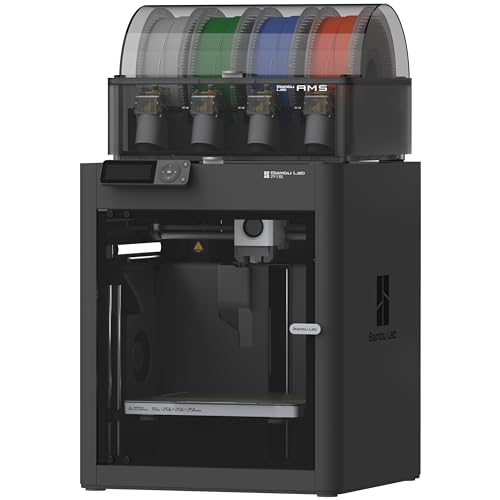 Bambu Lab P1S Combo with AMS Multi-Color
|
9.8/10 | $549.00 | Buy |
| Best Value |
 AOSEED AI 3D Printer for Kids, 400mm/s
|
9.6/10 | $329.99 | Buy |
 Bambu Lab A1 FDM 3D Printer
|
9.5/10 | $299.99 | Buy | |
| Best Budget |
 Flashforge Adventurer 5M 3D Printer
|
9.5/10 | $249.00 | Buy |
 Bambu Lab A1 mini 3D Printer with LED Lamp Kit
|
8.6/10 | $249.00 | Buy | |
 FLASHFORGE Adventurer 5M Pro CoreXY
|
9.4/10 | $379.00 | Buy |
Bambu Lab P1S 3D Printer
This enclosed FDM printer delivers production-speed output at 500mm/s with automatic bed leveling to minimize failed prints. Multi-color capability requires the separate AMS accessory, making it best for experienced makers who want fast iteration cycles without assembly headaches.
Pros
- Lightning-fast 500mm/s print speed and 20,000mm/s² acceleration reduce project turnaround time significantly
- Fully enclosed design stabilizes temperature for advanced filaments like ASA and PETG
- Automatic bed leveling removes a major source of print failures for beginners and professionals alike
- 15-minute setup means you start printing the same day, not hours later
Cons
- Multi-color printing requires purchasing the Bambu Lab AMS separately, adding to overall cost
- Cannot handle carbon or glass fiber reinforced polymers, limiting material versatility
Bambu Lab P2S Combo with AMS 2 Pro
This combo pairs Bambu Lab's high-speed P2S printer with the AMS 2 Pro multi-material system, enabling fast, precise prints up to 600 mm/s alongside seamless color-switching capability. The 15-minute setup and AI failure detection make it accessible to beginners, while the adaptive airflow system handles everything from flexible materials to engineering-grade filaments. Best suited for makers who want production-level speed without a steep learning curve.
Pros
- Prints at 600 mm/s with maintained precision and sharp layer consistency
- Ready to print in 15 minutes with automatic calibration and quick-swap nozzles
- AMS 2 Pro adds multi-color printing and built-in filament drying up to 65 degrees Celsius
- Adaptive airflow automatically adjusts cooling and heat retention for different materials
- Access to over one million models via MakerWorld with unified Bambu Studio workflow
Cons
- P2S printer alone does not support multi-color printing; combo purchase required for that capability
- Requires AMS 2 Pro module for multi-material functionality, adding to overall system cost
Entina Tina2C Mini 3D Printer for Beginners
This compact 3D printer is built for first-time users and kids, letting you start printing within 8 minutes of setup. It combines ease of use with practical learning features, including WiFi control, a 3000-model library, and 20+ STEM modules through the Poloprint Cloud app. Best for families and classrooms seeking an affordable entry point to 3D printing.
Pros
- Rapid setup and beginner-friendly interface with guided app onboarding
- Flexible printing options with both WiFi and offline TF card support
- Auto-leveling and power-loss recovery reduce failed prints and material waste
- Self-cleaning nozzle and magnetic build plate simplify maintenance and model removal
- Compact footprint ideal for home, classroom, and office spaces with quiet operation
Cons
- Very small 3.9 x 3.9 x 3.9 inch build volume limits project complexity and size
- Requires reliance on Poloprint Cloud app for full feature access and model library
Bambu Lab P1S Combo with AMS Multi-Color
This enclosed 3D printer combines rapid 500mm/s printing speed with multi-color capabilities when paired to its Automated Material System. Setup takes just 15 minutes, and automatic bed leveling removes guesswork from the printing process. Best suited for creators who want speed and color versatility without extended calibration.
Pros
- Exceptional print speed at 500mm/s with 20,000 mm/s² acceleration cuts production time significantly
- Up to 16-color printing capability enables complex multi-material designs in a single print job
- Fully enclosed design stabilizes temperature for advanced filaments like ASA and ABS
- Auto bed leveling and 15-minute setup lower the barrier for beginners
- Supports diverse filament types including PLA, PETG, TPU, and flexible materials
Cons
- AMS unit is required for multi-color printing and sold separately, adding to overall cost
- Cannot handle carbon or glass fiber reinforced polymers, limiting material range
AOSEED AI 3D Printer for Kids, 400mm/s
An enclosed 3D printer designed specifically for children, featuring AI-powered tools like voice and image-to-model conversion that eliminate the need for design skills. The starter kit includes eight PLA filament rolls and comes pre-calibrated for hassle-free setup, making it accessible for families new to 3D printing. Best suited for kids ages 8+ who want interactive STEM learning with guided creative projects.
Pros
- AI Doodle, AI MiniMe, and MINIMAKIE features let kids create custom models using voice, text, or photos without design experience
- Enclosed, pinch-resistant design with quiet operation and TÜV-certified PLA filament prioritizes child safety
- Leveling-free platform and one-tap app printing simplify the process for beginners
- Built-in camera with real-time monitoring and automatic time-lapse video creation lets families track progress together
- Complete starter kit includes 8 PLA rolls, tools, magnetic build plate, and access to 8,000+ pre-reviewed models across 17 themed categories
Cons
- Single-color printing only; multi-color designs require printing separate parts and manual assembly
- Actual print speeds (220-250 mm/s typical, 400 mm/s peak) vary by complexity, so 20-minute toy claims may not apply to all models
Bambu Lab A1 FDM 3D Printer
The Bambu Lab A1 brings high-speed printing and automatic calibration to beginners and hobbyists looking for a reliable, low-maintenance FDM printer. Its 10,000 mm/s² acceleration delivers fast prints with precision, while full-auto bed leveling and flow compensation eliminate setup frustration. Multi-color printing is possible with the optional AMS lite accessory.
Pros
- Automatic calibration and bed leveling reduce setup time and user error
- Exceptional print speed with 10,000 mm/s² acceleration while maintaining detail quality
- Active flow rate compensation ensures consistent, smooth print results
- Quiet operation with active motor noise canceling
- Quick-swap nozzle design simplifies maintenance and material changes
Cons
- Multi-color printing requires purchasing AMS lite separately, adding to total cost
- Touchscreen interface may require learning curve despite being user-friendly
Flashforge Adventurer 5M 3D Printer
A fast, user-friendly 3D printer built for creators who want minimal setup hassle. The Adventurer 5M combines automatic bed leveling with 600mm/s print speeds and a quick-change nozzle system, making it well-suited for both rapid prototyping and iterative design work. Remote monitoring via mobile app adds practical convenience for hands-off printing sessions.
Pros
- Automatic bed leveling eliminates manual calibration and ensures consistent first-layer adhesion
- CoreXY structure delivers 600mm/s travel speed with 20000mm/s² acceleration for faster production cycles
- 3-second nozzle swaps and interchangeable sizes (0.25mm to 0.8mm) accommodate diverse project requirements
- Real-time app monitoring allows remote print tracking and instant status alerts
- 280°C direct extruder with dual cooling fans maintains print quality at high speeds
Cons
- Print volume of 220x220x220mm is relatively compact for larger models
- Entry-level rating of 4.1 suggests potential quality control or durability concerns worth monitoring
Bambu Lab A1 mini 3D Printer with LED Lamp Kit
Bambu Lab's A1 mini brings 3D printing within reach for beginners with automatic calibration and straightforward setup. The bundled LED Lamp Kit expands creative possibilities, while integration with MakerWorld and the Bambu Handy app streamlines the entire workflow. Compact, quiet operation makes it suitable for home studios and shared spaces.
Pros
- Automatic calibration and simple setup eliminate common beginner frustrations
- Quiet, high-speed printing performs reliably without disrupting home environments
- Integrated ecosystem with MakerWorld library and mobile app management
- LED Lamp Kit included enables functional decorative projects out of the box
- Compact footprint fits naturally into workspaces and studios
Cons
- Beginner-focused design may lack advanced features for experienced makers
FLASHFORGE Adventurer 5M Pro CoreXY
This fast, enclosed 3D printer reaches up to 600mm/s thanks to its CoreXY structure and vibration compensation. It features a tool-free quick-swap nozzle and auto-leveling for easy setup, plus dual filtration and quiet operation under 50dB. Ideal for home, office, or classroom use, it supports standard and engineering materials like ABS and PETG-CF.
Pros
- Blazing 600mm/s print speed
- Tool-free 3-second nozzle swap
- One-click auto-leveling for perfect first layer
- Dual filtration system for clean air
- Quiet operation below 50dB
Cons
- Relatively heavy at 22 pounds
- Enclosed chamber lacks active heating
Best Small 3D Printer Buying Guide
Print Size and Build Volume
Even among compact machines, build volume varies significantly, from tiny 150x150x150 mm cubes to spacious 220x220x220 mm chambers. A larger volume lets you print bigger models in one piece, but reduces portability.
If you mainly make small figurines or parts, a smaller bed may suffice. If you occasionally want to print functional brackets or enclosures, aim for at least 180 mm on each axis.
Our Best Mini 3D Printer guide covers ultra‑compact options.
Speed and Precision
Modern small printers can reach speeds of 300, 600 mm/s without sacrificing layer adhesion. Faster printing reduces wait times, but it can amplify vibrations; look for features like CoreXY kinematics or reinforced frames. Minimum layer height (typically 0.05, 0.1 mm) defines detail resolution.
For highly detailed miniatures, a printer that can reliably handle 0.08 mm layers is preferable. For entry‑level machines, the Best Inexpensive 3D Printer guide highlights budget‑friendly models that balance speed and quality.
Assembly and Setup
Many small printers now come pre‑assembled or require only a few minutes to unpack and level. Features like automatic bed leveling and one‑click printing drastically lower the learning curve.
If you are new to 3D printing, a printer that arrives fully assembled and includes a guided setup app will get you printing quickly.
For a deeper look at high‑quality options, check out the Best Quality 3D Printer for Every Maker.
Filament Compatibility
Most small FDM printers handle PLA and PETG well, but if you want to print flexible TPU or engineering materials like nylon, you need an all‑metal hotend that reaches 280°C or higher.
A direct‑drive extruder (as opposed to Bowden) also improves flexible filament reliability. If you plan to experiment with advanced materials, make sure the printer supports them natively.
Connectivity and Smart Features
Wi‑Fi and app control allow you to send prints from your phone or monitor progress remotely. Some models offer cloud‑based model libraries with thousands of free designs, making it easy to start printing immediately.
Integrated cameras let you check layer adhesion without being in the room. For enclosed printers with extra safety, our Best Enclosed 3D Printer recommendations cover models that offer both connectivity and containment.
Safety and Enclosure
Fully enclosed printers are safer around children and pets because they contain moving parts and hot components. They also help maintain stable temperatures for materials like ABS.
If you plan to use the printer in a shared space or classroom, look for models with locked doors, thermal runaway protection, and low‑odor filtration.
The Best FDM 3D Printer for Every Maker guide discusses the benefits of enclosed vs. open‑frame designs.
Why You Should Trust Us
BestProducts evaluates each product using our proprietary BP Score (0, 10), based on consistent criteria. We analyze specifications, aggregated expert reviews, verified buyer feedback, and published data from reputable sources.
We do not conduct our own product trials; our evaluations are grounded in research, published data, expert review consensus, and verified buyer feedback. Our goal is to provide transparent, independent recommendations that help you make an informed purchase.
Final Thoughts
Best Overall: Bambu Lab P1S Combo, Combines multi‑color printing with a fully enclosed design and exceptional reliability, earning a top BP Score in our research.
Best for Beginners: Entina Tina2C, Pre‑assembled, app‑driven, and backed by a huge library of free models, making it the easiest way to start printing with a high BP Score.
Best Value: FLASHFORGE Adventurer 5M, Fast 600 mm/s speed, automatic leveling, and a detachable nozzle deliver impressive performance at an accessible price point.
Best for Kids: AOSEED AI 3D Printer, Fully enclosed with AI safety monitoring and an 8000+ model library, providing a secure and fun introduction to 3D printing.
Frequently Asked Questions
What is the best small 3D printer for beginners?
The Entina Tina2C is an excellent choice for first‑time users. It arrives fully assembled, features automatic bed leveling, and connects to a user‑friendly app with over 3000 free models. The machine starts printing in about eight minutes and requires minimal technical knowledge.
Do I need an enclosed printer?
Enclosed printers are recommended if you have children or pets, or if you plan to print materials like ABS that are sensitive to drafts. They also reduce noise and contain fumes.
For PLA and PETG, an open‑frame printer works perfectly fine in a well‑ventilated area.
What filament should I start with?
PLA is the easiest material for beginners. It requires a low nozzle temperature (190, 220°C), does not need a heated bed in most cases, and produces little odor. Once you are comfortable, PETG and TPU are great next steps for stronger or flexible parts.
How important is automatic bed leveling?
Automatic bed leveling is a major time‑saver, especially for beginners. It compensates for slight inconsistencies in the bed surface, reducing failed first layers and the need for manual adjustments. Most modern small printers include this feature, and we recommend it strongly.
Can I print multicolor with a small printer?
Yes, if the printer supports an optional material system. The Bambu Lab P1S Combo includes an AMS unit that loads up to four filaments, allowing multicolor prints without manual filament swapping. Standalone multicolor upgrades are also available for some models.
What is the difference between FDM and resin for small printers?
FDM (fused deposition modeling) uses spools of thermoplastic filament and is generally easier, safer, and more affordable for beginners. Resin printers produce higher detail but require messy post‑processing and ventilation.
For most hobbyists and educators, a compact FDM printer offers the best balance of convenience and capability.
About the author
Sharlene is BestProducts's telescope and 3D printer writer, weighing optics, print quality, and how much setup each machine demands. She helps readers get past the learning curve to real results.