The Best Commercial 3D Printer
We evaluated nine commercial 3D printers on print speed, build volume, reliability, and value. Our top picks include models from Flashforge, Creality, and Phrozen, with the Flashforge AD5X earning the highest BP Score for its multicolor capability and speed.
 By Sharlene Rose
Updated September 11, 2026
By Sharlene Rose
Updated September 11, 2026
Commercial 3D printing has moved beyond prototyping into full-scale production, tooling, and end-use parts. Whether you run a small design studio or a manufacturing floor, a reliable, fast, and high-quality printer is essential for keeping workflows efficient.
In this guide, we evaluate the top commercial 3D printers on the market based on specifications, expert consensus, and verified buyer feedback. Our picks range from large-format resin machines to high-speed FDM systems with multicolor capabilities.
Below, you’ll find our carefully vetted recommendations, followed by a detailed buying guide to help you choose the right machine for your business.
We’ve scored each model using our 0, 10 BP Score, which aggregates performance, reliability, and value. Use this roundup to quickly compare the leading options and find the commercial 3D printer that best fits your production needs.
| Award | Product | BP Score About BP ScoreThe BP Score is our own rating from 0 to 10, based on performance, design and build, ease of use, and value. It reflects independent research and is never influenced by manufacturers, retailers, or affiliate commissions. Learn more › | Price | |
|---|---|---|---|---|
 Anycubic Kobra X 4-Color 3D Printer
|
7.2/10 | $329.99 | Buy | |
 Flashforge AD5M Pro 600mm/s 3D Printer
|
7.3/10 | $378.99 | Buy | |
| Best Overall |
 FilaBees Flashforge AD5X Multi-Color 3D Printer
|
9.8/10 | $348.99 | Buy |
| Best Value |
 Flashforge AD5M Pro CoreXY 3D Printer
|
9.8/10 | $379.00 | Buy |
 Creality K2 Combo 3D Printer with Multicolor CFS
|
7.1/10 | $521.00 | Buy | |
| Best Premium |
 Creality K2 Combo Multicolor 3D Printer
|
9.5/10 | $549.00 | Buy |
| Best Budget |
 Flashforge Adventurer 5M 3D Printer
|
9.5/10 | $249.00 | Buy |
 Phrozen Sonic Mega 8K S 15in 8K Resin Printer
|
9.5/10 | $1,199.99 | Buy | |
 FLASHFORGE Adventurer 5M Pro CoreXY
|
9.4/10 | $379.00 | Buy |
Anycubic Kobra X 4-Color 3D Printer
A multicolor 3D printer designed for users who want vibrant prints without the typical hassle of color swaps. The Kobra X ships with four colors built-in and can expand to 19 with additional modules, while its optimized purge system cuts material waste and print time roughly in half. Best suited for makers, educators, and hobbyists seeking faster multicolor output with minimal setup friction.
Pros
- Native 4-color capability with expandable palette up to 19 colors via ACE 2 Pro modules
- Significant time savings: 81.25% reduction in purge filament and travel path, doubling effective speed to 600mm/s
- LeviQ 3.0 auto-leveling with 49-point calibration ensures reliable first layer; ready to print within 15 minutes of unboxing
- Hardened steel nozzle and vibration compensation maintain smooth layer quality at high speeds
- Large 260mm x 260mm x 260mm build volume supports diverse project sizes
Cons
- ACE 2 Pro modules required for colors beyond the base four, adding to overall system cost
- Supports only ACE 2 Pro expansion; ACE Pro units are incompatible, limiting upgrade flexibility
Flashforge AD5M Pro 600mm/s 3D Printer
A fully enclosed 3D printer designed for home and classroom use, combining high-speed printing at 600mm/s with a quiet operation mode that drops to 50dB. The one-click auto-leveling system and dual filtration (HEPA13 + activated carbon) address common pain points for beginners, while support for multiple materials and nozzle sizes appeals to makers who want versatility without constant calibration.
Pros
- Automatic leveling system eliminates manual Z-axis calibration for consistent first layers
- Dual filtration blocks 99% particulate matter and VOCs, making it safer for indoor environments
- Supports multiple filament types (PLA, ABS, PETG, TPU, ASA, carbon fiber variants) with quick-swap nozzles (0.25-0.8mm)
- Low-speed silent mode reduces noise to 50dB, suitable for shared spaces
- Remote monitoring and multi-printer management via Orca-Flashforge slicer and Flash Maker app
Cons
- Learning curve for users unfamiliar with multi-material printing and slicer software
- Relatively large footprint (15.75 x 17.83 x 14.96 inches) may challenge space-limited setups
FilaBees Flashforge AD5X Multi-Color 3D Printer
A multi-color 3D printer built for commercial use, the Flashforge AD5X supports up to four colors with auto filament loading and refill. Its high speed and precise printing make it suitable for industrial applications.
Pros
- Multi-color printing up to 4 colors
- High speed up to 600mm/s
- Auto filament loading and refill
- Supports flexible and carbon fiber filaments
- Remote app control and multi-device management
Cons
- Camera kit sold separately for monitoring
- Heavy at 24.25 pounds
Flashforge AD5M Pro CoreXY 3D Printer
This CoreXY-based 3D printer targets makers seeking speed without sacrificing precision. The AD5M Pro reaches 600mm/s print velocity while maintaining a 220mm cubic build volume, backed by quick-swap hotends rated to 280°C and a built-in camera for remote monitoring. Best suited for experienced users prioritizing production volume over maximum bed size.
Pros
- High-speed CoreXY kinematics deliver fast print times relative to traditional FDM
- Quick-swap hotend system with dual nozzle options (0.4mm and 0.6mm) reduces changeover friction
- Quiet operation at 50dB enables workshop integration without noise complaints
- Includes 250g PLA starter material and built-in camera for print supervision
- Compact footprint (15.75 x 17.83 x 14.96 inches) suits space-constrained environments
Cons
- 220mm build volume limits part size compared to larger format printers in the category
- Quick-swap hotend convenience may require learning curve for first-time multi-nozzle users
Creality K2 Combo 3D Printer with Multicolor CFS
The K2 Combo brings multicolor printing to the mainstream with its integrated CFS system, capable of producing up to 16 colors when multiple units are chained together. Its 95% pre-assembly and smart auto-leveling make it accessible for users new to 3D printing, while the step-servo motor system delivers both speed and precision without the noise typical of consumer printers.
Pros
- Multicolor capability with CFS system eliminates post-print painting for complex designs
- Exceptional quiet operation using step-servo motors and balanced fans, comparable to laptop keyboard noise
- Minimal assembly required with plug-and-play setup out of the box
- Smart auto-leveling targets only the print area, reducing calibration time and improving accuracy
- Fast 600mm/s print speed with stable frame and dynamic torque adjustment for consistent quality
Cons
- Multicolor printing requires purchasing additional CFS units separately to reach full 16-color potential
- Build volume of 260x260x260mm limits larger prototype or production-scale projects
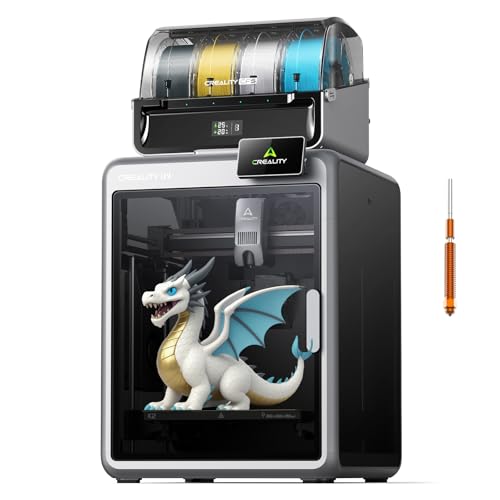
Creality K2 Combo Multicolor 3D Printer
This multicolor 3D printer expands your creative range with up to 16 color options through its modular CFS system and automatic filament switching. Built for both speed and precision, it reaches 600 mm/s print velocity while maintaining stability through an aerospace-grade aluminum frame and dual Z-axis design. Best suited for makers tackling multi-material projects, prototypes, and artistic prints who value a largely pre-assembled setup.
Pros
- Expandable multicolor capability with up to 4 CFS units for 16 vibrant colors and smooth color transitions
- High print speed of 600 mm/s with 20,000 mm/s² acceleration paired with strong structural stability
- Smart filament system with RFID auto-identification, moisture-proof storage, and automatic relay
- Fully pre-assembled and ready to use out of the box with guided auto-leveling calibration
- AI chamber camera for failure detection, time-lapse recording, and built-in air purifier for VOC filtration
Cons
- Premium positioning likely reflects higher cost compared to single-color 3D printer alternatives
- Multicolor printing adds complexity that may require learning curve despite user-friendly design claims
Flashforge Adventurer 5M 3D Printer
A fast, user-friendly 3D printer built for creators who want minimal setup hassle. The Adventurer 5M combines automatic bed leveling with 600mm/s print speeds and a quick-change nozzle system, making it well-suited for both rapid prototyping and iterative design work. Remote monitoring via mobile app adds practical convenience for hands-off printing sessions.
Pros
- Automatic bed leveling eliminates manual calibration and ensures consistent first-layer adhesion
- CoreXY structure delivers 600mm/s travel speed with 20000mm/s² acceleration for faster production cycles
- 3-second nozzle swaps and interchangeable sizes (0.25mm to 0.8mm) accommodate diverse project requirements
- Real-time app monitoring allows remote print tracking and instant status alerts
- 280°C direct extruder with dual cooling fans maintains print quality at high speeds
Cons
- Print volume of 220x220x220mm is relatively compact for larger models
- Entry-level rating of 4.1 suggests potential quality control or durability concerns worth monitoring
Phrozen Sonic Mega 8K S 15in 8K Resin Printer
The Phrozen Sonic Mega 8K S is a large-format resin 3D printer engineered for high-volume production, capable of printing 80 detailed miniatures in under 1.5 hours. Its 15-inch 8K LCD and 43µm XY resolution deliver industrial-grade precision, while the ACF film and TR300 resin enable speeds up to 10 times faster than standard printers.
Pros
- Massive productivity: 80 models in 90 minutes
- Up to 10x faster with ACF and TR300 resin
- Space-saving lift-up lid design
- Zero-waste drip hanger for resin recovery
- High 43µm XY resolution for fine detail
Cons
- Heavy at 57.3 pounds
- Large footprint requires dedicated workspace
- Optimal speed requires TR300 high-speed resin
FLASHFORGE Adventurer 5M Pro CoreXY
This fast, enclosed 3D printer reaches up to 600mm/s thanks to its CoreXY structure and vibration compensation. It features a tool-free quick-swap nozzle and auto-leveling for easy setup, plus dual filtration and quiet operation under 50dB. Ideal for home, office, or classroom use, it supports standard and engineering materials like ABS and PETG-CF.
Pros
- Blazing 600mm/s print speed
- Tool-free 3-second nozzle swap
- One-click auto-leveling for perfect first layer
- Dual filtration system for clean air
- Quiet operation below 50dB
Cons
- Relatively heavy at 22 pounds
- Enclosed chamber lacks active heating
Commercial 3D Printer Buying Guide
Print Speed and Throughput
For commercial use, speed directly impacts production capacity. Look for printers that offer high print speeds (300, 600 mm/s) without sacrificing accuracy. CoreXY kinematics and fast-heating hotends are common in top-tier models.
A printer that can produce multiple parts overnight will improve your return on investment. When comparing speed, check the manufacturer’s advertised rates against real-world prints, as layer height and material also affect cycle times.
For guidance on entry-level options, see our best entry 3D printer guide.
Many commercial machines include a high-flow extruder and a powerful part-cooling fan to maintain quality at speed. Features like auto-bed leveling and vibration compensation keep prints accurate even during long runs.
If you need to produce hundreds of parts per week, prioritize a model that can sustain high throughput with minimal operator intervention.
Build Volume and Material Compatibility
Larger build volumes let you print bigger objects or batch multiple parts in one run. For commercial applications, a build area of at least 250mm x 250mm is often recommended.
Resin printers like the Phrozen Sonic Mega 8K S offer a massive 330mm x 200mm x 300mm volume, ideal for detailed prototypes. FDM printers with 300mm or larger cubes are common for functional prototypes and jigs.
Material support is equally critical, consider whether you need to print engineering-grade filaments (nylon, polycarbonate, PETG) or advanced resins.
Check the maximum nozzle temperature and heated bed capabilities. Enclosed chambers can maintain stable temperatures for demanding materials like ABS or ASA. If you work with flexible or composite filaments, a direct-drive extruder and hardened nozzle are necessary.
For a broader comparison of enclosed options, visit our best enclosed 3D printer roundup.
Reliability and Maintenance
Downtime costs money in a commercial setting. Look for printers with all-metal frames, high-quality linear rails, and robust motion systems that can run for thousands of hours without significant wear. Quick-swappable nozzles and modular extruders simplify maintenance.
Printers with self-diagnostic features like AI print monitoring (e.g., Creality’s K2 Combo) can detect failures early and pause to save material.
For smaller workstations, you might also consider a mini 3D printer for secondary tasks, though confirmation of reliability is essential.
Filtered exhaust systems and low-noise operation (under 50 dB) are bonuses for office environments. Check user feedback on long-term durability: consistent layer adhesion, bed leveling retention, and extruder clogging are common pain points.
Models with a proven track record among verified buyers score higher in our evaluation.
Connectivity and Software
Commercial workflows often involve remote management. Printers with Wi-Fi, Ethernet, and USB connectivity, plus a built-in camera for monitoring, allow you to check progress from anywhere.
Cloud slicers and remote queue management (like Flashforge’s Polar Cloud or Creality Cloud) streamline multi-printer operations. Some models include a touchscreen interface for local control. For dedicated software tips, see our best 3D printer guide which covers software ecosystems.
Open-source vs. proprietary firmware is another consideration: open firmware allows customization but may affect warranty. Most commercial users prefer plug-and-play reliability, but advanced users may want to tweak print profiles.
Ensure the printer supports common file formats (G-code.stl.3mf) and integrates with your existing CAD tools.
Multicolor and Multi-Material Support
For commercial prototypes or final products, the ability to print in multiple colors or materials is a game-changer. Systems like the Flashforge AD5X and Creality K2 Combo use separate filament units to achieve full-color prints without manual filament changes.
This saves time and reduces waste. Resin printers, on the other hand, can achieve color by swapping resin vats, but automated options are rarer. If your business requires detailed, full-color parts, prioritize a printer with a proven multicolor system.
For a deeper dive into FDM options, our best FDM 3D printer roundup is worth reading.
Multi-material support (e.g., soluble supports, flexible/rigid combinations) further expands capabilities. Check the maximum number of filaments and the ease of switching. Some systems require dedicated purge blocks to clean the nozzle, affecting material usage.
Verified buyer feedback on print quality and jamming rates is crucial for these advanced features.
Price and Total Cost of Ownership
Commercial 3D printers range from $249.00 to $1,199.99, but the purchase price is only part of the equation. Factor in costs for materials, spare parts, and potential maintenance contracts.
Resin printers require consumables like FEP film, while FDM printers need occasional nozzle replacements. Energy consumption also adds up over a year. For budget-conscious buyers, our best inexpensive 3D printer guide highlights cost-effective models that still deliver commercial-grade reliability.
Consider warranty length and customer support quality. Brands like Flashforge and Creality offer dedicated business support tiers. A longer warranty often indicates confidence in durability. Overall, the total cost of ownership over three years should guide your decision as much as the upfront price.
Why You Should Trust Us
BestProducts is an independent review site that evaluates products using a consistent methodology. We do not conduct our own product trials; our evaluations are grounded in research, published data, expert review consensus, and verified buyer feedback.
Each product is scored on our 0, 10 BP Score based on multiple criteria including print quality, speed, reliability, build volume, and value. Our team analyzes technical specifications, reads professional reviews from industry specialists, and aggregates real-world experiences from verified purchasers.
We update our recommendations regularly to reflect market changes and new releases. For more on our approach, see the 3D Printers category page and other gear guides.
We are transparent about our affiliate relationships: if you purchase a product through our Amazon links, we may earn a small commission at no extra cost to you. This supports our editorial independence. We never accept payment for reviews or rankings.
Final Thoughts
After evaluating nine of the top commercial 3D printers, these are the models that stood out for their performance and value:
- Best Overall: Flashforge AD5X 3D Printer, With a top-tier BP Score and seamless multicolor printing, this machine handles complex commercial projects with ease while maintaining high throughput and print quality.
- Best for Large Prototypes: Phrozen Sonic Mega 8K S LCD/MSLA Resin 3D Printer, Its massive build volume and 43-micron resolution make it ideal for large, detailed models that require fine surface finish.
- Best Speed and Precision: Flashforge AD5M Pro 3D Printer, Delivering 600 mm/s speeds with dual nozzle options and near-silent operation, this pro machine is perfect for fast production in a workshop environment.
- Best Value Commercial Machine: FLASHFORGE Adventurer 5M 3D Printer, At an accessible price, it offers 600 mm/s printing, a 280°C hotend, and an all-metal CoreXY structure, making it a strong entry point for small businesses.
- Best Multicolor System: Creality K2 Combo 3D Printer, This model’s CFS multicolor unit and large 260mm build volume combine reliability with creative flexibility for full-color prototypes.
Frequently Asked Questions
What defines a commercial 3D printer?
A commercial 3D printer is designed for sustained, high-volume use in a business or professional setting. Key features include faster print speeds, larger build volumes, higher reliability, and advanced connectivity for remote management.
Unlike hobbyist models, commercial printers often have robust frames and support engineering materials.
How do I choose between FDM and resin for commercial use?
FDM printers are generally better for functional parts, larger volumes, and a wider range of filaments. Resin printers excel at high-detail, smooth-surface models and jewelry or dental applications.
Consider the typical part size, required surface finish, and material properties you need. For a side-by-side comparison, our best quality 3D printer guide covers both technologies.
What maintenance does a commercial 3D printer require?
Routine tasks include cleaning the build plate, inspecting belts and pulleys, lubricating linear rails, and replacing nozzles periodically. For resin printers, change the FEP film when it becomes cloudy and keep the resin vat clean.
Many commercial printers have self-maintenance features like automatic bed leveling and build plate calibration to reduce operator workload.
Can I use a commercial 3D printer for mass production?
Yes, many commercial printers are designed for low- to medium-volume production. With high-speed printing and large build volumes, they can run 24/7. However, for mass production of thousands of parts, injection molding or specialized industrial printers may be more cost-effective.
For small-batch manufacturing, these printers offer excellent flexibility.
What safety features should I look for in a commercial 3D printer?
Look for enclosures with HEPA or carbon filters to control fumes, especially when printing with engineering materials. Over-temperature protection, emergency stop buttons, and automatic filament run-out detection are important for safe unattended operation. Some printers include flame-retardant components.
How long do commercial 3D printers typically last?
With proper maintenance, a quality commercial printer can last 3, 5 years or more. Key factors include frame construction, motor quality, and how often it is used. Machines from established brands like Flashforge, Creality, and Phrozen have proven durability in professional environments.
About the author
Sharlene is BestProducts's telescope and 3D printer writer, weighing optics, print quality, and how much setup each machine demands. She helps readers get past the learning curve to real results.