The Best Portable Generator
Our research-backed guide to the best portable generators covers power output, fuel types, noise, and portability. Compare top models from Westinghouse, DuroStar, Generac, and more to find the right generator for your home, RV, or job site.
 By Katherine Henderson
Updated September 10, 2026
By Katherine Henderson
Updated September 10, 2026
Power outages can strike without warning, turning a comfortable home into a stressful situation. A portable generator keeps your lights on, your refrigerator running, and your devices charged during emergencies.
Whether you need backup for your whole house, power for a job site, or reliable electricity for an RV trip, choosing the right model is critical.
At BestProducts, we research each generator thoroughly, analyzing specifications, expert reviews, and verified buyer feedback to bring you honest, data-driven recommendations. Below, you’ll find our top-rated portable generators for 2026.
Our team evaluated over a dozen models based on power output, fuel flexibility, noise levels, portability, and reliability. We scored every unit on our 0, 10 BP Score using consistent criteria.
The result is a curated list of generators that offer real value for different needs and budgets. Keep reading to find the best portable generator for your situation.
| Award | Product | BP Score About BP ScoreThe BP Score is our own rating from 0 to 10, based on performance, design and build, ease of use, and value. It reflects independent research and is never influenced by manufacturers, retailers, or affiliate commissions. Learn more › | Price | |
|---|---|---|---|---|
| Best Overall |
 Westinghouse Tri-Fuel 13500W Generator
|
9.9/10 | $1,249.00 | Buy |
| Best Value |
 DuroStar DS13000MX 13,000W Generator
|
9.8/10 | $899.00 | Buy |
| Best Budget |
 Anker SOLIX S2000 2,010Wh Power Station
|
9.8/10 | $649.99 | Buy |
 Generac 12500 Tri-Fuel Portable Generator
|
9.8/10 | $1,069.00 | Buy | |
 AIVOLT 1600W Super Quiet Inverter Generator 28lbs
|
9.6/10 | $329.39 | Buy | |
 Westinghouse WGen9500DF Dual Fuel
|
9.6/10 | $999.00 | Buy | |
| Best Premium |
 DuroMax XP13000EH Dual Fuel Generator (13,000W)
|
9.6/10 | $1,499.00 | Buy |
 Westinghouse 14500 Tri-Fuel Generator
|
9.6/10 | $1,499.00 | Buy | |
 Jackery Explorer 1000 v2 1070Wh Power Station
|
9.6/10 | $559.00 | Buy |
Westinghouse Tri-Fuel 13500W Generator
This tri-fuel generator from Westinghouse offers flexibility with gasoline, propane, or natural gas. It delivers up to 13500 peak watts and features a remote start with key fob, making it a solid choice for home backup power. The long run time of up to 19 hours on a full tank adds to its reliability.
Pros
- Tri-fuel capability (gas, propane, natural gas)
- Remote start with included key fob
- High peak wattage (13500W on gas)
- Up to 19 hours run time on full tank
- Multiple outlet types including RV-ready 50A
Cons
- Heavy at 230 pounds
- Large footprint (27 x 26 x 26 inches)
DuroStar DS13000MX 13,000W Generator
The DuroStar DS13000MX delivers 13,000 watts of dual fuel power for whole-home backup or job site use. Its push-button electric start and CO alert add convenience and safety. Rugged all-metal construction ensures durability in harsh conditions.
Pros
- Dual fuel capability
- 13,000 watts of power
- CO detection safety feature
- Electric start convenience
- Sturdy steel construction
Cons
- Heavy at 220 pounds
- Large size requires space
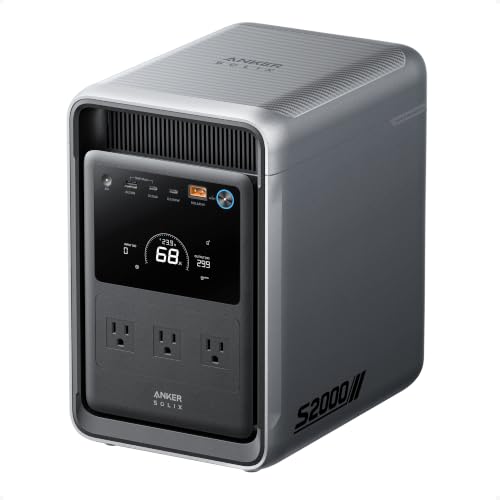
Anker SOLIX S2000 2,010Wh Power Station
The Anker SOLIX S2000 portable power station delivers a generous 2,010Wh capacity with a durable LFP battery rated for 10,000 charge cycles. It keeps a refrigerator running for up to 35 hours, and its compact, lightweight build (35.7 lbs) makes it easier to move than many competing models. This station is a solid choice for home backup or off-grid use, especially if you value long battery life and flexible recharging options.
Pros
- Very low idle power consumption
- Long-lasting LFP battery (10,000 cycles)
- Compact and lightweight for its capacity
- High 3,000W peak output
- Multiple recharging options
Cons
- No 12V DC port
Generac 12500 Tri-Fuel Portable Generator
The Generac 12500 Tri-Fuel portable generator delivers 12,500 starting watts and runs on gasoline, propane, or natural gas. With COsense automatic shutdown, electric start, and a 7.5-gallon tank providing up to 14 hours runtime on propane, it's a solid choice for home backup or job sites.
Pros
- Tri-fuel capability for flexible fuel use
- High surge capacity for starting large loads
- COSense safety system shuts off generator
- Electric start with included battery
- Large fuel tank gives extended runtime
Cons
- Heavy at 219 pounds, hard to move
- Requires oil change every 100 hours
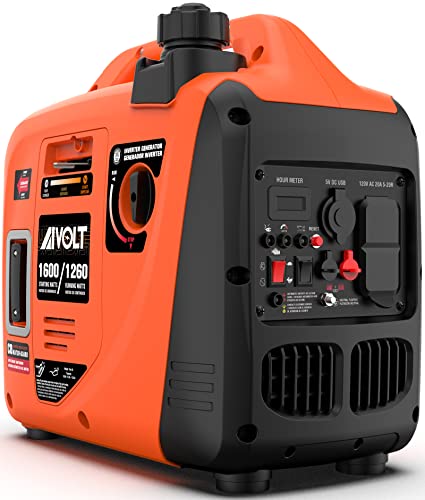
AIVOLT 1600W Super Quiet Inverter Generator 28lbs
This ultra-quiet inverter generator weighs just 28 pounds and delivers clean power (THD under 3%) for sensitive electronics. With a 57 dBA noise level and parallel capability, it's a practical choice for camping, RV trips, and home backup.
Pros
- Very lightweight at 28 lbs
- Quiet operation at 57 dBA
- Clean power for sensitive electronics
- Parallel capability for more power
- CO safety shutdown feature
Cons
- Only 1260 running watts may limit larger devices
- Short runtime of 2 hours at full load
- No parallel kit included
Westinghouse WGen9500DF Dual Fuel
This dual fuel generator delivers 9,500 running watts on gasoline or 8,500 on propane, making it a reliable backup for home power outages. It includes remote start via key fob, runs up to 12 hours per tank, and has outlets ready for transfer switches and RVs.
Pros
- Remote start with key fob
- Dual fuel for gasoline and propane
- High 9,500 running watts on gas
- Long runtime up to 12 hours
- RV ready and transfer switch ready outlets
Cons
- Very heavy at 209 pounds
- May have residual oil or fuel odor from factory
- Large footprint at 27.2 x 26.1 inches
DuroMax XP13000EH Dual Fuel Generator (13,000W)
A dual fuel portable generator that runs on gasoline or propane, the DuroMax XP13000EH delivers 13,000 watts for whole-home backup. Its electric start and transfer switch-ready 50 amp outlet simplify connection, and the all-metal frame with copper windings enhances durability.
Pros
- Dual fuel flexibility (gas or propane)
- Electric start for easy operation
- Transfer switch-ready 50 amp outlet
- Heavy-duty all-metal frame construction
- Copper windings for better heat dissipation
Cons
- Heavy at 234 pounds
- Large footprint (30x29x26 inches)
- Noise level not specified
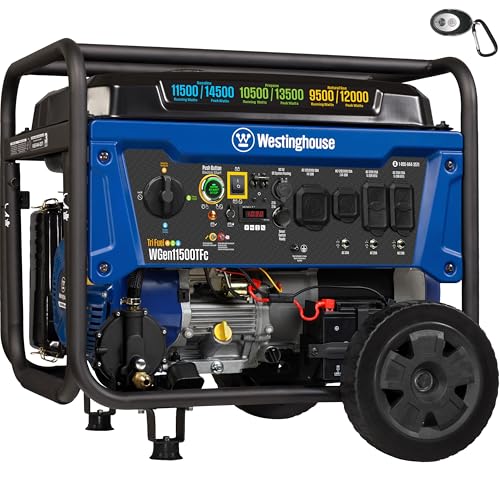
Westinghouse 14500 Tri-Fuel Generator
A heavy-duty backup generator that runs on gas, propane, or natural gas, delivering up to 14,500 peak watts. Its low THD makes it safe for sensitive electronics, and it can power a home for up to 19 hours on a full gas tank.
Pros
- Tri-fuel flexibility
- High peak and running wattage
- Long runtime on gasoline
- Safe for electronics
- Remote start included
Cons
- Very heavy at 230 pounds
- Large footprint (27 x 26 x 26 inches)
- Propane runtime only 7 hours
Jackery Explorer 1000 v2 1070Wh Power Station
This portable power station packs a 1070Wh LFP battery and 1500W output in a lightweight 23.8-pound design with a foldable handle. It offers fast charging via the Jackery App, multiple ports including USB-C PD 100W, and a 10-year lifespan making it a solid choice for camping or emergency backup.
Pros
- Fast 1-hour charging mode
- Long 10-year battery lifespan
- Lightweight at 23.8 pounds
- Multiple port options including USB-C PD 100W
Cons
- Solar panels sold separately
- Emergency charging must be enabled each time via app
Best Portable Generator Buying Guide
Power Output and Starting Watts
The first thing to consider is how much power you actually need. Portable generators are rated in running watts (continuous) and starting watts (surge).
A small fridge and a few lights might need only 1,500, 2,000 running watts, while a well pump, furnace, and sump pump can require 5,000, 7,000 watts. For whole-home backup, models like the Westinghouse 13500 Peak Watt Tri-Fuel deliver ample starting power.
If you’re unsure, a good rule is to add up the wattage of everything you want to run simultaneously and multiply by 1.5 for startup surge.
You can also check our guide to the 13000 watt portable generator for a deeper dive into high-wattage options.
Keep in mind that inverter generators, like the AIVOLT 1600W, are more fuel-efficient and quieter but usually cap out at lower wattages. They are ideal for camping or sensitive electronics.
Traditional generators, on the other hand, offer higher output for home backup at a lower upfront cost.
Fuel Type: Dual Fuel vs. Tri-Fuel vs. Single Fuel
Most portable generators run on gasoline, but dual-fuel models (gasoline + propane) and tri-fuel models (gasoline + propane + natural gas) give you flexibility during shortages.
Propane stores indefinitely and burns cleaner, while natural gas provides a virtually unlimited supply if your home has a gas line.
Tri-fuel generators such as the Generac 12,500 Starting Watt Tri-Fuel offer the ultimate convenience, letting you switch fuels without stopping the engine.
If you live in an area prone to extended outages, a dual-fuel or tri-fuel model is a wise investment. Single-fuel gasoline generators are cheaper and simpler but require storing fresh fuel and dealing with ethanol-related issues.
For RV use, propane is often preferred because it’s safer and doesn’t gum up the carburetor.
Portability and Size
Portable generators range from compact 30-pound units to 200-pound beasts on wheels. If you plan to move it between home, garage, and RV, look for models with a folding handle and never-flat wheels.
The DuroStar DS13000MX weighs over 200 pounds but includes a wheel kit and fold-down handle for easier transport. For camping or tailgating, a lightweight inverter like the AIVOLT 1600W (28 lbs) is far more manageable.
Always check the dimensions to ensure it fits in your vehicle or storage space.
Noise Level
Generator noise is measured in decibels (dBA). Most conventional generators run between 70, 80 dBA (comparable to a vacuum cleaner or lawn mower), while inverter models can drop to 50, 60 dBA (conversation-level).
If you’re camping or have close neighbors, a quieter unit is essential. Inverter generators like the AIVOLT 1600W are designed to be super quiet, making them perfect for campsites.
For home backup, you might tolerate more noise, but consider where you’ll place the generator relative to windows and bedrooms.
Additional Features: Electric Start, Transfer Switch Ready, and More
Electric start is a game-changer, no more pulling a recoil cord in the rain. Most mid-range and high-end generators come with a remote or push-button start.
Transfer switch readiness is crucial for whole-home backup: a generator with a built-in transfer switch or one that’s compatible simplifies hooking up to your home’s electrical panel.
Features like CO (carbon monoxide) shutoff, low-oil shutdown, and fuel gauge add safety and convenience. Models such as the Westinghouse 13500 Peak Watt Tri-Fuel include all these features, along with remote electric start and a 50A outlet for heavy loads.
For those who need portable power but not a gas engine, power stations like the Jackery Explorer 1000 v2 or the Anker SOLIX S2000 offer silent, emission-free operation with solar charging capability.
They are ideal for electronics and small appliances but can’t match the runtime of a fuel-powered generator for heavy loads.
Why You Should Trust Us
At BestProducts, we are committed to independent, unbiased reviews. Our editorial team evaluates each product against a consistent set of criteria and assigns a BP Score on a 0, 10 scale.
This score is derived from a comprehensive research process that includes analyzing official specifications, reading hundreds of professional reviews to form an expert review consensus, and sifting through verified buyer feedback from multiple sources.
We do not conduct our own product trials; our evaluations are grounded in research, published data, expert review consensus, and verified buyer feedback. Our goal is to help you make an informed purchase without the hype.
We also take care to highlight both strengths and weaknesses of every product we recommend. You can learn more about our methodology on our home improvement guides.
Final Thoughts
After analyzing the top contenders, we’ve selected the following generators as standout performers for 2026. Each earned a high BP Score through consistent evaluation of power, fuel flexibility, noise, and overall value.
- Best Overall: Westinghouse 13500 Peak Watt Tri-Fuel, With a tri-fuel engine, remote electric start, and a transfer switch ready design, this generator delivers the highest peak wattage in our lineup and earned the top BP Score for its outstanding reliability and versatility.
- Best Dual Fuel: DuroStar DS13000MX, Offering 13,000 watts on gasoline or propane, a remote start, and a competitive price, this model is a fantastic value for whole-home backup, backed by a strong BP Score.
- Best Budget: AIVOLT 1600W Super Quiet Inverter Generator, Weighing just 28 pounds and running whisper-quiet, this inverter is ideal for camping and light electronics, providing an affordable entry point with a solid BP Score.
- Best Power Station: Anker SOLIX S2000 Portable Power Station, For those who prefer silent, emission-free power, this 2,010Wh station offers massive capacity and fast solar recharging, earning a top BP Score in the battery category.
Frequently Asked Questions
What size generator do I need for my house?
To power essential appliances like a refrigerator, lights, and a furnace, you’ll typically need a generator with at least 5,000 running watts. For whole-home backup with multiple circuits, a 10,000, 13,000 watt unit is recommended. Use a wattage calculator or consult an electrician to determine your exact requirements.
What’s the difference between dual fuel and tri-fuel generators?
Dual fuel generators run on gasoline and propane, giving you two fuel options. Tri-fuel generators add natural gas, which is ideal for homes with a natural gas hookup, offering an unlimited fuel supply during extended outages.
Both provide flexibility, but tri-fuel models offer the most versatility.
Can I run a portable generator on natural gas?
Yes, but only if your generator is a tri-fuel model designed for natural gas. You’ll need a quick-connect gas line installed by a professional. Natural gas burns cleaner and never goes stale, making it a great backup fuel source.
How do I maintain a portable generator?
Regular maintenance includes checking oil levels before each use, changing oil after every 50, 100 hours, inspecting the air filter, and running the generator under load periodically. For long-term storage, drain the fuel or add a stabilizer to prevent carburetor issues.
Is a power station better than a gas generator?
It depends on your needs. Power stations are silent, emission-free, and require no fuel, making them perfect for indoor or campsite use with small electronics.
Gas generators offer much higher power output and longer runtimes for heavy appliances and whole-home backup. Many households now use both: a power station for daily needs and a gas generator for emergencies.
How loud are portable generators?
Conventional generators typically produce 70, 80 dBA, which is comparable to a vacuum cleaner. Inverter generators are quieter, ranging from 50, 60 dBA. If noise is a concern, look for models with a low dBA rating or an inverter design. Always check local noise ordinances before purchasing.
About the author
Katherine covers ladders, portable generators, and work lights for BestProducts, weighing load ratings, runtime, brightness, and safety certification. She helps readers work safely above the ground and through an outage.