The Best Nvidia Graphics Card
We researched top Nvidia graphics cards from budget to flagship, evaluating performance, VRAM, cooling, and value for gaming and creative workloads.
 By Irene Hopkins
Updated September 11, 2026
By Irene Hopkins
Updated September 11, 2026
Whether you’re building a gaming rig, upgrading a workstation for creative tasks, or diving into AI-driven applications, the graphics card is the heart of your system’s visual performance.
Nvidia’s lineup, from the entry-level GT 1030 to the flagship RTX 5080, offers a spectrum of options for every budget and use case. But with dozens of models spanning multiple architectures (Ampere, Ada Lovelace, Blackwell), choosing the right one can feel overwhelming.
At BestProducts, we take a research-driven approach to help you find the best Nvidia graphics card for your needs. We analyze specifications, expert review consensus, and verified buyer feedback to evaluate each model against consistent criteria.
Every product in this roundup has been scored on our 0, 10 BP Score, reflecting its performance, value, and reliability within its category. Below are our top picks, curated to cover everything from budget builds to premium 4K gaming.
| Award | Product | BP Score About BP ScoreThe BP Score is our own rating from 0 to 10, based on performance, design and build, ease of use, and value. It reflects independent research and is never influenced by manufacturers, retailers, or affiliate commissions. Learn more › | Price | |
|---|---|---|---|---|
| Best Overall |
 MSI GeForce RTX 3050 Ventus 2X 6G OC
|
9.9/10 | $259.99 | Buy |
| Best Value |
 Asus Prime RTX 5070 OC 12GB
|
9.9/10 | $856.99 | Buy |
| Best Premium |
 MSI RTX 5080 SUPRIM SOC 16GB
|
9.9/10 | $1,803.63 | Buy |
| Best Budget |
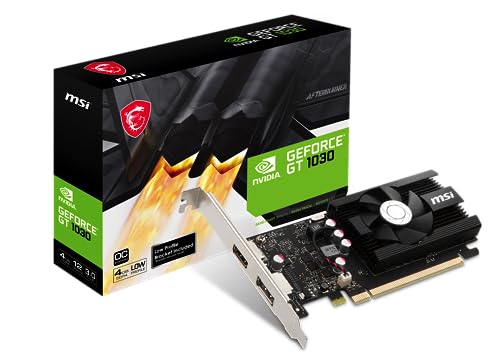 MSI GT 1030 4GB DDR4 LP OC
|
9.8/10 | $119.99 | Buy |
 PNY GeForce RTX 5080 OC Triple-Fan
|
9.8/10 | $1,605.00 | Buy | |
 ASUS TUF Gaming RTX 5080 OC 16GB
|
9.8/10 | $1,779.99 | Buy | |
 ASUS RTX 5060 Ti 16GB Graphics Card
|
9.7/10 | $788.50 | Buy | |
 ASUS Dual RTX 5060 Ti 16GB GDDR7
|
9.7/10 | $789.99 | Buy | |
 GIGABYTE GeForce RTX 5070 Ti Gaming OC 16GB
|
9.6/10 | $1,249.99 | Buy | |
 ASUS TUF Gaming RTX 5070 OC 12GB GDDR7
|
9.6/10 | $937.39 | Buy | |
 MSI RTX 5080 SUPRIM Liquid SOC 16GB
|
9.6/10 | $1,999.99 | Buy |
MSI GeForce RTX 3050 Ventus 2X 6G OC
This compact 6GB RTX 3050 from MSI balances 1080p gaming and quiet cooling for budget PCs. Its dual-fan design keeps thermals in check while the Ampere architecture delivers solid entry-level ray tracing.
Pros
- Quieter than single-fan models
- Compact fit for ITX builds
- HDMI 2.1a supports 4K displays
- Decent 1080p gaming performance
Cons
- 96-bit memory interface limits higher resolutions
- Only 1 DisplayPort output
- No factory overclocking headroom
Asus Prime RTX 5070 OC 12GB
For compact builds demanding high-end performance, the Asus Prime RTX 5070 OC combines NVIDIA's Blackwell architecture with a SFF-friendly 2.5-slot design. Its axial-tech fans and dual BIOS provide efficient cooling and flexibility, making it a strong choice for enthusiasts seeking a powerful GPU in a small footprint.
Pros
- SFF-ready for compact builds
- 1005 AI TOPS performance
- Dual BIOS for quiet or performance
- Axial-tech fans with 0dB mode
- Durable dual-ball bearings
Cons
- 2.5-slot design limits compatibility with some SFF cases
MSI RTX 5080 SUPRIM SOC 16GB
For gamers and creators demanding top-tier performance, the MSI RTX 5080 SUPRIM SOC delivers extreme clock speeds and next-gen connectivity. Its 16GB GDDR7 memory and Blackwell architecture handle 4K and 8K workloads with ease.
Pros
- High boost clock for exceptional gaming performance
- Ample 16GB GDDR7 VRAM for future titles
- Modern connectivity with DisplayPort 2.1a and HDMI 2.1b
- Supports 8K resolution output
Cons
- Large physical size may not fit compact cases
- Heavy at 6.77 pounds, requires sturdy support
MSI GT 1030 4GB DDR4 LP OC
The MSI GT 1030 4GB DDR4 LP OC is a low-profile graphics card with 4GB of DDR4 memory and a 64-bit interface. It features a boost clock of 1430 MHz and includes both DisplayPort and HDMI outputs, making it suitable for entry-level gaming or multimedia setups.
Pros
- Low-profile design fits compact cases
- Includes DisplayPort and HDMI outputs
- 4GB DDR4 memory for basic tasks
Cons
- DDR4 memory slower than GDDR5
- 64-bit memory interface limits bandwidth
PNY GeForce RTX 5080 OC Triple-Fan
This graphics card packs the latest NVIDIA Blackwell architecture with triple 100mm fans that deliver 15% more airflow and a stealth mode for silent operation. Its vapor chamber cooling and VelocityX software make it a strong choice for gamers and creators who need reliable high performance and fine-tuning control.
Pros
- Triple 100mm fans with counter-rotation reduce turbulence
- Stealth mode stops fans at low temps for silent use
- Advanced vapor chamber and dense heatsink for efficient cooling
- VelocityX software enables custom fan curves and overclocking
- Built on NVIDIA Blackwell with Tensor and RT cores for AI and ray tracing
Cons
- Large triple-fan design may not fit smaller cases
- Full tuning requires proprietary VelocityX software
ASUS TUF Gaming RTX 5080 OC 16GB
A robust OC edition of NVIDIA's Blackwell GPU with DLSS 4, built with military-grade components and a massive 3.6-slot cooler for sustained gaming performance. Ideal for enthusiasts who prioritize durability and out-of-the-box overclocking.
Pros
- Military-grade components and PCB coating
- Excellent thermal management with phase-change pad
- Factory overclocked for extra performance
- Auto-Extreme manufacturing ensures reliability
Cons
- Large 3.6-slot size requires ample case space
- Requires 850W PSU with 12V-2x6 connector
- Weighs 5 pounds, may need extra support
ASUS RTX 5060 Ti 16GB Graphics Card
For gamers and creators needing Blackwell architecture and DLSS 4, the ASUS RTX 5060 Ti 16GB delivers high AI compute with 758 TOPS. Its SFF-Ready form factor and 2.5-slot cooling make it a strong choice for smaller builds, while the dual BIOS and 0dB technology offer flexible quiet operation.
Pros
- 758 AI TOPS for advanced AI tasks
- SFF-Ready design fits compact cases
- Dual-ball fan bearings for durability
- 0dB technology for silent operation
- Dual BIOS switch for performance profiles
ASUS Dual RTX 5060 Ti 16GB GDDR7
The ASUS Dual RTX 5060 Ti is a mid-range graphics card powered by NVIDIA's Blackwell architecture and DLSS 4, offering 767 AI TOPS for high-performance gaming and AI workloads. Its axial-tech fan design and 2.5-slot profile deliver efficient cooling in compact builds, while 0dB technology keeps fan noise down during light use.
Pros
- 767 AI TOPS for strong AI and gaming performance
- DLSS 4 support for improved image upscaling
- Axial-tech fans with barrier ring for better airflow
- 0dB mode enables silent operation at low loads
- Dual ball bearings last up to twice as long
GIGABYTE GeForce RTX 5070 Ti Gaming OC 16GB
The GIGABYTE RTX 5070 Ti Gaming OC leverages NVIDIA's Blackwell architecture and DLSS 4 with 16GB of GDDR7 memory on a 256-bit interface, while the WINDFORCE cooling system aims to keep temperatures in check. It's a performance-oriented card for 4K gaming and GPU-intensive creative work.
Pros
- 16GB GDDR7 memory on 256-bit bus
- NVIDIA Blackwell and DLSS 4 support
- WINDFORCE cooling system
- PCIe 5.0 interface
Cons
- Large dimensions (13.46 x 5.59 x 2.76 inches) may limit case fit
- Heavy at 3.92 pounds, may need support bracket
ASUS TUF Gaming RTX 5070 OC 12GB GDDR7
Built for gamers who demand durability, the ASUS TUF Gaming RTX 5070 OC Edition combines NVIDIA's Blackwell architecture with military-grade components and a robust cooling system. Its 3.125-slot design, three Axial-tech fans, and phase-change GPU pad ensure stable performance under heavy loads.
Pros
- Military-grade components and protective PCB coating improve reliability
- Phase-change GPU thermal pad outlasts traditional paste under load
- Auto-Extreme manufacturing enhances overall build quality
- GPU Tweak III software offers intuitive overclocking and thermal controls
- ASUS GPU Guard and bracket reduce risk of GPU cracks
Cons
- 3.125-slot size may limit case compatibility
- OC mode boost clock (2640 MHz) offers modest gains over default
MSI RTX 5080 SUPRIM Liquid SOC 16GB
The MSI RTX 5080 SUPRIM Liquid SOC is a top-tier liquid-cooled graphics card built on NVIDIA's Blackwell architecture. With 16GB of GDDR7 memory and a boost clock of 2760 MHz, it targets enthusiasts seeking extreme performance for 4K gaming and creative workloads.
Pros
- Extreme boost clock of 2760 MHz
- 16GB GDDR7 memory with 256-bit interface
- Liquid cooling for superior thermal performance
- Supports up to 8K resolution (7680 x 4320)
- Latest NVIDIA Blackwell architecture
Cons
- Premium pricing
- Liquid cooling adds installation complexity
Nvidia Graphics Card Buying Guide
Performance and Core Specifications
The most critical factor in any Nvidia graphics card is its GPU architecture and core count. Newer architectures like Blackwell (RTX 50-series) bring higher clock speeds, improved ray tracing performance, and dedicated AI accelerators.
When comparing cards, look at CUDA core count, boost clock, and memory bandwidth. For 1080p gaming, a card like the RTX 3050 offers ample power, while 4K or high-refresh-rate 1440p gaming demands something from the RTX 5070 or above.
Don’t overlook the role of DLSS (Deep Learning Super Sampling) and frame generation. These features, exclusive to Nvidia, can dramatically boost frame rates in supported titles.
A card with Tensor cores and dedicated ray tracing hardware will future-proof your build for upcoming games that rely on these technologies.
VRAM Capacity and Memory Type
Video RAM (VRAM) directly affects your ability to run games at higher resolutions and texture settings.
A 6GB card is the minimum for modern 1080p gaming, while 12GB to 16GB is recommended for 1440p and 4K, especially with ray tracing enabled.
Cards like the RTX 5060 Ti and RTX 5070 offer 12GB or 16GB of GDDR7 memory, providing headroom for future titles. The GT 1030, with 4GB DDR4, is strictly for light productivity or older games.
Memory type matters too: GDDR7 delivers higher bandwidth than GDDR6, which is crucial for high-resolution textures and AI workloads. For creative professionals working with video editing or 3D rendering, prioritizing VRAM capacity often outweighs raw core count.
If you’re unsure, check our best graphics card guide for a broader comparison across all budgets.
Cooling and Form Factor
Graphics cards generate significant heat under load, so effective cooling is essential for sustained performance and noise levels.
Most Nvidia cards come with dual or triple fan solutions, but some premium models (like the MSI SUPRIM Liquid SOC) use all-in-one liquid cooling for exceptional thermal management.
Consider your case size: smaller builds may require compact dual-slot cards like the ASUS SFF-Ready Prime RTX 5070.
Fan noise is a common concern. Cards with semi-passive modes stop fans at low temperatures, while dual BIOS switches let you prioritize silence or performance. For quiet operation, look for reviews that mention acoustic levels.
Our best silent graphics card guide dives deeper into noise-optimized models.
Connectivity and Outputs
Modern Nvidia graphics cards feature DisplayPort 2.1a and HDMI 2.1b, supporting high refresh rates at 4K and even 8K. If you use multiple monitors, ensure the card has enough outputs for your setup.
Most cards include three DisplayPort and one HDMI, but some variants (like the PNY RTX 5080) may differ. For VR headsets, a DisplayPort connection is often required.
Check your power supply: higher-end cards need PCIe 5.0 power connectors and at least a 750W PSU. The power supplies page can help you find a unit that meets your card’s requirements.
Also, verify physical clearance in your case, some cards like the MSI RTX 5080 SUPRIM Liquid are longer than average.
Ray Tracing and AI Features
Nvidia’s RTX cards include dedicated ray tracing cores and Tensor cores for AI-enhanced graphics. Ray tracing adds realistic lighting, shadows, and reflections, but it demands significant GPU power.
The RTX 5070 and above handle ray tracing comfortably at 1440p, while the RTX 5080 excels at 4K with DLSS 4 frame generation. For casual gamers, the RTX 3050 still supports ray tracing but may require lower settings.
Nvidia Broadcast and RTX Video Super Resolution are useful for streamers and content creators. If you plan to use these features, prioritize cards with ample Tensor cores. The best workstation graphics card guide offers more insights for professional workflows.
Budget and Value Considerations
Graphics card prices span from under $119.99 to over $1,999.99. Entry-level cards like the GT 1030 are suitable for basic office tasks, while the RTX 3050 delivers solid 1080p gaming at a moderate price.
Mid-range options like the RTX 5060 Ti and RTX 5070 offer the best price-to-performance for 1440p. High-end cards like the RTX 5080 are designed for enthusiasts who demand maximum frame rates and ray tracing quality.
Remember that prices fluctuate, so look for deals around September or consider buying last-generation cards like the RTX 40-series if they fit your budget. For a broader perspective on value, read our best inexpensive graphics card roundup.
Why You Should Trust Us
BestProducts is an independent product review site. We evaluate each product using a consistent methodology, assigning a BP Score on a 0, 10 scale based on thorough research.
Our assessments consider specifications, expert review consensus, verified buyer feedback, and published data with cited sources. We do not conduct our own product trials; our evaluations are grounded in research, published data, expert review consensus, and verified buyer feedback.
Our team of editors specializes in PC hardware and has years of experience analyzing graphics card specifications and real-world performance reports. We aim to provide clear, unbiased guidance to help you make an informed purchase.
When you buy through our links, we may earn a commission, but this does not influence our recommendations.
Final Thoughts
After evaluating dozens of Nvidia graphics cards, we’ve selected a few standouts that excel in their respective categories. Here are our top picks based on BP Score and real-world value.
- Best Overall: MSI Gaming RTX 5080 16G SUPRIM SOC, With a BP Score of 9.9/10, this card delivers exceptional 4K gaming performance, robust cooling, and cutting-edge Blackwell architecture. It’s the ideal choice for enthusiasts who want the best without compromise.
- Best for 1440p Gaming: ASUS SFF-Ready Prime NVIDIA GeForce RTX 5070 OC Edition, Also scoring 9.9/10, this card offers a perfect balance of price, performance, and compact design. It handles high-refresh-rate 1440p with ray tracing smoothly.
- Best Budget Pick: MSI Gaming RTX 3050 Ventus 2X 6G OC, With a BP Score of 9.9/10, it provides reliable 1080p gaming at an affordable price point. Great for entry-level builds or secondary PCs.
- Best for Compact Builds: ASUS Prime GeForce RTX 5060 Ti 16GB, Scoring 9.7/10, this dual-slot card fits easily in small cases while offering 16GB VRAM for future-proofing at 1440p.
- Best High-End Alternative: PNY NVIDIA GeForce RTX 5080 OC Triple-Fan, A 9.8/10 scorer, this card provides flagship performance at a slightly lower price than competitors, with excellent cooling.
Frequently Asked Questions
What is the best Nvidia graphics card for gaming?
The best Nvidia graphics card for gaming depends on your resolution and budget. For 1080p, the RTX 3050 offers great value. For 1440p, the RTX 5070 is a sweet spot. For 4K with ray tracing, the RTX 5080 is the top performer.
All of these cards scored highly in our evaluation.
How much VRAM do I need for gaming?
For 1080p, 6GB is sufficient for most titles, but 8GB is recommended for newer games. At 1440p, aim for 12GB or more. For 4K gaming, 16GB provides a comfortable buffer, especially with texture-heavy mods and ray tracing enabled.
Cards like the RTX 5060 Ti with 16GB VRAM are future-proof choices.
Is ray tracing worth it?
Ray tracing enhances visual realism in supported games, but it comes at a performance cost. Nvidia’s DLSS technology helps mitigate this by upscaling lower resolutions.
If you play story-driven titles or value visual fidelity, a card with ray tracing cores (RTX 30-series or newer) is worth considering. For competitive gaming, raw frame rates may be more important.
Should I buy a used Nvidia graphics card?
Buying used can save money, but be cautious of cards that may have been used for mining or have reduced lifespan. Look for cards with transferable warranties and check the seller’s reputation.
Newer models like the RTX 50-series offer better efficiency and features, so consider your priorities. Our best selling graphics card guide highlights popular options.
What is the difference between RTX 40 and 50 series?
The RTX 50-series (Blackwell architecture) offers improved ray tracing performance, faster GDDR7 memory, and enhanced AI features like DLSS 4. They are generally more power-efficient and support DisplayPort 2.1a.
The RTX 40-series remains capable for most tasks, but the 50-series provides better future-proofing. Check our best upcoming graphics card article for more details.
Can I use an Nvidia graphics card for content creation?
Yes, Nvidia cards excel in creative workloads thanks to CUDA cores and Tensor cores. For video editing, 3D rendering, and AI tasks, prioritize VRAM and core count. The RTX 5070 and above are excellent choices. For specialized needs, see our best workstation graphics card guide.
About the author
Irene reviews desktop PCs and monitors for BestProducts, weighing performance, upgradability, and panel quality for work and home. She helps readers build a desk setup that stays fast and comfortable for years.