The Best Compact Circular Saw
The best compact circular saw balances power, blade size, and bevel control in a light body, with corded and cordless picks for every workshop.
 By Michelle Mendoza
Updated September 12, 2026
By Michelle Mendoza
Updated September 12, 2026
Compact circular saws are the middle ground between a full-size model and a trimming tool. They keep enough power for plywood, shelving, and light framing while staying light enough for one-handed work in tight spaces.
If your workshop is crowded, a compact saw can live in a drawer or a tool bag, which makes it a practical addition for weekend renovations and everyday repairs.
For heavier framing and deep cuts, a full-size circular saw is still the workhorse, but a compact model handles the majority of cutting tasks with less fatigue.
In this guide, we researched today’s compact saw market and compared specifications, expert review consensus, and verified buyer feedback to identify the best compact circular saw for a range of budgets and use cases.
Whether you want a cordless saw for roof work or a corded tool for workbench accuracy, the picks below are grouped by the tradeoffs that matter most.
Keep reading for our top recommendations, followed by a buying guide that breaks down the key factors to weigh before you order.
| Award | Product | BP Score About BP ScoreThe BP Score is our own rating from 0 to 10, based on performance, design and build, ease of use, and value. It reflects independent research and is never influenced by manufacturers, retailers, or affiliate commissions. Learn more › | Price | |
|---|---|---|---|---|
| Best Overall |
 GALAX PRO 4-Amp Corded Mini Circular Saw
|
9.9/10 | $49.99 | Buy |
| Best Premium |
 WORKPRO 20V 4-1/2" Mini Circular Saw
|
9.9/10 | $109.99 | Buy |
 DEWALT DCS571B 4-1/2-Inch Circular Saw
|
9.7/10 | $134.00 | Buy | |
| Best Value |
 DOVAMAN 5.8A 4-1/2" Circular Saw
|
9.6/10 | $69.97 | Buy |
| Best Budget |
 Genesis GCS445SE 4-1/2-Inch Compact Saw
|
9.5/10 | $32.95 | Buy |
 WEN 3625 5-Amp 4-1/2-Inch Circular Saw
|
9.5/10 | $64.15 | Buy | |
 Skil 5280-01 7-1/4 Inch Circular Saw with Laser
|
9.5/10 | $69.00 | Buy | |
 SEESII 4.5-Inch Brushless Cordless Circular Saw
|
9.5/10 | $99.99 | Buy | |
 Seesii 4-1/2" Circular Saw with Laser
|
9.4/10 | $64.99 | Buy |
GALAX PRO 4-Amp Corded Mini Circular Saw
A compact 4-amp circular saw with a laser guide and rip guide for precise cuts in softwood, plywood, PVC, and drywall. Its 5.5-pound build and ergonomic handle suit DIYers and light contractors working in tight spaces.
Pros
- Laser guide enhances cut accuracy
- Lightweight and portable at 5.5 pounds
- Ergonomic rubber handle reduces hand stress
- Vacuum adapter keeps workspace clean
- Comes with two saw blades and accessories
Cons
- Limited to 4-1/2-inch blade size
- Corded design restricts mobility
- No variable speed control
WORKPRO 20V 4-1/2" Mini Circular Saw
This cordless mini saw delivers 4500 RPM and includes three blades for wood, plastic, and tile. Its adjustable cutting angle and depth make it versatile for DIY projects, while the included 4.0Ah battery and fast charger provide extended runtime.
Pros
- Powerful 4500 RPM motor
- Adjustable depth and bevel cuts
- Fast charging 2.4A charger
- Includes three specialized blades
- Ergonomic handle with safety lock
Cons
- Kit weight of 9.59 pounds may be heavy
- Maximum cut depth limited to 1-11/16 inches
DEWALT DCS571B 4-1/2-Inch Circular Saw
This compact circular saw from DEWALT's ATOMIC series features a brushless motor and electronic blade brake for efficient cutting. Its 4-1/2-inch blade can cut 2x material at 90 degrees and 1x lumber at 45 degrees, making it suitable for light framing and trim work. The removable auxiliary handle and onboard dust port add versatility.
Pros
- Brushless motor for efficient cuts
- Electronic blade brake for safety
- Bevels up to 45 degrees
- Onboard dust port for cleanliness
- Compact and lightweight at 6.53 lbs
Cons
- Tool only, battery and charger sold separately
- Small 4-1/2-inch blade limits cutting depth
DOVAMAN 5.8A 4-1/2" Circular Saw
This compact circular saw from DOVAMAN stands out for its versatility, as it includes six blades for cutting wood, soft metal, plastic, and tile. A built-in laser guide and edge guide help improve cut accuracy, while the auxiliary handle and large base enhance stability during use.
Pros
- Comes with six blades for multiple materials
- Built-in laser and edge guide for precision
- Auxiliary handle and large base improve stability
- Easy bevel adjustment from 0 to 45 degrees
- Depth adjustable for up to 1-11/16" cuts
Cons
- Relatively small 4-1/2" blade limits cutting depth
- Orange color may not appeal to all users
Genesis GCS445SE 4-1/2-Inch Compact Saw
A lightweight barrel-grip circular saw with a 4.0 amp motor that cuts through 2x lumber. Its compact size and one-handed operation make it a practical choice for tight spaces and quick cuts.
Pros
- Compact and lightweight at 5 pounds
- One-handed operation saves effort
- Cuts through 2x material
- Quick blade changes with spindle lock
Cons
- Small blade limits cutting depth
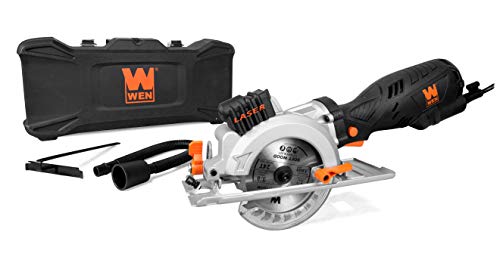
WEN 3625 5-Amp 4-1/2-Inch Circular Saw
This compact circular saw combines a 5-amp motor with a laser guide for accurate cuts up to 1-11/16 inches deep. It can handle a variety of materials and create beveled cuts from 0 to 45 degrees.
Pros
- Laser guide improves cut accuracy
- Bevels 0 to 45 degrees
- Includes blade, case, and dust tube
- Versatile for multiple materials
Cons
- Weight listed as extremely light at 0.0006 pounds
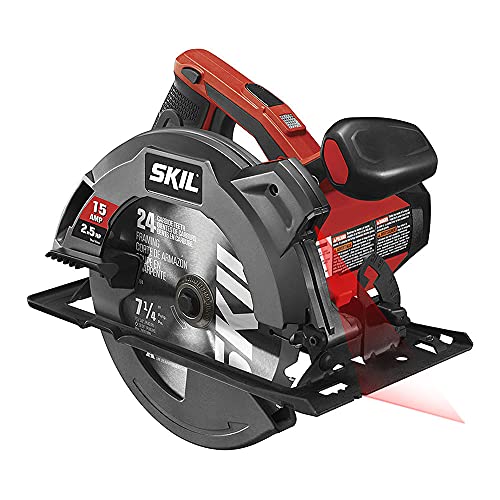
Skil 5280-01 7-1/4 Inch Circular Saw with Laser
This Skil circular saw delivers a 15-amp motor churning out 5300 RPM for fast cuts. Its single beam laser guide aids accuracy and the dust blower keeps the cut line visible. A reliable option for framing and general construction work.
Pros
- 15-amp motor with 5300 RPM speed
- Single beam laser guide for alignment
- Dust blower improves line-of-cut visibility
- Spindle lock for quick blade changes
- 51° bevel capacity with positive stop at 45°
Cons
- Weighs 8.7 pounds, heavier than some models
- Fixed speed only, no variable speed control
SEESII 4.5-Inch Brushless Cordless Circular Saw
This compact circular saw from Seesii features a brushless motor that delivers up to 6500 RPM for efficient cutting, paired with two 4.0Ah batteries for extended runtime. A laser guide and included multi-material blades enhance versatility, making it a solid choice for DIYers and home improvement projects.
Pros
- Brushless motor offers longer runtime and durability
- Comes with two 4.0Ah batteries for extended use
- Laser guide and guide rail improve cutting accuracy
- Includes three blades for wood, metal, and tile
- Lightweight and compact design for easy handling
Cons
- Shallow cutting depth at 1-11/16 inches
- Small 4.5-inch blade limits cutting capacity
- Heavier than some competing compact saws at 10 pounds
Seesii 4-1/2" Circular Saw with Laser
This compact corded circular saw from Seesii offers a 4.8A motor for 4000 RPM cutting speed and comes with three blades for wood, metal, tile, and plastic. It features a laser guide for accuracy, adjustable depth and bevel, and a lightweight design for one-handed use, making it a practical choice for DIYers and home projects.
Pros
- Includes blades for wood, metal, tile, and plastic
- Laser guide improves cut precision
- Adjustable cutting depth and 45° bevel
- Lightweight at 4.73 pounds for one-hand use
- Safety dual-switch prevents accidental start
Cons
- Corded design limits portability
- Small blade restricts maximum cutting depth
- No storage case included
Best Compact Circular Saw Buying Guide
Corded vs. Cordless Power
Corded compact saws deliver steady power without battery management. A 4 to 6 amp motor is enough for most trim and sheet goods, and the tool keeps its speed until the cut is finished.
They also tend to weigh less than cordless models that carry a battery, making them a comfortable choice for benchtop work and indoor renovations.
If you mostly cut near an outlet, our small corded circular saw guide lists additional wired picks to compare.
Battery powered compact saws trade a little runtime for freedom. They shine on ladders, roofs, and outdoor job sites where extension cords are awkward.
Most cordless kits include a battery and charger, although some tools ship bare if you already own a platform. Before buying, check the voltage and amp hour rating, because battery capacity directly affects how long you can work.
For mobile cutting, the battery powered circular saw roundup covers the cordless side of the market.
Blade Size and Cutting Depth
Most compact saws use a 4-1/2 inch blade, which keeps the tool small without sacrificing a practical cutting depth.
You can typically rip a 2×4 in a single pass, and the smaller blade spins fast enough to keep the cut smooth. Look for motors rated around 3,500 RPM or higher, because smaller blades need surface speed to cut efficiently.
If you regularly work with thick framing lumber, the 7 1/4 circular saw recommendations show what a larger platform can do.
A compact saw performs best with a sharp, well-matched blade. Low-cost blades wear quickly and create rougher edges, while carbide-tipped blades stay sharp across dozens of projects.
Many compact models include a 24 tooth carbide blade from the factory, which is a solid starting point; replacing it with a versatile circular saw blade later can improve finish quality without changing the tool.
Bevel Capacity and Cutting Angle
Bevel capacity determines whether you can cut angled edges for trim, dados, and simple joinery. Most compact saws offer 0 to 45 degrees, with a detent at 45 and sometimes at 90.
Check that the base plate locks securely and that the depth adjustment holds position during repeated cuts; a wobbly shoe will leave you with inconsistent angles.
A 45 degree bevel on a 4-1/2 inch saw handles the majority of common beveled cuts.
For more complex angled work, a table mounted circular saw setup can improve accuracy, and new users will find that a beginner friendly circular saw guide explains the adjustment routine clearly.
Ergonomics, Weight, and Safety
Weight matters more on a compact saw than on a full-size model because you often use the tool one-handed. Look for a balanced body, a comfortable grip, and a trigger that falls naturally under your fingers.
A solid blade guard and an electric brake are useful safety features that reduce the chance of accidents when you set the saw down between cuts.
For long workdays, the lighter body of a compact saw is easier on your arms.
Some professionals prefer the higher torque and stability of a worm drive circular saw for continuous cutting, while others value the low vibration of a modern compact machine.
If domestic manufacturing is important to you, the USA made corded circular saw lineup is worth browsing.
Laser Guides and Cut Line Visibility
A laser guide projects a line onto the workpiece so you can align the cut without lowering the guard. Basic units use a red line, while more advanced ones show the kerf width or a shadow line.
Lasers are helpful in bright workshops, but many users still prefer the simple edge-of-shoe alignment method.
Set reasonable expectations: a laser is a convenience, not a replacement for careful measuring. If the saw includes one, make sure the laser is adjustable, because a misaligned guide is worse than none.
For perfectly straight long rips, a track circular saw system offers a different approach that eliminates most alignment errors.
Dust Collection and Workflow
Tool-mounted dust collection keeps your workspace cleaner and helps you see the cut line. Vacuum adapters on compact saws vary in quality, so look for a port that connects snugly to a standard shop vacuum hose.
Budget models sometimes blow debris to the side, which is fine for outdoor work.
Think about how the saw fits into your daily routine. A compact saw is easy to grab for quick cuts, but specialized jobs may call for a different blade or tool design.
For cutting metal, metal cutting circular saw choices use abrasive or carbide blades that can handle steel and aluminum.
Why You Should Trust Us
BestProducts is an independent review website, and our recommendations are built on research rather than sales rankings.
We evaluate each compact circular saw against a consistent set of criteria that includes motor power, blade size, bevel capability, build quality, safety features, and overall value.
We then rate every product on our 0 to 10 BP Score so you can compare competing models at a glance. You can see the same method applied across our power tool guides.
Our research process combines official specifications, published data, consensus from professional reviews, and feedback from verified buyers.
We look for patterns in what owners say over time: common complaints about a weak guard, praise for an accurate laser, or durability issues that only surface after years of use.
This approach separates polished marketing claims from tools that actually hold up. We do not conduct our own product trials; our evaluations are grounded in research, published data, expert review consensus, and verified buyer feedback.
Final Thoughts
The best compact circular saw for your workshop depends on where and how you cut. The awards below highlight the strongest picks in this roundup, with corded and cordless options for every kind of project.
- Best Overall: GALAX PRO Corded Mini Circular Saw earns the highest BP Score in this group, pairing a 4 amp motor, a laser guide, and two blades in a package that suits most weekend projects.
- Best Cordless Compact Saw: WORKPRO 20V Cordless Mini Circular Saw also reaches a near-perfect BP Score, and the included 4.0Ah battery makes it a convenient grab-and-go partner around the house and on job sites.
- Best for Pros: DEWALT ATOMIC 20V MAX Circular Saw earned a strong BP Score with its dependable 20V platform and compact build, so users inside the DEWALT system get familiar controls and a proven motor.
- Best Budget Pick: Genesis GCS445SE Compact Circular Saw delivers a solid BP Score at a budget-friendly price, with a 24T carbide blade, a 45 degree bevel, and a parallel guide for light framing and trim.
If you need more reach than a compact body allows, the corded circular saw roundup includes full-size wired models for deeper cuts and heavier work.
Frequently Asked Questions
How deep can a compact circular saw cut?
With a 4-1/2 inch blade, most compact saws cut roughly 1-1/2 to 1-3/4 inches deep at 90 degrees, which is enough for a single pass through dimensional lumber like 2x4s. At 45 degrees, the depth drops to about 1-1/4 inches.
Always check the published cut capacity because blade geometry and base plate design vary between models.
Can a compact circular saw replace a full-size saw?
For many DIY tasks, yes, as long as the blade depth and motor power fit the material. A compact saw excels with sheet goods, furring strips, and quick crosscuts, while a full-size model gives you deeper cuts for thick lumber.
If you work mostly indoors or only occasionally, the best compact circular saw is often the only saw you need. For one-off projects, our roundup of used circular saw alternatives shows how to stretch a tight budget.
Are cordless compact saws as strong as corded models?
Modern battery saws with brushless motors produce nearly the same cutting speed as corded models, but the comparison depends on battery voltage and blade size. A 20V or 18V platform can handle pressure-treated lumber and plywood without bogging down.
Runtime is the main difference, so choose a battery amp hour rating that matches the length of your sessions. More battery power also adds weight, which matters in a compact saw.
Do I need a laser guide on a compact circular saw?
A laser guide is a convenience, not a requirement. It helps you follow a marked line when cutting plywood or trim, especially in dim areas.
If you prefer to rely on the shoe edge, save a little money and choose a model without a laser. What matters more is a clear blade guard, a stiff base plate, and an accurate depth stop.
Can a compact saw handle beveled cuts?
Most compact circular saws tilt the base plate from 0 to 45 degrees, which covers common bevel cuts for trim and joinery.
Check that the bevel detent locks firmly at the settings you use most, because a loose stop will produce inconsistent angles.
A compact saw is a great companion for a beginner’s project, while a track saw is the better tool if you need perfectly straight long bevels.
About the author
Michelle is BestProducts's saw writer, weighing cut accuracy, blade quality, dust control, and safety features. She helps woodworkers get clean, repeatable cuts at every budget.