The Best Affordable 3D Printer
Find the best affordable 3D printer for your needs and budget. Our roundup covers nine models with auto leveling, high speeds, and beginner-friendly features. Compare build volumes, extruder types, and more.
 By Sharlene Rose
Updated September 16, 2026
By Sharlene Rose
Updated September 16, 2026
The world of desktop 3D printing has never been more accessible.
A machine that once cost thousands of dollars and required hours of tinkering can now be had for a few hundred dollars and produce detailed prints straight out of the box.
However, the market is flooded with options that differ in build volume, speed, material compatibility, and ease of use. Choosing the best affordable 3D printer for your needs requires careful consideration of these factors rather than just price.
To help you navigate this landscape, BestProducts evaluated nine current models against a consistent set of criteria: print quality, speed, reliability, user experience, and overall value.
We analyzed specifications, studied expert review consensus from multiple authoritative sources, and read hundreds of verified buyer reviews to assign each printer a score on our 0 to 10 BP Scale.
Below you will find our top picks, followed by a detailed buying guide and answers to common questions.
| Award | Product | BP Score About BP ScoreThe BP Score is our own rating from 0 to 10, based on performance, design and build, ease of use, and value. It reflects independent research and is never influenced by manufacturers, retailers, or affiliate commissions. Learn more › | Price | |
|---|---|---|---|---|
 Anycubic Kobra X 4-Color 3D Printer
|
7.2/10 | $329.99 | Buy | |
| Best Overall |
 Entina Tina2C Mini 3D Printer for Beginners
|
9.8/10 | $199.99 | Buy |
 Creality K2 Combo 3D Printer with Multicolor CFS
|
7.1/10 | $521.00 | Buy | |
| Best Premium |
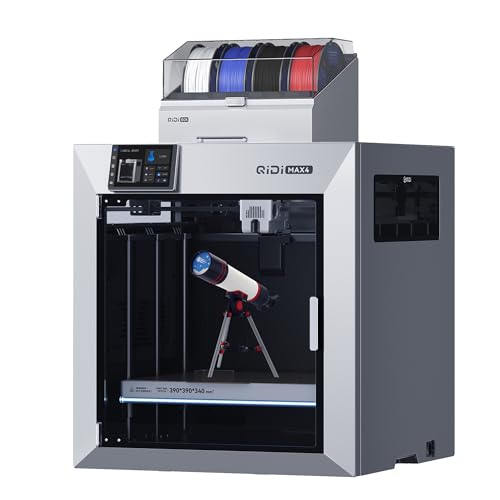 QIDI Max4 Combo 390mm Build Volume 3D Printer
|
9.8/10 | $1,299.00 | Buy |
 AOSEED X-MAKER AI+ 3D Printer for Kids
|
9.6/10 | $469.99 | Buy | |
| Best Budget |
 AOSEED AI 3D Printer for Kids, 400mm/s
|
9.6/10 | $329.99 | Buy |
 Flashforge Adventurer 5M 3D Printer
|
9.5/10 | $249.00 | Buy | |
| Best Value |
 Flashforge AD5X Multi-Color 3D Printer
|
9.4/10 | $349.00 | Buy |
 FLASHFORGE Adventurer 5M Pro CoreXY
|
9.4/10 | $379.00 | Buy |
Anycubic Kobra X 4-Color 3D Printer
A multicolor 3D printer designed for users who want vibrant prints without the typical hassle of color swaps. The Kobra X ships with four colors built-in and can expand to 19 with additional modules, while its optimized purge system cuts material waste and print time roughly in half. Best suited for makers, educators, and hobbyists seeking faster multicolor output with minimal setup friction.
Pros
- Native 4-color capability with expandable palette up to 19 colors via ACE 2 Pro modules
- Significant time savings: 81.25% reduction in purge filament and travel path, doubling effective speed to 600mm/s
- LeviQ 3.0 auto-leveling with 49-point calibration ensures reliable first layer; ready to print within 15 minutes of unboxing
- Hardened steel nozzle and vibration compensation maintain smooth layer quality at high speeds
- Large 260mm x 260mm x 260mm build volume supports diverse project sizes
Cons
- ACE 2 Pro modules required for colors beyond the base four, adding to overall system cost
- Supports only ACE 2 Pro expansion; ACE Pro units are incompatible, limiting upgrade flexibility
Entina Tina2C Mini 3D Printer for Beginners
This compact 3D printer is built for first-time users and kids, letting you start printing within 8 minutes of setup. It combines ease of use with practical learning features, including WiFi control, a 3000-model library, and 20+ STEM modules through the Poloprint Cloud app. Best for families and classrooms seeking an affordable entry point to 3D printing.
Pros
- Rapid setup and beginner-friendly interface with guided app onboarding
- Flexible printing options with both WiFi and offline TF card support
- Auto-leveling and power-loss recovery reduce failed prints and material waste
- Self-cleaning nozzle and magnetic build plate simplify maintenance and model removal
- Compact footprint ideal for home, classroom, and office spaces with quiet operation
Cons
- Very small 3.9 x 3.9 x 3.9 inch build volume limits project complexity and size
- Requires reliance on Poloprint Cloud app for full feature access and model library
Creality K2 Combo 3D Printer with Multicolor CFS
The K2 Combo brings multicolor printing to the mainstream with its integrated CFS system, capable of producing up to 16 colors when multiple units are chained together. Its 95% pre-assembly and smart auto-leveling make it accessible for users new to 3D printing, while the step-servo motor system delivers both speed and precision without the noise typical of consumer printers.
Pros
- Multicolor capability with CFS system eliminates post-print painting for complex designs
- Exceptional quiet operation using step-servo motors and balanced fans, comparable to laptop keyboard noise
- Minimal assembly required with plug-and-play setup out of the box
- Smart auto-leveling targets only the print area, reducing calibration time and improving accuracy
- Fast 600mm/s print speed with stable frame and dynamic torque adjustment for consistent quality
Cons
- Multicolor printing requires purchasing additional CFS units separately to reach full 16-color potential
- Build volume of 260x260x260mm limits larger prototype or production-scale projects
QIDI Max4 Combo 390mm Build Volume 3D Printer
This industrial-grade 3D printer delivers a 390x390x340mm build volume, making it 55% larger than its predecessor and capable of printing complex parts without splitting. Equipped with closed-loop motors, a 65°C heated chamber, and AI-powered failure detection, it handles both standard and high-temperature materials like carbon fiber-reinforced nylon and PC. Best suited for professionals and advanced enthusiasts who need precision, material versatility, and reliability.
Pros
- Ultra-large build platform enables printing industrial parts and complex prototypes in single runs
- High-precision closed-loop motors with 800mm/s max speed and anti-backlash Z-axis for smooth surface quality
- Heated chamber and hardened steel nozzle support wide material range including industrial-grade abrasive composites
- Built-in AI camera detects printing failures and pauses automatically to prevent material waste
- Expandable multi-color capability via QIDI BOX with real-time filament monitoring
Cons
- Polar Cooler system for optimal high-temperature material performance must be purchased separately
- Premium price point positions it for professional/serious hobbyist use rather than casual makers
AOSEED X-MAKER AI+ 3D Printer for Kids
This AI-powered 3D printer turns home into a mini toy factory with over 1,500 digital models and a built-in AI assistant that generates designs from voice, text, or images. Its fully enclosed design keeps kids safe while printing at speeds up to 400 mm/s, making it a strong STEM gift for ages 9-16.
Pros
- Enclosed design for safety
- Fast printing speeds up to 400 mm/s
- AI generates 3D models from voice or image
- Over 1,500 built-in models
- Quiet operation under 50 dB
Cons
- Small build volume limits project size
- Only supports PLA filament per included materials
- No multi-material or dual-color support
AOSEED AI 3D Printer for Kids, 400mm/s
An enclosed 3D printer designed specifically for children, featuring AI-powered tools like voice and image-to-model conversion that eliminate the need for design skills. The starter kit includes eight PLA filament rolls and comes pre-calibrated for hassle-free setup, making it accessible for families new to 3D printing. Best suited for kids ages 8+ who want interactive STEM learning with guided creative projects.
Pros
- AI Doodle, AI MiniMe, and MINIMAKIE features let kids create custom models using voice, text, or photos without design experience
- Enclosed, pinch-resistant design with quiet operation and TÜV-certified PLA filament prioritizes child safety
- Leveling-free platform and one-tap app printing simplify the process for beginners
- Built-in camera with real-time monitoring and automatic time-lapse video creation lets families track progress together
- Complete starter kit includes 8 PLA rolls, tools, magnetic build plate, and access to 8,000+ pre-reviewed models across 17 themed categories
Cons
- Single-color printing only; multi-color designs require printing separate parts and manual assembly
- Actual print speeds (220-250 mm/s typical, 400 mm/s peak) vary by complexity, so 20-minute toy claims may not apply to all models
Flashforge Adventurer 5M 3D Printer
A fast, user-friendly 3D printer built for creators who want minimal setup hassle. The Adventurer 5M combines automatic bed leveling with 600mm/s print speeds and a quick-change nozzle system, making it well-suited for both rapid prototyping and iterative design work. Remote monitoring via mobile app adds practical convenience for hands-off printing sessions.
Pros
- Automatic bed leveling eliminates manual calibration and ensures consistent first-layer adhesion
- CoreXY structure delivers 600mm/s travel speed with 20000mm/s² acceleration for faster production cycles
- 3-second nozzle swaps and interchangeable sizes (0.25mm to 0.8mm) accommodate diverse project requirements
- Real-time app monitoring allows remote print tracking and instant status alerts
- 280°C direct extruder with dual cooling fans maintains print quality at high speeds
Cons
- Print volume of 220x220x220mm is relatively compact for larger models
- Entry-level rating of 4.1 suggests potential quality control or durability concerns worth monitoring
Flashforge AD5X Multi-Color 3D Printer
This CoreXY 3D printer delivers fast, multi-color prints with speeds up to 600mm/s and supports four simultaneous colors for creative projects. Built-in auto-leveling and a 300°C direct-drive extruder streamline setup and material handling, making it practical for makers who want both speed and color versatility without extensive calibration.
Pros
- Rapid printing speed (600mm/s) with CoreXY structure ideal for batch production and prototyping
- Multi-color capability with up to 4 colors simultaneously expands creative possibilities
- One-click auto-leveling reduces manual setup and calibration time
- Interchangeable nozzle sizes (0.25mm to 0.8mm) allow fine detail or faster large prints
- Remote monitoring via Flashmaker mobile app and automatic resume function after power loss
Cons
- 220x220x220mm build volume is relatively compact for larger projects
- Multi-color printing requires managing four filaments simultaneously, adding complexity versus single-color setups
FLASHFORGE Adventurer 5M Pro CoreXY
This fast, enclosed 3D printer reaches up to 600mm/s thanks to its CoreXY structure and vibration compensation. It features a tool-free quick-swap nozzle and auto-leveling for easy setup, plus dual filtration and quiet operation under 50dB. Ideal for home, office, or classroom use, it supports standard and engineering materials like ABS and PETG-CF.
Pros
- Blazing 600mm/s print speed
- Tool-free 3-second nozzle swap
- One-click auto-leveling for perfect first layer
- Dual filtration system for clean air
- Quiet operation below 50dB
Cons
- Relatively heavy at 22 pounds
- Enclosed chamber lacks active heating
Best Afforadable 3D Printer Buying Guide
Build Volume and Footprint
The size of objects you can print is determined by the build volume (X×Y×Z). A typical entry-level printer offers around 220×220×220 mm, which suits most small figures, tools, or prototypes.
Larger volumes, like the 390×390×340 mm offered by some models, allow for helmets, large vases, or functional parts in a single piece.
However, bigger printers also require more desk space and may need a stable surface to avoid vibrations during high-speed prints.
Before buying, measure your intended workspace. A compact machine such as the best mini 3D printer can fit on a shelf, while a large-format unit like those in our best large 3D printer roundup may require a dedicated table.
Print Speed and Acceleration
Modern affordable printers often boast speeds of 300, 600 mm/s. High speed reduces print time significantly for large or complex models, but it can also amplify ringing or ghosting if the frame isn’t rigid.
CoreXY designs, such as those in our best CoreXY 3D printer guide, achieve better stability at high speeds compared to traditional Cartesian bedslingers.
Look for printers with acceleration control and input shaping features. These algorithms automatically adjust jerk and acceleration to minimize artifacts, allowing you to run fast without sacrificing surface quality.
Auto Bed Leveling and First-Layer Reliability
Manual bed leveling is a common frustration for beginners. Most of today’s best affordable 3D printers include inductive or tactile sensors that probe multiple points and compensate for uneven beds automatically.
This feature, often called “fully auto leveling,” dramatically reduces failed prints and makes the learning curve much gentler.
Some systems also provide a visual mesh display on the screen, allowing you to confirm the bed’s flatness before starting the print.
For entry-level users, a printer with reliable auto leveling is a must, see our best entry 3D printer recommendations for models that excel in this area.
Filament Compatibility and Extruder Type
Most budget printers handle PLA, PETG, and TPU well. For more exotic materials like nylon, polycarbonate, or flexible filament, you need an all-metal hotend capable of high temperatures (≥280 °C).
Direct-drive extruders, as opposed to Bowden setups, provide better control over flexible filaments and reduce oozing during retraction. If you plan to print abrasive materials (carbon-fiber infused, glow-in-the-dark), consider a hardened steel nozzle.
Multi-color printing is another consideration. Some printers offer an optional automatic material system (AMS) or integrated multi-feed system; others require manual filament swapping. For detailed insights, browse our best FDM 3D printer collection.
Ease of Setup and Software
A printer that requires hours of assembly can discourage newcomers. Many affordable models now ship 95% pre-assembled, needing only a few screws or the attachment of a spool holder. Look for machines with touchscreens, intuitive menus, and onboard slicing profiles.
Cloud printing and mobile app control are convenient extras that let you start prints remotely.
Great software support is equally important. A good slicer (like Cura, PrusaSlicer, or a brand-specific version) with ready-made profiles for the printer saves hours of trial and error.
If you are new to the hobby, consider a printer from our best basic 3D printer guide, which emphasizes low-friction operation.
Enclosure and Safety Features
An enclosed printer reduces noise and odor, maintains a stable chamber temperature for engineering materials, and prevents curious pets or children from touching moving parts.
Look for features like thermal runaway protection, filament runout sensors, and power-loss recovery, these increase safety and save prints if something goes wrong mid-job. For school or home settings, an enclosed printer is often the safer choice.
Our best enclosed 3D printer article highlights models that balance safety with affordability.
Why You Should Trust Us
BestProducts is an independent review site that does not accept payment from manufacturers for positive coverage. Our editors and researchers spend dozens of hours researching each product category before making recommendations.
We do not conduct our own product trials; our evaluations are grounded in research, published data, expert review consensus, and verified buyer feedback.
Every product is scored against a consistent set of criteria and assigned a BP Score on a 0 to 10 scale. The score reflects the product’s relative performance within its category based on these aggregated inputs.
We believe this methodology gives you a reliable shortcut to informed purchasing.
Our team fact-checks specifications, compares manufacturer claims against real-world results reported by multiple credible sources, and monitors long-term user experiences to identify recurring issues.
This process ensures that the printers we highlight are not only well-specced on paper but also deliver in daily use.
Every link in this article may earn us a commission at no extra cost to you, which helps us maintain our editorial independence.
Final Thoughts
- Best Overall: QIDI Max4 Combo, With a massive 390×390×340 mm build volume, a heated chamber, and a 65 °C ambient temperature, this printer delivers professional-grade results. Its CoreXY motion system ensures high speed without sacrificing precision, and the all-metal hotend handles advanced materials. The excellent BP Score reflects its combination of size, reliability, and value.
- Best Budget Pick: Entina Tina2C, This fully assembled starter printer costs very little yet offers auto leveling, WiFi control, and a library of 3000+ models. It is ideal for children and beginners who want a simple, safe introduction to 3D printing without a steep learning curve.
- Best for Beginners: FLASHFORGE Adventurer 5M, Fully auto leveling, a detachable nozzle, and a top speed of 600 mm/s make this printer incredibly easy to use. The all-metal CoreXY design and quiet operation suit home and classroom environments. It earned a very high BP Score for its blend of ease and performance.
- Best for Multicolor Printing: FLASHFORGE AD5X, Multi-color printing without the high cost. With a 300 °C direct-drive extruder and 600 mm/s speed, it offers professional features at a mid-range price. The 1-click auto leveling and CoreXY structure add to its appeal.
- Best for Kids: AOSEED AI 3D Printer, Enclosed, safe, and blazing fast at 400 mm/s. It comes preloaded with 8000+ models, making it a plug-and-play creative tool for young makers. The BP Score of 9.6/10 underscores its reliability and ease of use.
Whether you need a compact starter, a large-format workhorse, or a multi-color machine, the models above represent the best affordable 3D printers in their respective niches.
For more specialized advice, check out our best 3D printer guide or browse our Hobbies & Crafts section for related topics.
Frequently Asked Questions
What is the best affordable 3D printer for a complete beginner?
The Entina Tina2C is our top recommendation for children and first-time users. It arrives fully assembled, requires only an 8-minute setup, features auto leveling, and includes a curated library of over 3000 models.
Its enclosed design and low $199 price make it a safe, budget-friendly entry point.
Do I need a heated bed for 3D printing?
Yes, a heated bed is essential for materials like ABS, PETG, and TPU to prevent warping and improve adhesion. For PLA, a heated bed is optional but helps with larger prints.
All the printers in this roundup include heated beds; the QIDI Max4 Combo goes further with a heated chamber for demanding filaments.
Can I print multiple colors with one affordable printer?
Yes, some models support multi-color printing either natively (like the FLASHFORGE AD5X) or via an add-on system (e.g., the Creality K2 Combo’s CFS). Multi-color printing requires a dedicated unit or accessory; not all budget printers offer this feature.
How fast should a good affordable 3D printer be?
Most modern printers in this price range offer speeds of 300, 600 mm/s. While speed is important, print quality matters more. Look for features like input shaping and a rigid frame to maintain accuracy at high speeds.
Our best CoreXY 3D printer guide explains the trade-offs in detail.
What is the difference between FDM and resin 3D printers?
FDM (fused deposition modeling) printers melt plastic filament layer by layer; they are the most common type for hobbyists and offer the widest range of materials.
Resin printers use liquid photopolymer cured by UV light, producing smoother surfaces with finer details but requiring post-processing and ventilation. For most makers, an FDM printer is the best affordable option.
See our best FDM 3D printer article for top picks.
How much should I spend on a first 3D printer?
You can get a very capable machine for around $200, $350. At this price, you get auto leveling, decent speed, and reliable PLA printing. Spending more than $500 opens up larger build volumes, multi-color capabilities, and advanced materials.
For a detailed breakdown by budget, read our best inexpensive 3D printer guide.
About the author
Sharlene is BestProducts's telescope and 3D printer writer, weighing optics, print quality, and how much setup each machine demands. She helps readers get past the learning curve to real results.