The Best 3D Printer Motherboard
Upgrading your printer's motherboard delivers quieter, faster, and more reliable prints. We researched the top options, from drop‑in replacements for Creality printers to universal boards with Wi‑Fi, and scored them on our 0‑10 BP Score based on specs, expert consensus, and verified buyer feedback.
 By Sharlene Rose
Updated September 11, 2026
By Sharlene Rose
Updated September 11, 2026
Upgrading the motherboard, often called the mainboard or control board, is one of the most impactful changes you can make to a 3D printer.
A modern board brings 32‑bit processing, silent stepper drivers, and reliable firmware support, turning a noisy, inconsistent machine into a precise, quiet workhorse.
Whether you are breathing new life into an older Ender 3 or building a custom Core‑XY, the right motherboard directly affects print quality, speed, and overall reliability.
BestProducts evaluated each motherboard against consistent criteria: processor architecture, stepper driver type, connectivity options, form‑factor compatibility, and verified user feedback.
Every model was scored on our 0‑to‑10 BP Score, based on specifications, expert review consensus, and real‑world buyer experiences. Below are our top picks, carefully researched to help you find the best upgrade for your printer and budget.
| Award | Product | BP Score About BP ScoreThe BP Score is our own rating from 0 to 10, based on performance, design and build, ease of use, and value. It reflects independent research and is never influenced by manufacturers, retailers, or affiliate commissions. Learn more › | Price | |
|---|---|---|---|---|
| Best Overall |
 Creality Ender 3 V3 SE Silent Mainboard Kit
|
9.9/10 | $35.99 | Buy |
| Best Value |
 Creality Ender 3 Silent Motherboard V4.2.7
|
9.8/10 | $37.99 | Buy |
| Best Budget |
 YWBL-WH ESP32 3D Printer Control Board
|
9.7/10 | $37.15 | Buy |
 BIGTREETECH SKR Mini E3 V2.0 TMC2209
|
9.6/10 | $33.99 | Buy | |
| Best Premium |
 Creality V4.2.7 Silent Board for Ender 3 Series
|
9.6/10 | $49.99 | Buy |
 Creality K1 Mainboard Kit with TMC2209
|
9.5/10 | $81.21 | Buy | |
 Ender V4.2.7 Silent Motherboard with TMC2225
|
9.4/10 | $48.58 | Buy |
Creality Ender 3 V3 SE Silent Mainboard Kit
This genuine Creality replacement mainboard is engineered for the Ender 3 V3 SE, offering a drop-in upgrade that reduces noise while maintaining reliability. It is ideal for users who want a straightforward way to restore or silence their printer.
Pros
- Genuine Creality part for exact compatibility
- Very quiet operation during prints
- Thermal runaway protection enhances safety
- Durable build with stable performance
- Easy install with pre-loaded firmware
Cons
- Only fits Ender 3 V3 SE (not universal)
Creality Ender 3 Silent Motherboard V4.2.7
This upgrade board from Creality swaps in TMC2225 drivers for near-silent operation and supports both Marlin and Klipper firmware. It is a plug-and-play replacement for Ender 3 owners who want quieter prints without complex wiring.
Pros
- Dramatically reduces printer noise
- Easy drop-in replacement for Ender 3
- Supports both Marlin and Klipper
- Enhanced cooling keeps board stable
- Pre-loaded firmware simplifies setup
Cons
- Only compatible with Creality Ender 3
- Requires careful power polarity check
YWBL-WH ESP32 3D Printer Control Board
This 32-bit control board uses the ESP32 DOWD V3 chip at up to 240MHz and includes 8MB flash memory. It supports Marlin 2.0 firmware and a variety of screens (LCD2004, 12864, MKS MINI12864V3, MKSTFT). Built-in back EMF protection helps reduce stepper motor driver damage.
Pros
- High-speed 32-bit LX6 processor
- Onboard Bluetooth and USB connectivity
- Works with many popular 3D printer screens
- Back EMF protection for motor drivers
Cons
- Limited brand support information available
BIGTREETECH SKR Mini E3 V2.0 TMC2209
This upgrade motherboard from BIGTREETECH replaces the stock Ender 3 board with a 32-bit STM32F103RCT6 chip and TMC2209 stepper drivers for quieter operation. It adds support for BLTouch, filament detection, and power-loss recovery, though the CNC fan needs manual speed setting.
Pros
- Silent TMC2209 stepper drivers
- 32-bit processor with 256K flash
- Supports BLTouch and filament detection
- Low-resistance hot-bed MOSFET
- Easy drop-in upgrade for Ender 3
Cons
- CNC fan requires manual speed configuration
Creality V4.2.7 Silent Board for Ender 3 Series
This upgraded mainboard from Creality reduces stepper motor noise using a TMC2225 driver, keeping operation under 50 dB. It is a plug-and-play replacement for the Ender 3 but requires a firmware flash for other Ender 3 variants.
Pros
- Reduces stepper motor noise significantly
- Plug-and-play for Ender 3 only
- Works with multiple Ender 3 variants
- Bootloader preinstalled for simple updating
Cons
- Firmware flash required for non-Ender 3 models
- Only includes a single board, no extras
Creality K1 Mainboard Kit with TMC2209
This official replacement mainboard for the Creality K1 features 32-bit processing and TMC2209 stepper drivers for significantly quieter operation. It comes preloaded with K1 firmware for a straightforward swap, making it a solid choice for fixing or upgrading your printer's control board.
Pros
- Genuine Creality part ensures perfect fit
- TMC2209 drivers reduce noise dramatically
- 32-bit chip for stable and fast processing
- Thermal runaway protection enabled by default
- Plug-and-play with pre-installed firmware
Cons
- Only compatible with Creality K1
- Requires careful cable management during install
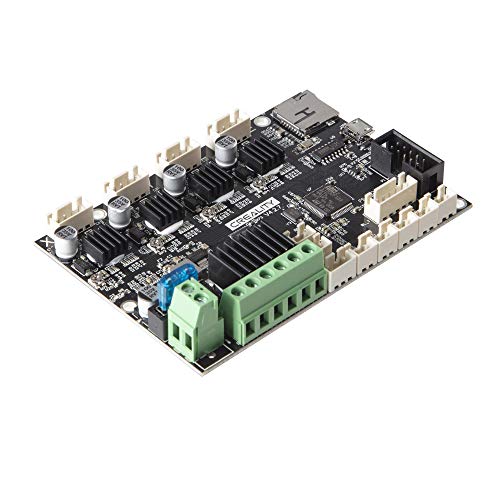
Ender V4.2.7 Silent Motherboard with TMC2225
This upgrade board replaces the mainboard on Ender 3, 3 Pro, 3S, and 5 printers with quieter TMC2225 stepper drivers and Marlin 2.0.1 firmware. It includes thermal runaway protection and a pre-installed bootloader for easy firmware modification via USB.
Pros
- Quiet TMC2225 drivers
- Easy firmware updates via USB
- Thermal runaway protection
- Compatible with multiple Ender models
- Pre-installed Marlin 2.0.1
Cons
- Only ships with Ender-3 Pro firmware
- May require manual firmware flash for other models
Best 3D Printer Motherboard Buying Guide
Processor and Architecture
Most modern motherboards use a 32‑bit microcontroller such as an ARM Cortex‑M series or an ESP32.
Compared to older 8‑bit boards, 32‑bit processors handle complex calculations faster, allow higher stepper speeds, and support advanced features like linear advance and input shaping.
When choosing a board, look for a chip with enough flash memory and RAM to run the firmware you plan to use, Marlin 2.x or Klipper both benefit from at least 256 KB of flash and 64 KB of RAM.
Boards like the Creality V4.2.7 and the BIGTREETECH SKR Mini E3 use 32‑bit processors that are well‑suited for most hobbyist printers.
For more demanding applications, such as a high‑speed Core‑XY or a printer with multiple extruders, a board with a faster CPU, like the Creality K1 mainboard based on the X2000E chip, provides the headroom needed for real‑time control.
Stepper Drivers
The stepper drivers control the motors that move the print head and bed. Integrated drivers like the TMC2209, TMC2225, and MS35774 offer near‑silent operation, sensorless homing, and higher microstepping resolution.
A board with UART‑controlled drivers allows you to adjust current and microstepping in firmware, giving you fine‑tuned control over motor behaviour.
For noise‑sensitive environments, a board with TMC2209 or TMC2225 drivers is a must. The Creality V4.2.7 uses TMC2225 drivers, while the BIGTREETECH SKR Mini E3 V2.0 uses TMC2209 with UART mode.
Both deliver excellent silence, but the TMC2209’s UART capability gives you more flexibility for tuning.
Connectivity and Expansion
Look for a board with a USB‑B or USB‑C port for direct connection to a computer, a microSD card slot for standalone printing, and headers for adding accessories like a BLTouch, filament runout sensor, or second extruder.
Some boards also include a dedicated port for a Raspberry Pi or other single‑board computer to run Klipper.
The ESP32‑based YWBL‑WH board adds built‑in Wi‑Fi and Bluetooth, enabling wireless printing and remote monitoring without extra hardware.
For most users, a board with a USB port and SD slot is sufficient, but if you plan to run Klipper, ensure the board has a serial port or UART header for the Pi.
Form Factor and Compatibility
Motherboards come in different sizes and mounting hole patterns. The most common form factors are the Creality standard (used by Ender 3, Ender 3 Pro, Ender 5, etc.) and the Mini E3 form factor (designed as a drop‑in replacement for Creality boards).
Before buying, measure your printer’s mounting holes and compare them to the board’s dimensions. Many boards, like the SKR Mini E3 V2.0, are designed to be a direct swap for Creality printers, requiring no modification.
For non‑Creality printers, look for boards that match your printer’s connector layout (e.g., endstop connectors, fan headers, thermistor inputs).
The Creality K1 mainboard is specific to the K1 series, while the Ender 3 V3 SE mainboard is tailored for that model. Universal boards like the BIGTREETECH SKR series fit many custom builds with standard wiring.
Firmware Support
Most 3D printer motherboards ship with a version of Marlin firmware, but you may want to compile your own or switch to Klipper. Check whether the board has an available bootloader and whether the community provides pre‑compiled firmware images.
Boards with a widely used chip (like the GD32 or STM32 series) have extensive support. The Creality V4.2.7 and BIGTREETECH SKR Mini E3 have large user communities and ready‑made firmware builds for common printers.
If you plan to use Klipper, confirm that the board’s microcontroller is listed in the Klipper documentation. The ESP32 board, for instance, can run Klipper via a dedicated port, but some boards require an additional Raspberry Pi.
For a hassle‑free experience, choose a board with well‑documented firmware guides.
Silent Operation and Heat Dissipation
Silent stepper drivers dramatically reduce printer noise, but the board itself must also manage heat. Look for boards with a large heatsink on the main chip and drivers, or with active cooling (a small fan header).
The Creality V4.2.7 includes a heatsink for the TMC2225 drivers, while the SKR Mini E3 V2.0 uses a metal‑cased design that dissipates heat well. Overheating can cause thermal runaway or skipped steps, so good thermal design is essential.
Some boards, like the Creality K1 mainboard, are designed for enclosed printers and include a dedicated fan header. For open‑frame printers, a board with a heatsink and a fan header is sufficient to keep temperatures stable during long prints.
Why You Should Trust Us
BestProducts is an independent review site that evaluates products through comprehensive research. We do not conduct our own product trials; our evaluations are grounded in research, published data, expert review consensus, and verified buyer feedback.
Each product receives a BP Score from 0 to 10 based on a consistent set of criteria tailored to its category. Our goal is to provide transparent, objective recommendations that help you make informed purchasing decisions.
We earn a commission through affiliate links, but this does not influence our ratings or editorial content. Our methodology is designed to prioritise accuracy and usefulness over commercial interests. For more details, see our best 3D printer guide and other related resources.
Final Thoughts
After evaluating the top motherboards on the market, here are our top picks based on BP Score and real‑world feedback:
- Best Overall: Creality Official Ender 3 V3 SE Mainboard Kit, With the highest BP Score in our lineup, this 32‑bit board delivers excellent silent operation, a reliable GD303RET6 chip, and seamless compatibility with the Ender 3 V3 SE. It’s the ideal choice for users who want a factory‑optimised upgrade that just works.
- Best for Ender 3 Upgrades: BIGTREETECH SKR Mini E3 V2.0, This drop‑in replacement board offers TMC2209 drivers with UART control, 32‑bit processing, and a compact form factor that fits most Creality printers. It’s a favourite among the modding community for its flexibility and silent operation.
- Best Value: Creality Ender 3 Silent Motherboard V4.2.7, At a competitive price, this board provides TMC2225 drivers, 32‑bit performance, and all‑round heat dissipation. It’s a cost‑effective way to silence an Ender 3 without sacrificing reliability.
- Best for K1 Series: Creality Official K1 Mainboard Kit, Designed specifically for the Creality K1, this board features TMC2209 drivers and a powerful X2000E chip. It’s the only choice for K1 owners looking for a genuine replacement or upgrade.
- Best Budget Pick: YWBL‑WH ESP32 3D Printer Motherboard, This ESP32‑based board offers built‑in Wi‑Fi and Bluetooth at a low price, making it a great entry point for wireless printing. Its 32‑bit processor and ample flash memory are sufficient for most hobbyist projects.
Frequently Asked Questions
What is a 3D printer motherboard?
The motherboard (or mainboard) is the central control board of a 3D printer. It houses the microcontroller, stepper motor drivers, and connectors for the heated bed, hotend, fans, endstops, and sensors.
It interprets G‑code commands from the slicer and sends signals to the motors and heaters to produce a print.
How do I know if a motherboard is compatible with my printer?
Check the mounting hole pattern, the voltage requirements (12 V or 24 V), and the connector types. Many aftermarket boards are designed as drop‑in replacements for popular printers like the Ender 3.
Measure your old board’s dimensions and compare them to the new board’s specifications. Also verify that the firmware supports your printer’s display and thermistor type.
Can I use a motherboard from one printer in another brand?
Yes, if the voltage, wiring layout, and firmware are compatible. Many universal boards (like the BIGTREETECH SKR series) can be used with custom builds or different printer models after re‑wiring and re‑compiling firmware. However, it requires more technical skill than a direct swap.
What is the difference between TMC2209 and TMC2225 drivers?
Both are silent stepper drivers from Trinamic. The TMC2209 supports UART control (adjustable current and microstepping via firmware) and sensorless homing. The TMC2225 is a simpler driver with fixed microstepping and no UART, but it is still very quiet.
TMC2209 offers more flexibility, while TMC2225 is a cost‑effective silent option.
Do I need to update firmware after installing a new motherboard?
Yes, almost always. The new board will have different pin mappings, driver settings, and features. You will need to compile or download firmware (usually Marlin or Klipper) that matches your printer’s configuration.
Many boards come with pre‑loaded firmware for common printers, but customisation is often required for optimal performance.
Can a motherboard improve print quality?
Yes. A 32‑bit board with high‑quality stepper drivers can reduce print artifacts like ghosting and ringing, enable faster acceleration, and allow smoother motion.
Features like linear advance and input shaping (available in Marlin 2.x and Klipper) directly improve dimensional accuracy and surface finish. Upgrading the motherboard is one of the most effective ways to enhance print quality on older printers.
About the author
Sharlene is BestProducts's telescope and 3D printer writer, weighing optics, print quality, and how much setup each machine demands. She helps readers get past the learning curve to real results.