The Best 1440P Monitor Under $200
Upgrade from 1080p without breaking the bank. We compared six QHD monitors under $200, evaluating resolution, refresh rate, color accuracy, and connectivity to find the best value for gamers and professionals alike.
 By Irene Hopkins
Updated September 11, 2026
By Irene Hopkins
Updated September 11, 2026
You don’t have to spend a fortune to get a crisp, high-resolution display.
The best 1440p monitor under 200 delivers a noticeable upgrade over 1080p, sharper text, more screen real estate, and better detail in games and creative work, without pushing past a reasonable budget.
In 2026, a growing number of panels at this price point combine QHD resolution with fast refresh rates, solid color coverage, and ergonomic features that were once reserved for premium models.
We evaluated each model against consistent criteria and scored it on our 0 to 10 BP Score. Our picks are based on specifications, expert review consensus, verified buyer feedback, and published data. Below you’ll find our top-rated 1440p monitors that balance performance, features, and value.
| Award | Product | BP Score About BP ScoreThe BP Score is our own rating from 0 to 10, based on performance, design and build, ease of use, and value. It reflects independent research and is never influenced by manufacturers, retailers, or affiliate commissions. Learn more › | Price | |
|---|---|---|---|---|
| Best Overall |
 ASUS TUF Gaming VG27AQL5A 27" 1440p 210Hz Monitor
|
9.9/10 | $189.00 | Buy |
| Best Premium |
 Sceptre C345B-QUT168 34-inch Curved Ultrawide WQHD
|
9.9/10 | $199.97 | Buy |
| Best Value |
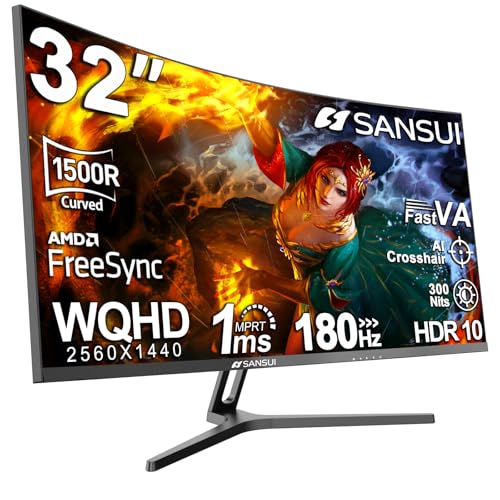 SANSUI 32-Inch Curved Gaming Monitor 180Hz
|
9.8/10 | $189.99 | Buy |
| Best Budget |
 Sceptre E345B-QU180D 34" Ultrawide 180Hz
|
9.6/10 | $188.97 | Buy |
 Acer Nitro XV272U W2 27in QHD 240Hz Gaming Monitor
|
9.5/10 | $199.99 | Buy | |
 Dell S2725DSM 27" QHD 144Hz Monitor
|
9.4/10 | $189.99 | Buy |
ASUS TUF Gaming VG27AQL5A 27" 1440p 210Hz Monitor
This 27-inch QHD Fast IPS monitor delivers a 210Hz overclocked refresh rate and 0.3ms response time for competitive gaming. With ELMB Sync and FreeSync Premium, it eliminates ghosting and tearing while offering ergonomic height adjustment for comfortable sessions.
Pros
- Fast 0.3ms response time
- High 210Hz refresh rate
- ELMB Sync eliminates motion blur
- FreeSync Premium for tear-free gaming
- Ergonomic height adjustment
Cons
- Requires overclocking for 210Hz
- No built-in speakers included
- Limited to DisplayPort cable included
Sceptre C345B-QUT168 34-inch Curved Ultrawide WQHD
This ultrawide monitor brings vivid WQHD detail and fast 1ms response to gamers seeking an immersive curved display. With 99% sRGB coverage and built-in speakers, it covers both creative and everyday use.
Pros
- Sharp WQHD ultrawide resolution
- Fast 1ms response time for gaming
- High color accuracy with 99% sRGB
- Immersive R1500 curve
- Built-in speakers save desk space
Cons
- No HDMI input mentioned
- Limited ergonomic adjustability likely
- Speakers may lack deep bass
SANSUI 32-Inch Curved Gaming Monitor 180Hz
Gamers looking for a large curved display with high refresh rates will find this 32-inch SANSUI monitor appealing. It features a WQHD resolution, 180Hz refresh rate, and 1ms response time for smooth gameplay, along with wide color coverage and an ergonomic stand. Note that it lacks built-in speakers and the stand only tilts.
Pros
- 180Hz refresh rate for smooth gameplay
- Fast 1ms response time
- Wide color gamut (sRGB 125% and DCI-P3 95%)
- Ergonomic stand with tilt adjustment
- Multiple connectivity options including DP 1.4 and HDMI
Cons
- No built-in speakers
- Stand only offers tilt adjustment
- HDMI limited to 144Hz; DP required for full 180Hz
Sceptre E345B-QU180D 34" Ultrawide 180Hz
This 34-inch ultrawide monitor offers UWQHD resolution and a 180Hz refresh rate for smooth gaming and multitasking. Built-in speakers and Blue-Light Shift add convenience, while custom gaming modes tailor performance to different genres.
Pros
- Ultrawide 3440x1440 resolution expands workspace
- 180Hz refresh rate delivers fluid motion
- Built-in speakers eliminate extra cables
- Blue-Light Shift reduces eye strain
Cons
- No USB ports for peripherals
- Large desk footprint (32.2 inches wide)
Acer Nitro XV272U W2 27in QHD 240Hz Gaming Monitor
This 27-inch QHD IPS monitor delivers a fast 240Hz refresh rate and 1ms response time, making it a strong choice for competitive gaming. With AMD FreeSync Premium, ergonomic adjustments, and built-in speakers, it offers solid versatility for gamers who value both speed and image quality.
Pros
- High 240Hz refresh rate with DisplayPort
- Fast 1ms GtG response time
- QHD resolution for sharp detail
- Full ergonomic stand with height, tilt, swivel, pivot
- AMD FreeSync Premium support
Cons
- HDMI limited to 144Hz
- Built-in speakers only 2W each
Dell S2725DSM 27" QHD 144Hz Monitor
The Dell S2725DSM delivers a crisp QHD resolution with a 144Hz refresh rate and 1ms MPRT for smooth, tear-free visuals during gaming and video playback. Integrated dual 3W speakers add convenience, while the ergonomic stand and TÜV-certified eye comfort make it a flexible option for long work sessions.
Pros
- QHD resolution with 1500:1 contrast ratio
- 144Hz refresh rate and 1ms MPRT
- Integrated dual 3W speakers
- Fully ergonomic stand (height, tilt, pivot, swivel)
- AMD FreeSync support
Cons
- Built-in speakers may lack bass
- No USB-C connectivity included
1440p Monitor Buying Guide
Panel Technology and Color Accuracy
The panel type directly affects viewing angles, contrast, and color reproduction.
IPS panels are the most common choice at this price point because they offer wide viewing angles (typically 178 degrees) and decent color accuracy out of the box, good enough for photo editing and everyday use.
VA panels, often found in curved ultrawide models, provide deeper blacks and higher contrast ratios, making them a solid option for immersive gaming and media consumption.
If color-critical work is a priority, look for monitors that advertise 99% sRGB or better coverage, as this ensures hues appear natural and consistent across the screen.
For most users, an IPS or VA panel with at least 90% sRGB coverage will satisfy both work and play needs.
If you’re pairing the monitor with a capable graphics card, you’ll appreciate the extra vibrancy in games and the reduced eye strain during long reading sessions.
Those who prioritize color fidelity for design tasks may want to check our QHD monitor guide for additional options with factory calibration.
Refresh Rate and Adaptive Sync
A higher refresh rate makes motion appear smoother, which is especially noticeable in fast-paced games and when scrolling through documents or web pages.
Most 1440p monitors under $200 offer refresh rates between 144 Hz and 180 Hz, a sweet spot that balances fluidity with the graphical demands of QHD resolution.
For competitive shooters or racing sims, a 165 Hz or 180 Hz panel can give you a tangible edge in reaction time.
Adaptive sync technologies like AMD FreeSync or NVIDIA G-SYNC Compatible help eliminate screen tearing by synchronizing the monitor’s refresh rate with the GPU’s frame output.
If you’re building a gaming rig, ensure your desktop PC or laptop supports the same sync standard.
Many monitors in this segment include FreeSync Premium, which also enables low framerate compensation (LFC) for smoother gameplay during dips below the monitor’s minimum refresh rate.
Connectivity and Ergonomic Adjustability
Modern monitors should offer at least one DisplayPort 1.4 and one HDMI 2.0 port to handle full QHD resolution at high refresh rates.
USB-C with power delivery is a welcome addition for laptop users who want a single-cable solution, though it’s still rare in this price range.
Built-in speakers are convenient for casual use, but their audio quality is generally basic, dedicated desktop speakers or a good pair of headphones will provide a much better experience.
Ergonomic adjustability, height, tilt, swivel, and pivot, can dramatically improve comfort during long work sessions. A monitor with a fully adjustable stand reduces neck and shoulder strain and makes it easier to create a clean, organized desk setup.
If you’re looking to save desk space, consider pairing the monitor with a sturdy dual monitor arm for maximum flexibility.
Screen Size and Curvature
Screen size influences both immersion and productivity. A 27-inch flat panel is the classic QHD size, offering a pixel density that makes text razor-sharp without requiring scaling.
Ultrawide 34-inch curved models (3440×1440) provide extra horizontal space for multitasking and a more enveloping experience in games and movies.
The 1500R curvature common in budget ultrawides matches the natural field of view, reducing eye movement and making the screen feel larger than it is.
For office work and content creation, a flat 27-inch monitor is often the most versatile choice because it avoids distortion at the edges.
If you’re a gamer or a power user who frequently runs multiple windows side by side, an ultrawide can replace a dual-monitor setup.
Check our ultrawide monitor for productivity roundup for more details on how different aspect ratios affect workflow.
Why You Should Trust Us
BestProducts is an independent review site that evaluates products through comprehensive research. We do not conduct our own product trials; our evaluations are grounded in research, published data, expert review consensus, and verified buyer feedback.
Each product we recommend is assigned a BP Score on a 0 to 10 scale based on a consistent set of criteria, including specifications, real-world user satisfaction, and expert consensus.
Our goal is to provide transparent, trustworthy recommendations that help you make informed purchasing decisions. We may earn a commission if you buy through our links, but this does not influence our ratings or editorial content.
Final Thoughts
After analyzing the top contenders, here are our award picks based on their BP Score and key strengths:
- Best Overall: ASUS TUF Gaming VG27AQL5A, This 27-inch 1440p monitor combines a fast 210 Hz refresh rate with G-SYNC compatibility and strong color accuracy, earning the top BP Score in our lineup. It’s an excellent choice for gamers and professionals who want premium performance without exceeding the budget.
- Best Ultrawide for Immersion: Sceptre 34-Inch Curved Ultrawide WQHD Monitor (C345B-QUT168), With a 34-inch 1500R curve, 180 Hz refresh rate, and 99% sRGB coverage, this model delivers a cinematic experience for gaming and multitasking. Its BP Score reflects outstanding value for the ultrawide format.
- Best Value 32-Inch Curved: SANSUI 32-Inch Curved Gaming Monitor, A 32-inch 1500R panel at 180 Hz offers a large, immersive display at a very attractive price. It earned a high BP Score for its balance of size, speed, and affordability.
- Best for Competitive Gaming: Acer Nitro 27-inch QHD IPS 240Hz Gaming Monitor (XV272U W2bmiiprx), The fastest refresh rate in our selection at 240 Hz makes this monitor ideal for esports and fast-paced shooters. Its IPS panel ensures wide viewing angles and vibrant colors, backed by a strong BP Score.
Frequently Asked Questions
Is a 1440p monitor worth it over 1080p?
Yes, especially if you work with text, spreadsheets, or creative software. QHD resolution provides 78% more pixels than 1080p, making icons and fonts noticeably sharper. In games, the extra detail can reveal finer textures and distant objects.
The difference is most apparent on 27-inch and larger screens.
Can my computer run a 1440p monitor?
Most modern computers with a dedicated graphics card (e.g., NVIDIA GTX 1060 or AMD RX 580 and newer) can handle QHD for everyday tasks. For gaming at high frame rates, a mid-range GPU like an RTX 3060 or RX 6600 is recommended.
Integrated graphics may struggle with demanding games at this resolution.
Do I need DisplayPort or HDMI for 1440p at high refresh rates?
DisplayPort 1.4 or HDMI 2.0 is required to achieve 1440p at 144 Hz or higher. Older HDMI 1.4 ports are limited to 60 Hz at this resolution. Most monitors in this guide include at least one DisplayPort 1.4 and one HDMI 2.0 port, so check your GPU’s outputs before buying.
Are curved monitors good for office work?
Curved monitors can reduce eye strain by keeping the edges of the screen at a consistent distance from your eyes, which is beneficial for long work sessions.
However, flat panels are generally preferred for design work where straight lines must remain distortion-free. For general productivity, a gentle 1500R curve works well.
What is the difference between FreeSync and G-SYNC?
Both technologies synchronize the monitor’s refresh rate with the GPU to eliminate screen tearing. FreeSync is an open standard that works with AMD and some NVIDIA GPUs (via HDMI or DisplayPort).
G-SYNC is NVIDIA’s proprietary solution, typically found on higher-end monitors. Many budget monitors now support FreeSync Premium and are certified as G-SYNC Compatible, offering a good middle ground.
How long do 1440p monitors typically last?
With proper care, a modern LED-backlit monitor can last 5 to 8 years or more before noticeable degradation in brightness or color uniformity. Factors like brightness settings, usage hours, and ambient temperature affect lifespan.
Most monitors come with a 3-year warranty, so check the manufacturer’s policy before purchasing.
About the author
Irene reviews desktop PCs and monitors for BestProducts, weighing performance, upgradability, and panel quality for work and home. She helps readers build a desk setup that stays fast and comfortable for years.