The Best QHD Monitor
We evaluated top QHD monitors from Samsung, LG, Acer, AOC, and Dell based on specs, expert consensus, and user reviews to find the best options for gaming and productivity in 2026.
 By Irene Hopkins
Updated September 10, 2026
By Irene Hopkins
Updated September 10, 2026
In 2026, a QHD monitor (2560×1440) offers the perfect balance between crisp detail and smooth performance without pushing your GPU to its limits.
Whether you’re gaming, editing photos, or working from home, the best Qhd monitor can transform your daily experience.
At BestProducts, we evaluate each model through comprehensive research: analyzing specifications, synthesizing expert review consensus, and weighing verified buyer feedback to assign a BP Score out of 10.
Our roundup highlights the top Qhd monitors that deliver exceptional value and performance for different needs and budgets. For a deeper look at what makes 2560×1440 resolution the sweet spot, check out our 2560×1440 monitor guide.
Below, you’ll find our curated list of the best Qhd monitors available today, each chosen for its combination of resolution, refresh rate, panel quality, and connectivity. Whether you want a blazing-fast gaming display or a color-accurate screen for creative work, we have you covered.
| Award | Product | BP Score About BP ScoreThe BP Score is our own rating from 0 to 10, based on performance, design and build, ease of use, and value. It reflects independent research and is never influenced by manufacturers, retailers, or affiliate commissions. Learn more › | Price | |
|---|---|---|---|---|
| Best Overall |
 Samsung Odyssey G5 G51F 27" QHD 1440p Monitor
|
9.9/10 | $149.99 | Buy |
| Best Budget |
 Acer KG271U N3bmiipx 27" QHD 180Hz
|
9.9/10 | $149.99 | Buy |
 LG 27GS75Q-B 27-inch QHD Gaming Monitor
|
9.9/10 | $159.99 | Buy | |
| Best Premium |
 Samsung Odyssey G5 32-Inch QHD Gaming Monitor
|
9.9/10 | $219.99 | Buy |
| Best Value |
 Samsung Odyssey G5 27" QHD 180Hz Monitor
|
9.7/10 | $169.99 | Buy |
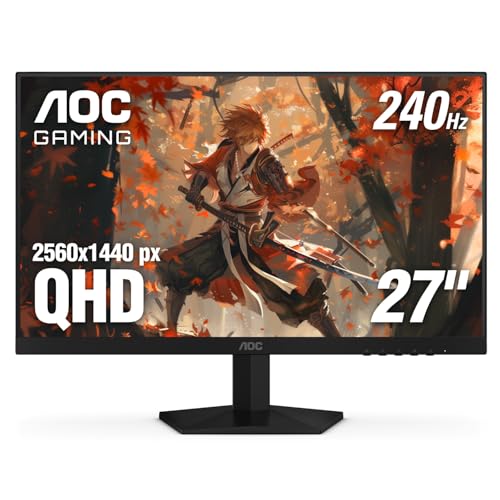 AOC Q27G41ZE 27" QHD 240Hz Gaming Monitor
|
9.6/10 | $159.99 | Buy | |
 Samsung Odyssey G55C 32" QHD Curved Monitor
|
9.6/10 | $236.99 | Buy | |
 LG 32GS60QC-B 32" QHD 180Hz Curved
|
9.5/10 | $203.99 | Buy | |
 Dell S2725DSM 27" QHD 144Hz Monitor
|
9.4/10 | $189.99 | Buy |
Samsung Odyssey G5 G51F 27" QHD 1440p Monitor
This 27-inch QHD gaming monitor from Samsung delivers sharp 1440p visuals with a fast 180Hz refresh rate and 1ms response time, making it a solid choice for competitive gamers. Its HDR10 support and AMD FreeSync help reduce screen tearing and enhance contrast for more immersive gameplay.
Pros
- Sharp QHD resolution with high pixel density
- Fast 180Hz refresh rate and 1ms response
- HDR10 for more vivid contrast
- AMD FreeSync for smooth, tear-free gameplay
- Fully adjustable ergonomic stand
Cons
- No built-in speakers
- Limited connectivity options
- HDR performance may not match premium models
Acer KG271U N3bmiipx 27" QHD 180Hz
The Acer KG271U N3bmiipx is a 27-inch gaming monitor with QHD resolution, a 180Hz refresh rate, and IPS panel. It supports AMD FreeSync and a 0.5ms response time, making it suitable for fast-paced gaming.
Pros
- QHD 2560x1440 IPS display for clear visuals
- 180Hz refresh rate reduces input lag
- 0.5ms GTG response time minimizes ghosting
- AMD FreeSync eliminates screen tearing
- DCI-P3 95% color accuracy for color-critical work
Cons
- No built-in speakers mentioned
- Limited to 60Hz on some connections potentially
- Stand may lack ergonomic adjustments
LG 27GS75Q-B 27-inch QHD Gaming Monitor
This 27-inch QHD IPS monitor offers a smooth 200Hz refresh rate and 1ms response time, making it a strong choice for competitive gamers. Its G-Sync and FreeSync support, along with a fully adjustable stand, add versatility for various setups.
Pros
- High 200Hz refresh rate
- Fast 1ms response time
- Adaptive sync support (G-Sync and FreeSync)
- Vivid 99% sRGB color coverage
- Ergonomic stand adjustments
Cons
- No built-in speakers
- Limited to 27-inch size
- HDR10 support is basic
Samsung Odyssey G5 32-Inch QHD Gaming Monitor
This 32-inch QHD gaming monitor from Samsung combines a 180Hz refresh rate with 1ms response time and IPS panel for smooth, vivid gameplay. HDR10 and Black Equalizer improve visibility in dark scenes, and the ergonomic stand adjusts for comfort.
Pros
- High 180Hz refresh rate
- Fast 1ms response time
- QHD resolution for sharp details
- Wide 178° viewing angle
- Ergonomic stand adjustments
Cons
- Limited to 32-inch size only
- HDR10 without local dimming
Samsung Odyssey G5 27" QHD 180Hz Monitor
This 27-inch QHD gaming monitor combines a fast 180Hz refresh rate and 1ms response time for fluid, tear-free gameplay. Its IPS panel delivers vivid colors and wide viewing angles, while HDR10 support and features like Black Equalizer enhance visibility in dark scenes.
Pros
- Sharp QHD resolution (2560x1440)
- High 180Hz refresh rate for smooth motion
- 1ms GtG response time reduces ghosting
- IPS panel with wide 178° viewing angles
- Height-adjustable, tilt, swivel stand
Cons
- HDR10 may not match premium HDR
- No built-in speakers
AOC Q27G41ZE 27" QHD 240Hz Gaming Monitor
This AOC monitor combines a 27-inch QHD IPS panel with a 240Hz refresh rate and 0.3ms response time, making it a strong choice for competitive gamers seeking smooth, tear-free gameplay via Adaptive-Sync support.
Pros
- Fast 240Hz refresh rate and 0.3ms response
- QHD resolution on an IPS panel
- Adaptive-Sync compatible
- Tilt adjustable stand
- Slim frameless design
Cons
- No height or swivel adjustment
- Only HDMI 2.0 ports (no HDMI 2.1)
- Limited to 240Hz via DisplayPort
Samsung Odyssey G55C 32" QHD Curved Monitor
This 32-inch QHD curved monitor wraps around your view with a 1000R curve, making it ideal for immersive gaming. Its 165Hz refresh rate and 1ms response time deliver smooth, blur-free action, while FreeSync reduces tearing for a fluid experience.
Pros
- High refresh rate and fast response
- Immersive 1000R curve
- QHD resolution provides clear visuals
- FreeSync prevents tearing
- Eye care features for long sessions
Cons
- No built-in speakers
- Stand has limited adjustability
- HDR performance is basic
LG 32GS60QC-B 32" QHD 180Hz Curved
The LG 32GS60QC-B is a 32-inch QHD curved gaming monitor with a 180Hz refresh rate and 1ms response time. Its 1000R curve and AMD FreeSync support deliver immersive, tear-free gameplay. Ideal for competitive gamers seeking smooth visuals and a near-borderless design.
Pros
- 180Hz refresh rate with 1ms response
- 1000R curved screen for immersion
- AMD FreeSync reduces screen tearing
- Three-side borderless design
- Black Stabilizer improves dark scenes
Cons
- Tilt-only stand adjustment
- No built-in speakers
- No USB hub included
Dell S2725DSM 27" QHD 144Hz Monitor
The Dell S2725DSM delivers a crisp QHD resolution with a 144Hz refresh rate and 1ms MPRT for smooth, tear-free visuals during gaming and video playback. Integrated dual 3W speakers add convenience, while the ergonomic stand and TÜV-certified eye comfort make it a flexible option for long work sessions.
Pros
- QHD resolution with 1500:1 contrast ratio
- 144Hz refresh rate and 1ms MPRT
- Integrated dual 3W speakers
- Fully ergonomic stand (height, tilt, pivot, swivel)
- AMD FreeSync support
Cons
- Built-in speakers may lack bass
- No USB-C connectivity included
Best Qhd Monitor Buying Guide
Panel Technology: IPS vs VA vs Curved
The panel type directly impacts color accuracy, contrast, and viewing angles. IPS panels (like in many of our top picks) offer superior color reproduction and wide 178-degree viewing angles, making them ideal for design work and shared screens.
VA panels deliver deeper blacks and higher contrast ratios, great for dark-room gaming and movie watching. Curved monitors like the Samsung Odyssey G55C wrap around your field of view, reducing eye strain during long sessions.
For a broader look at different LED monitor options, see our dedicated guide.
If color-critical work is your priority, prioritize IPS. For immersive gaming, VA or curved panels can enhance the experience. Every monitor in our list uses either IPS or VA technology, and we note the panel type in each product card.
Refresh Rate and Gaming Performance
Refresh rate determines how smoothly motion appears on screen. For the best Qhd monitor in gaming, 144Hz is the baseline, but many models now offer 180Hz or even 260Hz overclocked.
The LG 27GS75Q reaches up to 200Hz, giving competitive players a clear edge. Higher refresh rates demand a capable GPU; we recommend pairing your monitor with a powerful graphics card to fully utilize the speed.
Even if you don’t game, a 120Hz+ panel makes everyday desktop use feel snappier. For productivity, 144Hz is plenty; for esports titles, 180Hz or more provides the best responsiveness.
Connectivity and Ergonomics
Modern QHD monitors should include at least one HDMI 2.0 and a DisplayPort 1.4 to handle high bandwidth. Many also offer USB-C with power delivery for connecting laptops with a single cable.
Adjustable stands are crucial: height, tilt, pivot, and swivel allow you to find the perfect viewing angle.
Dell’s S2725DSM features a fully ergonomic stand, while budget models like the Acer Nitro offer tilt-only adjustment, worth considering if you plan to mount the monitor.
Built-in speakers are convenient but often underpowered; the Dell includes 2x3W speakers that suffice for casual use. Most gamers will prefer external speakers or a headset.
Size and Curvature: 27-inch vs 32-inch
Screen size is a personal choice, but 27-inch is the most popular for QHD because pixel density (109 PPI) strikes a sharp image without scaling issues.
32-inch QHD monitors have a lower pixel density (93 PPI) but offer more screen real estate, ideal for productivity or immersive gaming in a curved form. A curved 32-inch panel, like the Odyssey G55C, can fill your peripheral vision.
Pair your setup with comfortable office chairs to maintain good posture during extended use.
If desk space is tight, a 27-inch flat monitor is easier to fit and often cheaper. For a cinematic experience, a 32-inch curved display is worth the extra investment.
Adaptive Sync and Additional Features
Adaptive sync (FreeSync or G-Sync Compatible) eliminates screen tearing and stuttering during gaming. Most monitors here support both AMD FreeSync and NVIDIA G-Sync Compatible, ensuring smooth gameplay with either brand of graphics card.
Features like Black Stabilizer, crosshairs, and FPS counters are common on gaming-oriented monitors. If you also use a gaming laptop, look for a monitor with USB-C or HDMI that can mirror or extend your display without lag.
HDR10 support is standard, but real HDR performance depends on peak brightness and local dimming. For true HDR, you’d need a more expensive panel; in this price range, HDR10 enhances contrast slightly but is not transformative.
Why You Should Trust Us
BestProducts is an independent review site dedicated to helping you make informed decisions.
We evaluate each product using our proprietary BP Score (0, 10), which is determined by a consistent set of criteria: analyzing specifications, aggregating expert review consensus, examining verified buyer feedback, and incorporating published data with proper attribution.
We do not conduct our own product trials; our evaluations are grounded in research, published data, expert review consensus, and verified buyer feedback. Our team spends hundreds of hours researching and cross-referencing multiple sources to bring you reliable recommendations.
For more details on our methodology, visit our computers and office category page to see how we cover a wide range of tech products.
Final Thoughts
After extensive research and analysis, here are our top picks across different needs:
- Best Overall: Samsung 27″ Odyssey G5 (G51F) Series QHD Gaming Monitor, With a 9.9 BP Score, this Samsung delivers the best all-around performance: 1440p resolution, 144Hz refresh rate, and excellent color accuracy at an accessible price point.
- Best for High Refresh Rate: LG 27GS75Q-B 27″ Ultragear QHD Monitor, This 9.9-scored monitor boosts up to 200Hz overclocked, ideal for competitive gamers who want the smoothest motion. Its IPS panel ensures vibrant colors.
- Best Budget Pick: Acer Nitro 27″ QHD IPS Gaming Monitor KG271U, Also scoring 9.9, this Acer monitor offers 180Hz and speedy 1ms response at a bargain price, making it the best value in the roundup.
- Best Curved Display: Samsung 32″ Odyssey G55C Series QHD Curved Gaming Monitor, With a 9.6 BP Score, its 1000R curve envelops you, while fast response and FreeSync support make it a great immersive gaming choice.
- Best for Productivity: Dell 27 Plus QHD Monitor S2725DSM, Sporting a 9.4 BP Score, this Dell includes built-in speakers, a fully adjustable ergonomic stand, and a crisp 144Hz panel, perfect for home offices and creative tasks. Pair it with a capable graphics card for photo editing to maximize its potential.
Frequently Asked Questions
What is the difference between QHD and 4K?
QHD (2560×1440) offers about 3.7 million pixels, while 4K (3840×2160) has over 8 million. QHD is easier on your GPU and still looks sharp on 27-inch screens. For gaming, QHD provides a great balance between sharpness and high frame rates.
If you need extreme detail and have a powerful dedicated graphics card, 4K might be worth the extra cost.
Is QHD good for gaming?
Absolutely. QHD is the sweet spot for gaming because it offers a noticeable upgrade from 1080p while still allowing mid-range and high-end GPUs to push high refresh rates. With monitors offering 144Hz to 260Hz, you get both clarity and fluidity.
If you have an AMD Radeon graphics card, look for FreeSync support to eliminate tearing.
What refresh rate do I need for QHD gaming?
For casual and story-driven games, 144Hz is excellent. For competitive esports (Valorant, CS:GO, Overwatch), 180Hz or higher provides a competitive advantage. The LG 27GS75Q’s 200Hz is a great sweet spot.
Your GPU must be able to output those frame rates; pair your monitor with a strong laptop or desktop GPU accordingly.
Should I get a curved QHD monitor?
Curved monitors (1000R or 1500R) are beneficial for immersion and reducing eye strain during long sessions, especially on 32-inch screens. For 27-inch, the curve is less impactful.
If you prefer a flat panel for design work to avoid distortion, stick with IPS flat monitors. A curved display pairs nicely with a stylish mechanical keyboard for an all-gaming setup.
Can I use a QHD monitor with my laptop?
Yes, most modern laptops with HDMI 2.0 or USB-C/Thunderbolt can drive a QHD monitor. Check your laptop’s specs, some may need a USB-C to DisplayPort adapter for high refresh rates.
For desktop compatibility, ensure your desktop PC has a graphics card that supports QHD at your desired refresh rate.
How do I choose between IPS and VA for QHD?
Choose IPS if you need accurate colors, wide viewing angles, and fast response times, ideal for photo/video editing, competitive gaming, and shared screen work.
Choose VA if you prioritize deep blacks and high contrast, which is better for dark-room movie watching and immersive single-player gaming. Both panel types are available in our picks, so consider your primary use case.
For balanced performance, many users prefer IPS.
About the author
Irene reviews desktop PCs and monitors for BestProducts, weighing performance, upgradability, and panel quality for work and home. She helps readers build a desk setup that stays fast and comfortable for years.