The Best 1440P 165Hz Monitor
We researched and scored the top 1440p 165Hz monitors to help you find the perfect balance of sharp QHD resolution and fluid motion for gaming, work, and creative tasks in 2026.
 By Irene Hopkins
Updated September 10, 2026
By Irene Hopkins
Updated September 10, 2026
If you’re building or upgrading a gaming rig, a 1440p 165Hz monitor hits the sweet spot between visual fidelity and fluid motion.
Quad HD resolution delivers noticeably sharper images than 1080p, while a 165Hz refresh rate keeps fast-paced action smooth without the extreme GPU demands of 4K.
Whether you play competitive shooters, open-world RPGs, or creative work, investing in the best 1440p 165Hz monitor ensures your setup stays relevant for years.
In this guide, we’ve researched and scored the top models on the market to help you find the perfect fit for your desk and budget.
Our team at BestProducts evaluated each monitor against consistent criteria, panel technology, color accuracy, connectivity, adaptive sync support, and real-world buyer feedback, to assign a BP Score on our 0-to-10 scale.
We do not conduct our own product trials; instead, we aggregate specifications, expert review consensus, and verified owner experiences to bring you an unbiased, data-driven recommendation. Below, you’ll find our curated list of the best 1440p 165Hz monitors for 2026.

Samsung Odyssey G5 G51F 27" QHD 1440p Monitor
This 27-inch QHD gaming monitor from Samsung delivers sharp 1440p visuals with a fast 180Hz refresh rate and 1ms response time, making it a solid choice for competitive gamers. Its HDR10 support and AMD FreeSync help reduce screen tearing and enhance contrast for more immersive gameplay.
Pros
- Sharp QHD resolution with high pixel density
- Fast 180Hz refresh rate and 1ms response
- HDR10 for more vivid contrast
- AMD FreeSync for smooth, tear-free gameplay
- Fully adjustable ergonomic stand
Cons
- No built-in speakers
- Limited connectivity options
- HDR performance may not match premium models

Gawfolk 32-inch 2K 165Hz Curved Gaming Monitor
This 32-inch curved gaming monitor delivers immersive visuals with its 1800R VA panel and 2K resolution. The 165Hz refresh rate and 1ms response time ensure smooth, tear-free gameplay, while FreeSync support and low blue light mode reduce eye strain during long sessions.
Pros
- 2K QHD resolution with 3000:1 contrast
- 165Hz refresh rate and 1ms response
- 1800R curved VA panel for immersion
- FreeSync technology reduces tearing
- Low blue light and flicker-free DC dimming
Cons
- Requires DisplayPort for 165Hz refresh
- No HDR support mentioned
- No built-in speakers

CRUA 34-Inch UWQHD 165Hz IPS Ultrawide Monitor
This ultrawide monitor combines a spacious 34-inch UWQHD IPS panel with a 165Hz refresh rate and AMD FreeSync, making it a solid choice for gamers and multitaskers who want smooth visuals and extra screen real estate without breaking the bank.
Pros
- High refresh rate with FreeSync
- Wide color gamut and good brightness
- PIP/PBP for dual-source workflow
- Multiple video inputs reduce cable swapping
- VESA mountable for flexible setups
Cons
- No height or swivel adjustment
- Built-in speakers are basic
- Limited to 1000:1 contrast ratio

ASUS TUF Gaming VG27AQL5A 27" 1440p 210Hz Monitor
This 27-inch QHD Fast IPS monitor delivers a 210Hz overclocked refresh rate and 0.3ms response time for competitive gaming. With ELMB Sync and FreeSync Premium, it eliminates ghosting and tearing while offering ergonomic height adjustment for comfortable sessions.
Pros
- Fast 0.3ms response time
- High 210Hz refresh rate
- ELMB Sync eliminates motion blur
- FreeSync Premium for tear-free gaming
- Ergonomic height adjustment
Cons
- Requires overclocking for 210Hz
- No built-in speakers included
- Limited to DisplayPort cable included

Z-Edge 32-Inch IPS QHD Gaming Monitor
This 32-inch IPS gaming monitor from Z-Edge delivers smooth gameplay with a 200Hz refresh rate via DisplayPort and 1ms response time. QHD resolution and wide viewing angles make it a solid choice for immersive gaming.
Pros
- High 200Hz refresh rate via DP
- Sharp QHD resolution
- IPS panel for wide viewing angles
- Multiple ports (2 HDMI, 2 DP)
- Frameless design with VESA mount
Cons
- No built-in speakers
- Stand might need assembly effort

Sceptre C345B-QUT168 34-inch Curved Ultrawide WQHD
This ultrawide monitor brings vivid WQHD detail and fast 1ms response to gamers seeking an immersive curved display. With 99% sRGB coverage and built-in speakers, it covers both creative and everyday use.
Pros
- Sharp WQHD ultrawide resolution
- Fast 1ms response time for gaming
- High color accuracy with 99% sRGB
- Immersive R1500 curve
- Built-in speakers save desk space
Cons
- No HDMI input mentioned
- Limited ergonomic adjustability likely
- Speakers may lack deep bass

KOORUI G2421V 24-inch 1440p 180Hz Monitor
This KOORUI monitor delivers a fast 180Hz refresh rate and 1ms response time on a 24-inch 1440p Fast IPS panel, making it a strong option for competitive gamers. It also features HDR400 support and an ergonomic stand for comfortable extended use.
Pros
- High 180Hz refresh rate with Adaptive Sync
- Sharp 1440p resolution on a 24-inch screen
- Fast IPS panel with 90% DCI-P3 color gamut
- Ergonomic stand with tilt adjustment
- Multiple connectivity options (HDMI, DisplayPort)
Cons
- Limited ergonomic adjustment (tilt only)
- Entry-level HDR400 brightness
- No built-in speakers

KTC H32S5 32" 2K Curved Gaming Monitor
This KTC 32-inch curved gaming monitor delivers a sharp 2K resolution and an overclockable 185Hz refresh rate for smooth gameplay. Its 1500R HVA panel and wide color gamut enhance immersion, making it a solid choice for gamers seeking vivid visuals.
Pros
- High 185Hz refresh rate for fluid motion
- Vivid colors with 99% sRGB coverage
- Effective Adaptive FreeSync for smooth gaming
- Immersive 1500R curve enhances field of view
- Good connectivity with dual DP and HDMI ports
Cons
- Overclocking required to reach 185Hz
- No built-in speakers mentioned
- Limited adjustability (tilt only)

ASUS TUF Gaming VG34VQL1B 34-inch Ultrawide
The ASUS TUF Gaming VG34VQL1B is a 34-inch ultrawide curved monitor with 1440p resolution and a 165Hz refresh rate, built for immersive gameplay. It combines FreeSync Premium, a 1ms response time, and DisplayHDR 400 support to deliver smooth, tear-free visuals with enhanced contrast.
Pros
- Fast 1ms response time for competitive gaming
- Ultrawide 3440x1440 resolution adds screen real estate
- Adaptive sync via FreeSync Premium
- Height-adjustable stand improves ergonomics
- DisplayHDR 400 enhances HDR content
Cons
- No built-in speakers included
- Limited to 60Hz over HDMI without DSC
- HDR performance is entry-level for the certification

KTC H24T7 24-Inch QHD 180Hz Monitor
This gaming monitor packs a 180Hz refresh rate and 1ms response time into a sharp 24-inch QHD IPS panel. With 99% sRGB coverage and HDR400, it delivers vibrant colors for both fast-paced games and everyday use. Adaptive-Sync keeps gameplay smooth without tearing, making it a solid choice for competitive gamers who prefer a smaller high-resolution screen.
Pros
- 180Hz refresh rate with 1ms response
- Sharp QHD resolution on 24-inch screen
- 99% sRGB color gamut and HDR400
- Adaptive-Sync for tear-free gaming
- Ergonomic stand with tilt, pivot, and height adjustment
Cons
- HDR400 is entry-level HDR performance
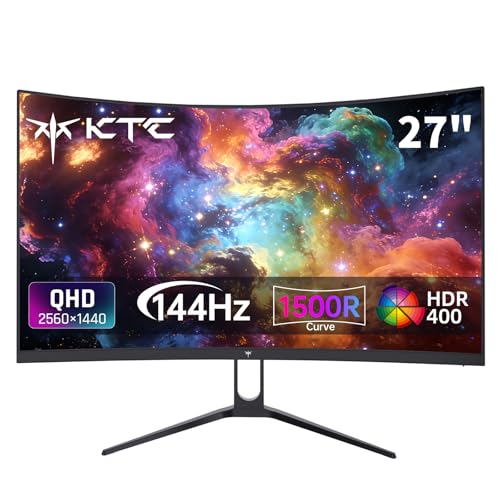
KTC H27S5C 27-Inch Curved 1440p 144Hz Monitor
This curved 27-inch monitor combines 1440p resolution with a 144Hz refresh rate and 1500R curvature for immersive gaming and work. Its wide color gamut and adaptive sync support deliver smooth, vibrant visuals, while eye care features and an ergonomic stand add everyday comfort.
Pros
- Immersive 1500R curved panel
- High color accuracy (129% sRGB, 110% DCI-P3)
- 144Hz refresh rate with adaptive sync
- Built-in eye care features
- Ergonomic tilt-adjustable stand
Cons
- Basic HDR400 certification
- Tilt-only stand, no height or swivel
- No USB ports
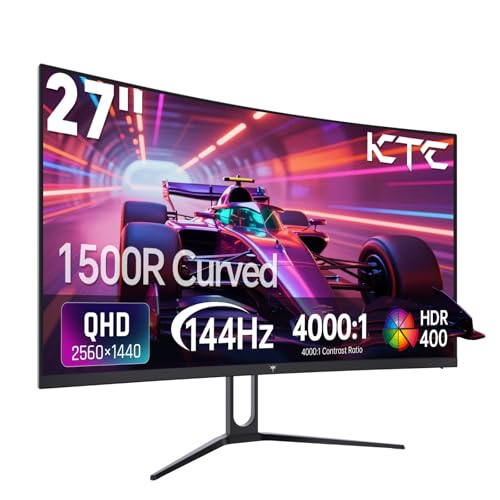
KTC H27S5C 27" 1440p 144Hz Curved Monitor
This 27-inch curved gaming monitor from KTC combines a 2560x1440 resolution with a 144Hz refresh rate and Adaptive-Sync for smoother gameplay. Its 1500R curvature and HDR400 support aim to deliver an immersive viewing experience for both gaming and office tasks.
Pros
- High resolution and refresh rate for gaming
- Immersive 1500R curve reduces distortion
- Good color coverage with 129% sRGB
- HDR400 enhances contrast and brightness
- Flexible tilt and VESA mount options
Cons
- No built-in speakers
- Limited to HDMI 2.0 (not 2.1)
- Only tilt adjustment, no height or swivel
Best 1440p 165Hz Monitor Buying Guide
Panel Type: IPS vs. VA vs. TN
The panel technology largely determines viewing angles, contrast, and response times. IPS panels offer the best color accuracy and wide viewing angles, making them ideal for both gaming and creative work.
VA panels deliver deeper blacks and higher contrast ratios, which enhance immersion in dark scenes, though they may exhibit slower pixel response. TN panels are rare in modern 1440p monitors due to inferior colors and angles.
For most buyers, an IPS panel strikes the best balance; many of our top picks use fast IPS variants that reach 1ms response times without sacrificing image quality.
Refresh Rate and Response Time
A 165Hz refresh rate refreshes the image 165 times per second, translating to smoother motion and less perceived stutter in fast games. Combined with a low response time (ideally 1ms to 4ms), ghosting and motion blur are minimized.
Some monitors in our list offer overclockable refresh rates up to 180Hz or 200Hz, giving you extra headroom for competitive titles.
Keep in mind that achieving these frame rates requires a capable GPU; pairing a graphics card with enough horsepower is essential to fully benefit from high-refresh gaming.
Resolution and Aspect Ratio
All monitors in this roundup feature 2560×1440 (QHD/WQHD) resolution, offering roughly 78% more pixels than 1080p. This makes text and fine details noticeably crisper without the heavy GPU load of 4K.
Aspect ratios vary: standard 16:9 panels (24, 27, 32 inches) are the most versatile, while ultrawide 21:9 models (34 inches) provide an immersive field of view for racing and flight sims.
If you’re considering an ultrawide, our ultrawide curved monitor guide covers additional considerations like curvature and desk space.
Connectivity and Ergonomics
Modern 1440p 165Hz monitors should include at least DisplayPort 1.4 (for full bandwidth at 165Hz) and HDMI 2.0 or higher. USB-C with DisplayPort Alt Mode is a plus for laptop users who want single-cable video and charging.
Ergonomics matter for long sessions: look for height adjustment, tilt, swivel, and pivot, especially if you share a desk or alternate between sitting and standing. Many budget models omit height adjustment, so check the specs carefully.
A sturdy monitor stand can save you from neck strain and improve your overall setup comfort.
Adaptive Sync and HDR Support
Adaptive sync technologies, NVIDIA G-SYNC Compatible and AMD FreeSync, eliminate screen tearing and stuttering by synchronizing the monitor’s refresh rate with your GPU’s frame output. Most 1440p 165Hz monitors support FreeSync Premium or G-SYNC Compatible out of the box.
HDR (High Dynamic Range) is increasingly common, though few monitors in this price range deliver true HDR brightness. Look for VESA DisplayHDR 400 certification as a baseline; higher tiers like 600 or 1000 are rare at this price point.
For deeper dives into display technologies, our QHD monitor guide offers additional benchmarks.
Why You Should Trust Us
At BestProducts, we believe in transparent, research-backed recommendations. Every monitor in this roundup was evaluated using our proprietary BP Score system (0 to 10), which weighs specifications, expert review consensus, verified buyer feedback, and publicly available data.
We do not conduct our own product trials; our evaluations are grounded in research, published data, expert review consensus, and verified buyer feedback. Our team continuously monitors new releases and price changes to keep this guide current.
We also disclose that some of the links in this article are affiliate links, if you buy through them, we may earn a small commission at no extra cost to you.
This helps us maintain our independence and continue producing in-depth content like this 2560×1440 monitor roundup.
Final Thoughts
After analyzing dozens of models, three picks stand out for different needs and budgets. Each earned a top BP Score in its category through consistent performance across our criteria.
- Best Overall: Samsung 27″ Odyssey G5 (G51F) QHD Gaming Monitor, With a nearly perfect BP Score, this 27-inch IPS panel delivers excellent color, fast response, and robust adaptive sync support at a competitive price, making it the most well-rounded choice for most gamers.
- Best Budget Pick: Gawfolk 32″ 2K QHD 165Hz Curved Gaming Monitor, Despite its affordable price, this VA panel offers impressive contrast and a large 32-inch screen, earning a top BP Score for value. Ideal for immersive single-player games and everyday use.
- Best Ultrawide: ASUS TUF Gaming VG34VQL1B 34″ 1440p 165Hz Ultrawide HDR Gaming Monitor, This 34-inch ultrawide combines a 1500R curve, 165Hz refresh, and HDR support for an immersive experience. Its strong BP Score reflects excellent build quality and feature set for sim racing and productivity.
For a broader look at high-performance displays, check out our best monitor for work guide if you also need a productivity-focused screen.
Frequently Asked Questions
Is a 1440p 165Hz monitor worth it over 1080p 240Hz?
It depends on your priorities. 1440p offers significantly sharper image quality, which benefits both gaming and everyday tasks like reading text or editing photos.
1080p 240Hz is still preferred by some competitive esports players who prioritize maximum smoothness, but for most users, the visual upgrade of 1440p at 165Hz is more noticeable than the extra 75Hz.
A high-refresh monitor paired with a capable gaming laptop can also be a great match.
Can my PC run a 1440p 165Hz monitor?
You’ll need a graphics card that can push 60+ fps at 1440p in your target games. Mid-range GPUs like an RTX 3060 Ti / RX 6700 XT or higher can handle many titles at high settings.
For competitive shooters, a stronger GPU (RTX 4070 or above) helps maintain 165 fps. Check your CPU too, bottlenecks can limit frame rates. For a deeper look at compatible hardware, see our AMD Radeon graphics card guide.
What’s the difference between 144Hz and 165Hz?
The difference is subtle: 165Hz displays 13% more frames per second than 144Hz. In practice, most users won’t notice a major difference in smoothness, but 165Hz panels often include better response times or newer panel technology.
If the price gap is small, 165Hz is a nice bonus, but 144Hz remains excellent for gaming. Many monitors in this roundup also support overclocking to 180Hz or beyond.
Do I need DisplayPort 1.4 for 165Hz at 1440p?
Yes, DisplayPort 1.4 is required to achieve 165Hz without chroma subsampling. HDMI 2.0 can also handle 1440p at 144Hz, but for the full 165Hz refresh, DisplayPort is the standard.
Most modern GPUs and monitors include DP 1.4, but double-check your cable, older cables may not support the required bandwidth.
Are curved monitors better for 1440p gaming?
Curved monitors (typically 1500R or 1000R) can enhance immersion, especially on ultrawide 34-inch screens, by matching the natural curvature of your eyes. For standard 27-inch 16:9 panels, the curve is less impactful.
The choice comes down to personal preference and desk layout. If you’re considering a curved model, our ultrawide resolution guide explains how curvature affects viewing experience.
How long do 1440p 165Hz monitors last?
With proper care, a quality monitor can last 7 to 10 years or more. LED backlights have long lifespans, and most modern panels are rated for 30,000+ hours.
The more likely upgrade trigger is new features (like OLED or higher refresh rates) rather than failure. Investing in a well-reviewed model from a reputable brand ensures reliability and good resale value.
About the author
Irene reviews desktop PCs and monitors for BestProducts, weighing performance, upgradability, and panel quality for work and home. She helps readers build a desk setup that stays fast and comfortable for years.