The Best Curved 4K Gaming Monitor
We've researched the top curved 4K gaming monitors, evaluating panel types, refresh rates, and connectivity to help you find the perfect immersive display for your gaming rig.
 By Irene Hopkins
Updated September 10, 2026
By Irene Hopkins
Updated September 10, 2026
Curved 4K gaming monitors offer an immersive experience that flat panels can’t match, wrapping the display around your field of view for deeper engagement in open-world games and fast-paced shooters.
With resolutions up to 3840×2160, these monitors deliver sharp details and vibrant colors, making every scene pop.
Whether you’re building a high-end gaming rig or upgrading your current setup, choosing the right curved 4K monitor involves balancing screen size, panel technology, refresh rate, and connectivity.
At BestProducts, we’ve analyzed specifications, expert reviews, and verified buyer feedback to identify the top curved 4K gaming monitors available in 2026. Our research-based BP Score system rates each model on clarity, color accuracy, motion handling, build quality, and value.
Below, you’ll find our curated list of the best curved 4K gaming monitors, followed by a detailed buying guide to help you make an informed decision.
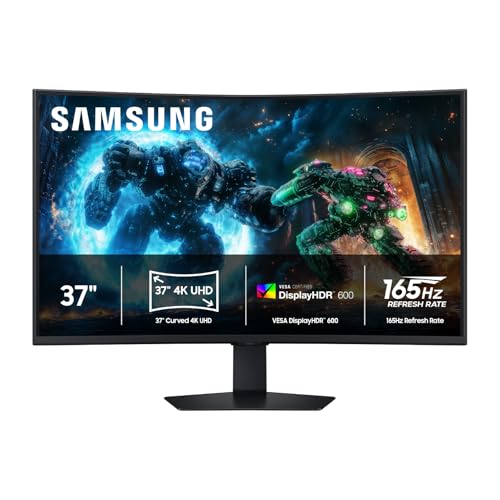
Samsung Odyssey G7 G75F 37-Inch 4K Curved Monitor
This curved 4K display wraps around your field of view for an immersive gaming experience. With a 165Hz refresh rate and 1ms response time, it offers smooth, lag-free gameplay. HDR600 support enhances contrast for better visibility in dark scenes.
Pros
- Immersive 1000R curved screen
- High 165Hz refresh rate
- Fast 1ms response time
- Good HDR contrast with DisplayHDR 600
Cons
- Heavy at 24.7 pounds
- Large footprint may require deep desk

Alienware AW3425DW 34-inch QD-OLED 240Hz Monitor
This ultrawide gaming monitor combines a 34-inch QD-OLED panel with 240Hz refresh and sub-millisecond response, delivering vivid colors and buttery smooth motion for competitive and immersive gameplay. Its 1800R curve and HDR400 TrueBlack support make it a premium pick for gamers who demand both speed and picture quality.
Pros
- Incredible color accuracy and vibrancy
- Ultra-fast 240Hz for smooth motion
- Deep blacks and high contrast with QD-OLED
- Supports multiple adaptive sync technologies
Cons
- Premium pricing tier
- No built-in speakers
- Requires ample desk space due to size

Alienware AW3425DWM 34-inch WQHD Gaming Monitor
This ultrawide monitor delivers smooth 180Hz performance with WQHD resolution and a 1500R curve for immersive gaming. It supports AMD FreeSync Premium and VESA AdaptiveSync to minimize screen tearing. The hardware-based low blue light solution helps reduce eye strain during long sessions.
Pros
- Excellent color accuracy with DCI-P3 95% coverage
- Smooth 180Hz refresh rate with 1ms response
- Immersive 1500R curve for ultrawide gaming
- AMD FreeSync Premium and VESA AdaptiveSync support
- Hardware-based low blue light reduces eye strain
Cons
- No built-in speakers

LG 27GS60QC-B 27" QHD Curved Gaming Monitor
This 27-inch QHD curved monitor delivers smooth gameplay with a 180Hz refresh rate and 1ms GtG response, supported by AMD FreeSync for tear-free action. The steep 1000R curve and 99% sRGB color gamut enhance immersion, making it a solid mid-range choice for competitive and immersive gaming alike.
Pros
- 180Hz refresh rate and 1ms GtG response
- Immersive 1000R curved screen
- AMD FreeSync for tear-free gaming
- Borderless three-side design
- Black Stabilizer and FPS Counter features
Cons
- Tilt-only stand adjustment
- No built-in speakers

ZZA 34-Inch Ultrawide WQHD Curved Monitor
This 34-inch ultrawide monitor from ZZA offers a 3800R curve and WQHD resolution for expansive views in gaming and productivity. Its 100Hz refresh rate and built-in speakers make it a functional all-in-one display for users seeking smooth motion and convenience.
Pros
- Immersive 34-inch curved screen
- Smooth 100Hz refresh rate
- Rich 100% sRGB color accuracy
- Built-in speakers save desk space
- Versatile HDMI and DisplayPort inputs
Cons
- Only 100Hz refresh rate, not for high-end gaming
- No adjustable stand included
- Limited to 3800R curvature, less aggressive curve

Amzfast 32-Inch 4K 120Hz Curved Gaming Monitor
The Amzfast 32-inch curved monitor delivers a compelling 4K 120Hz experience with HDMI 2.1 VRR support, making it a strong candidate for console gamers on PS5 and Xbox. Its wide color gamut and high contrast ratio also suit creative work, though the built-in speakers and peak brightness are modest.
Pros
- 4K 120Hz with HDMI 2.1 VRR
- Adaptive Sync reduces stutter and tearing
- Wide color gamut 131% sRGB
- 3000:1 contrast ratio for deep blacks
- PIP/PBP split screen functionality
Cons
- Built-in speakers limited to 3W
- 300 nits brightness modest for HDR
- 8-bit color panel, not true 10-bit

LG 37G800A-B 37-Inch 4K Curved Gaming Monitor
A 37-inch curved 4K monitor with a 165Hz refresh rate and 1ms response time, this LG UltraGear model targets gamers who want immersive visuals and smooth motion. It supports AMD FreeSync Premium Pro and VESA DisplayHDR 600 for vibrant colors and reduced tearing, plus includes HDMI 2.1 and USB-C with 65W power delivery for versatile connectivity.
Pros
- 165Hz refresh rate for smooth gameplay
- 1ms response time minimizes blur
- FreeSync Premium Pro reduces screen tearing
- DisplayHDR 600 enhances contrast and color
- Adjustable stand with tilt, swivel, height
Cons
- Heavy at 30.3 pounds
- Large footprint may not fit small desks
- No built-in speakers mentioned

Samsung Odyssey Neo G9 G95NC 57-Inch Dual UHD
This 57-inch curved monitor delivers dual 4K resolution in a single screen, effectively replacing two UHD monitors with a seamless, immersive view. Its 240Hz refresh rate, 1ms response time, and DisplayPort 2.1 input make it a top choice for competitive gamers seeking ultra-wide, high-performance visuals.
Pros
- World's first dual UHD resolution for expansive workspace
- 240Hz refresh rate and 1ms response time
- Quantum Mini LEDs with 2,392 local dimming zones
- VESA DisplayHDR 1000 for vivid contrast
- AMD FreeSync Premium Pro for smooth gameplay
Cons
- Large size and weight (41.9 lbs) may require sturdy desk
- Premium pricing limits accessibility

CRUA 32-Inch 4K 160Hz Curved Monitor
The CRUA 32-inch curved monitor delivers 4K UHD resolution with a 160Hz refresh rate and 1500R curvature, creating an immersive experience for gaming and productivity. Its VA panel covers 120% sRGB and offers a 3000:1 contrast ratio, while built-in speakers and RGB lighting add convenience and style for home office or gaming setups.
Pros
- 4K UHD resolution for sharp detail
- 160Hz refresh rate with FreeSync for smooth gameplay
- 1500R curvature enhances immersion
- 120% sRGB and 3000:1 contrast for vivid colors
- Built-in speakers reduce desktop clutter
Cons
- No HDR support mentioned
- Limited port selection (only HDMI and DP)
- White color only may not suit all setups

ZZA 32-Inch 4K 160Hz Curved Monitor
The ZZA 32-inch curved monitor delivers 4K UHD resolution with a 160Hz refresh rate and AMD FreeSync for smooth gaming. Its 1500R curvature and 100% sRGB color accuracy make it suitable for immersive gameplay and content creation. With HDMI 2.1 and DP 1.4 connectivity, it supports modern consoles and PCs.
Pros
- 4K resolution with 160Hz refresh
- Immersive 1500R curved screen
- AMD FreeSync for tear-free gaming
- 100% sRGB color coverage
- HDMI 2.1 supports next-gen consoles
Cons
- No built-in speakers
- Stand lacks height and tilt adjustment

Samsung Odyssey G7 G75F 40" WUHD Curved
The Samsung Odyssey G7 G75F wraps around your field of vision with a 1000R curve and ultrawide 4K resolution, making it a solid choice for immersive gaming. With its 180Hz refresh rate and 1ms response time, it minimizes lag for smooth, competitive play.
Pros
- Immersive 1000R curved 40-inch screen
- Ultrawide 4K resolution for sharp detail
- 180Hz refresh rate reduces motion blur
- 1ms GtG response time minimizes lag
- VESA DisplayHDR 600 enhances contrast
Cons
- No height or swivel adjustments listed
- Requires ample desk space at 40 inches

Samsung Odyssey G55C 32" QHD Curved Monitor
This 32-inch QHD curved monitor wraps around your view with a 1000R curve, making it ideal for immersive gaming. Its 165Hz refresh rate and 1ms response time deliver smooth, blur-free action, while FreeSync reduces tearing for a fluid experience.
Pros
- High refresh rate and fast response
- Immersive 1000R curve
- QHD resolution provides clear visuals
- FreeSync prevents tearing
- Eye care features for long sessions
Cons
- No built-in speakers
- Stand has limited adjustability
- HDR performance is basic
Best Curved 4K Gaming Monitor Buying Guide
Panel Technology: VA, IPS, and OLED
The panel type determines contrast, color accuracy, and response time. VA panels are common in curved monitors because they offer high native contrast ratios (3000:1 or more) for deep blacks, ideal for dark game scenes.
IPS panels provide wider viewing angles and better color consistency but lower contrast. OLED panels, found in premium models like the Alienware AW3425DW, deliver perfect blacks and near-instant response times but are more expensive.
For a balance of contrast and color, many gamers prefer VA; for competitive play, fast IPS or OLED are excellent. If you prioritize color-critical work alongside gaming, consider a high-quality IPS panel.
For more on panel types, see our guide to 1440p gaming monitors.
Resolution and Screen Size
4K UHD (3840×2160) provides four times the pixels of 1080p, delivering incredible detail that’s especially noticeable on larger screens.
Screen sizes from 27 to 57 inches are available; 32 inches is a popular sweet spot for 4K gaming, offering a pixel density that balances sharpness and performance.
Ultrawide monitors like the 34-inch Alienware and 37-inch Samsung Odyssey G7 give you extra horizontal space, ideal for racing or flight sims. The massive 57-inch Samsung Odyssey Neo G9 provides dual 4K resolution for an unparalleled panoramic view.
For productivity, larger screens can replace multi-monitor setups. Learn more about monitor sizes for work in our guide to monitor sizes.
Refresh Rate and Response Time
Higher refresh rates (120Hz, 144Hz, 160Hz, 180Hz, 240Hz) result in smoother motion, which is crucial for fast-paced gaming. For 4K, 144Hz is a common target, but even 120Hz is a significant upgrade from 60Hz.
Response time (measured in ms) affects ghosting; 1ms (MPRT) is typical for VA and IPS, while OLED can achieve 0.03ms. Adaptive sync technologies like FreeSync and G-Sync Compatible eliminate screen tearing.
If you play competitive shooters, a 240Hz OLED or 180Hz VA monitor can give you an edge. For a deeper dive, check our roundup of 165Hz monitors.
Connectivity and Ports
For 4K at high refresh rates, HDMI 2.1 is essential to support up to 4K 144Hz without compression. DisplayPort 1.4 also handles this bandwidth. USB-C with power delivery is convenient for laptops. Many monitors include a USB hub for peripherals.
Ensure your graphics card has matching ports. For multi-monitor setups, a docking station can simplify connections. See our best dual monitor docking station guide for recommendations.
Curve and Ergonomics
The curvature (measured in R, e.g., 1000R, 1500R) indicates how tightly the screen bends. 1000R is the most aggressive, matching the human eye’s natural curvature for maximum immersion, while 1500R is more subtle and easier to use for productivity.
Ergonomic adjustments, height, tilt, swivel, and pivot, are important for long gaming sessions. A VESA mount option allows for custom arm setups. For a comprehensive look at curved displays, read our ultrawide curved monitor guide.
Adaptive Sync and HDR
Adaptive sync (FreeSync Premium Pro or G-Sync Compatible) synchronizes the monitor’s refresh rate with your GPU to eliminate stutter and tearing. HDR (High Dynamic Range) enhances contrast and color; look for DisplayHDR 600 or higher for meaningful HDR performance.
OLED panels excel in HDR due to per-pixel lighting. For HDR content creation, a calibrated monitor is beneficial. Explore our best monitor for work guide for HDR options.
Why You Should Trust Us
BestProducts is an independent review site that does not accept free products or payments from manufacturers. Our recommendations are based on thorough research and analysis.
Each product is evaluated against a consistent set of criteria and scored on our 0 to 10 BP Score. We gather data from published specifications, expert review consensus, and verified buyer feedback to ensure a balanced assessment.
We do not conduct our own product trials; our evaluations are grounded in research, published data, expert review consensus, and verified buyer feedback. This methodology helps us identify the best curved 4K gaming monitors for various needs and budgets.
Final Thoughts
After evaluating the top curved 4K gaming monitors, we’ve selected the following standouts based on BP Score and performance:
- Best Overall: Samsung 37” Odyssey G7 (G75F), With a BP Score of 9.9, this monitor combines a 4K 165Hz VA panel with 1000R curvature, delivering immersive visuals and smooth gameplay.
- Best Premium Ultrawide: Alienware 34 240Hz QD-OLED (AW3425DW), Also scoring 9.9, this OLED ultrawide offers incredible color accuracy and a 0.03ms response time for competitive gaming.
- Best Value: LG 27GS60QC-B, A 27-inch QHD curved monitor with 180Hz and 1ms response, it’s an affordable option for high-refresh-rate gaming at a lower resolution.
- Best Immersion: Samsung 57” Odyssey Neo G9, The massive dual 4K screen and 1000R curve provide an unmatched panoramic experience for simulation games.
- Best Budget 4K: CRUA 32” 4K 160Hz, A 4K curved monitor at a competitive price, offering solid specs for gamers on a budget.
Frequently Asked Questions
What is the ideal screen size for a curved 4K gaming monitor?
The ideal size depends on your desk space and viewing distance. For 4K, 27 to 32 inches is common; larger sizes like 37 or 57 inches offer more immersion but require more space. Ultrawide monitors (34 inches) provide a cinematic aspect ratio.
For a detailed breakdown, see our monitor size guide.
Is a curved monitor better for gaming?
Curved monitors can enhance immersion by wrapping the image around your peripheral vision, reducing distortion at the edges. They are particularly beneficial for racing, flight sims, and open-world games.
However, for competitive FPS games, a flat monitor with fast response times may be preferred. Many gamers enjoy the immersive benefits of a curved display.
What refresh rate should I look for in a 4K gaming monitor?
For 4K gaming, a refresh rate of 120Hz or 144Hz is a good balance between smoothness and GPU demand. Higher rates like 160Hz or 240Hz are available but require very powerful graphics cards.
If you play competitive games, prioritize refresh rate; for single-player titles, resolution and HDR may be more important. Check our 1440p 165Hz monitor guide for insights on high refresh rates.
Do I need HDMI 2.1 for 4K gaming?
HDMI 2.1 is required to achieve 4K at 120Hz or higher without chroma subsampling. If your graphics card and monitor support DisplayPort 1.4, you can also achieve 4K 144Hz. Many modern GPUs (RTX 30/40 series, RX 6000/7000) include HDMI 2.1. For multi-monitor setups, a docking station can help manage connections.
Are curved monitors good for productivity?
Curved monitors can reduce eye strain by maintaining a consistent focal distance across the screen, which is beneficial for long work sessions. Ultrawide curved monitors can replace dual-monitor setups for multitasking.
However, for color-critical work, a flat IPS monitor may be preferable. For productivity-focused recommendations, see our productivity monitor guide.
How does OLED compare to VA for gaming?
OLED offers superior contrast (infinite blacks), faster response times (0.03ms), and vibrant colors, but it is more expensive and may have burn-in risk with static elements.
VA panels provide high contrast at a lower price and are available in larger sizes, but have slower response times and can exhibit black smearing. For competitive gaming, OLED is ideal; for immersive single-player, VA is a great choice.
About the author
Irene reviews desktop PCs and monitors for BestProducts, weighing performance, upgradability, and panel quality for work and home. She helps readers build a desk setup that stays fast and comfortable for years.