The Best 1440P Gaming Monitor
From budget IPS panels to high-refresh OLEDs, these 1440p gaming monitors deliver sharp visuals and smooth motion for every player.
 By Irene Hopkins
Updated September 10, 2026
By Irene Hopkins
Updated September 10, 2026
The 1440p gaming monitor has become the sweet spot for PC gamers who want sharp visuals without the heavy GPU demands of 4K.
A good QHD panel delivers noticeably crisper text and more detail than 1080p, while still letting modern graphics cards push high frame rates in competitive titles.
That combination explains why 1440p is now the resolution most enthusiasts recommend when building a new gaming setup.
We researched the current market and compared dozens of models across key criteria like panel technology, refresh rate, response time, color accuracy, connectivity, and ergonomics.
Our evaluation combines official specifications, expert review consensus, verified buyer feedback, and published data to score each monitor on our 0 to 10 BP Score scale.
Whether you want a budget-friendly 27-inch workhorse, an ultrawide curved display, or a high-refresh-rate OLED, this guide will help you find the right fit. Below, you will find our top picks for the best 1440p gaming monitor on the market.
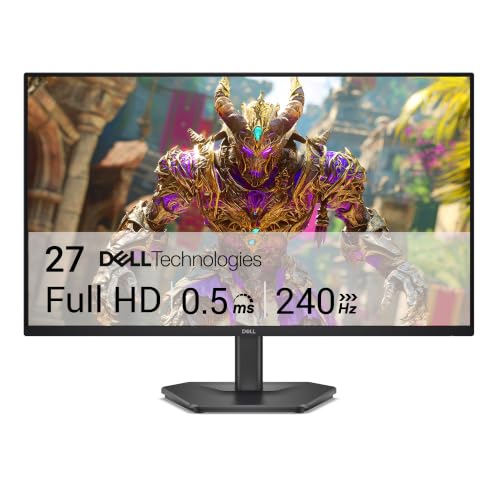
Dell SE2726HG 27-inch FHD 240Hz IPS Gaming Monitor
This 27-inch gaming monitor from Dell packs a 240Hz refresh rate and 0.5ms response time for exceptionally smooth gameplay. With FreeSync Premium and 99% sRGB coverage, it's a solid choice for competitive gamers who value both speed and color accuracy.
Pros
- Excellent 240Hz performance for competitive gaming
- Fast 0.5ms response time reduces motion blur
- FreeSync Premium works with PC and console
- Accurate colors with 99% sRGB coverage
- Eye comfort certification without sacrificing color
Cons
- Only FHD resolution on a 27-inch panel
- Limited ergonomics (tilt only, no height adjust)
- No built-in speakers or USB hub

Samsung Odyssey G5 G51F 27" QHD 1440p Monitor
This 27-inch QHD gaming monitor from Samsung delivers sharp 1440p visuals with a fast 180Hz refresh rate and 1ms response time, making it a solid choice for competitive gamers. Its HDR10 support and AMD FreeSync help reduce screen tearing and enhance contrast for more immersive gameplay.
Pros
- Sharp QHD resolution with high pixel density
- Fast 180Hz refresh rate and 1ms response
- HDR10 for more vivid contrast
- AMD FreeSync for smooth, tear-free gameplay
- Fully adjustable ergonomic stand
Cons
- No built-in speakers
- Limited connectivity options
- HDR performance may not match premium models

Acer KG271U N3bmiipx 27" QHD 180Hz
The Acer KG271U N3bmiipx is a 27-inch gaming monitor with QHD resolution, a 180Hz refresh rate, and IPS panel. It supports AMD FreeSync and a 0.5ms response time, making it suitable for fast-paced gaming.
Pros
- QHD 2560x1440 IPS display for clear visuals
- 180Hz refresh rate reduces input lag
- 0.5ms GTG response time minimizes ghosting
- AMD FreeSync eliminates screen tearing
- DCI-P3 95% color accuracy for color-critical work
Cons
- No built-in speakers mentioned
- Limited to 60Hz on some connections potentially
- Stand may lack ergonomic adjustments

Sceptre C345B-QUT168 34-inch Curved Ultrawide WQHD
This ultrawide monitor brings vivid WQHD detail and fast 1ms response to gamers seeking an immersive curved display. With 99% sRGB coverage and built-in speakers, it covers both creative and everyday use.
Pros
- Sharp WQHD ultrawide resolution
- Fast 1ms response time for gaming
- High color accuracy with 99% sRGB
- Immersive R1500 curve
- Built-in speakers save desk space
Cons
- No HDMI input mentioned
- Limited ergonomic adjustability likely
- Speakers may lack deep bass

Samsung Odyssey G5 27" QHD 180Hz Monitor
This 27-inch QHD gaming monitor combines a fast 180Hz refresh rate and 1ms response time for fluid, tear-free gameplay. Its IPS panel delivers vivid colors and wide viewing angles, while HDR10 support and features like Black Equalizer enhance visibility in dark scenes.
Pros
- Sharp QHD resolution (2560x1440)
- High 180Hz refresh rate for smooth motion
- 1ms GtG response time reduces ghosting
- IPS panel with wide 178° viewing angles
- Height-adjustable, tilt, swivel stand
Cons
- HDR10 may not match premium HDR
- No built-in speakers

ASUS TUF Gaming VG27AQM5A 27" QHD 300Hz
This 27-inch QHD monitor uses Fast IPS for a 0.3ms response time and 300Hz refresh, paired with ELMB Sync to reduce motion blur during competitive gaming. Its 95% DCI-P3 coverage ensures vibrant colors for both games and content creation.
Pros
- 300Hz refresh rate for smooth gaming
- 0.3ms GTG response time reduces motion blur
- ELMB Sync eliminates ghosting and tearing
- 95% DCI-P3 for vibrant colors
- Shadow Boost enhances dark scenes
Cons
- No USB-C or HDMI 2.1 mentioned
- Built-in speakers may lack bass depth
- Stand offers limited ergonomic adjustments
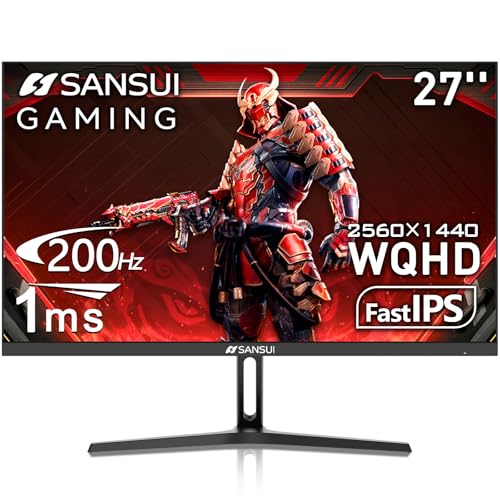
SANSUI 27 Inch WQHD 200Hz Gaming Monitor
This 27-inch QHD IPS monitor offers a smooth 200Hz refresh rate and 1ms response time, ideal for competitive gaming. Its 120% sRGB color gamut and HDR support deliver vibrant visuals, while the included DP cable and VESA mount add value.
Pros
- High 200Hz refresh rate for smooth motion
- Fast 1ms response time reduces ghosting
- IPS panel offers wide viewing angles and accurate colors
- 120% sRGB gamut enhances color vibrancy
- VESA mountable for flexible setup
Cons
- No built-in speakers
- HDMI limited to 144Hz, DP needed for 180Hz
- Limited tilt adjustment range (-5 to 15 degrees)
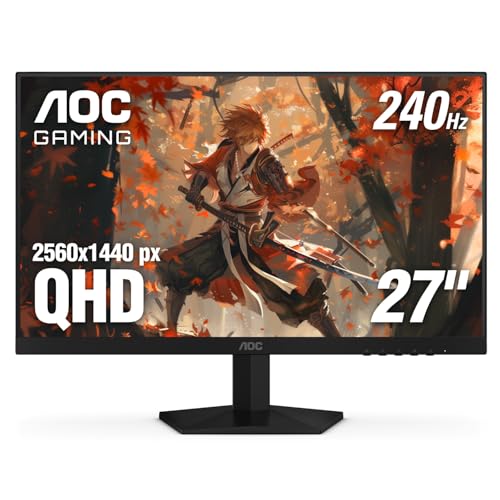
AOC Q27G41ZE 27" QHD 240Hz Gaming Monitor
This AOC monitor combines a 27-inch QHD IPS panel with a 240Hz refresh rate and 0.3ms response time, making it a strong choice for competitive gamers seeking smooth, tear-free gameplay via Adaptive-Sync support.
Pros
- Fast 240Hz refresh rate and 0.3ms response
- QHD resolution on an IPS panel
- Adaptive-Sync compatible
- Tilt adjustable stand
- Slim frameless design
Cons
- No height or swivel adjustment
- Only HDMI 2.0 ports (no HDMI 2.1)
- Limited to 240Hz via DisplayPort

ASUS TUF Gaming VG27AQ3A 27" 1440p 180Hz
This 27-inch QHD monitor targets competitive gamers who want a high-refresh-rate panel without breaking the bank. The Fast IPS panel delivers smooth 180Hz performance with ELMB Sync to reduce ghosting, while FreeSync Premium and G-Sync compatible support keep tearing at bay.
Pros
- High refresh rate for smooth gaming
- Good color accuracy with 130% sRGB
- Both FreeSync and G-Sync support
- Built-in speakers save desk space
- Includes DisplayPort cable and screwdriver
Cons
- Speakers may lack bass for immersive audio
- No USB-C connectivity included

ASUS ROG XG27ACS 27" 1440p 180Hz Monitor
This 27-inch 1440p gaming monitor delivers a 180Hz refresh rate and 1ms GTG response using Fast IPS, making it a strong option for competitive gamers. It also features ELMB SYNC to reduce motion blur and a USB-C hub that handles video and peripherals.
Pros
- 1ms GTG response time
- 180Hz refresh rate for smooth gameplay
- ELMB SYNC eliminates ghosting and tearing
- USB-C hub supports video and peripherals
- DisplayWidget software for easy OSD control
Cons
- No built-in speakers
- Stand lacks height adjustment

AOC Q27GAZD 27" QHD 240Hz OLED Gaming Monitor
This 27-inch QHD gaming monitor uses QD OLED technology to deliver vibrant colors and deep blacks, backed by a 240Hz refresh rate and 0.03ms response time for smooth, tear-free gameplay. It's a strong choice for competitive gamers who want both speed and visual fidelity.
Pros
- 240Hz refresh rate and 0.03ms response time
- QD OLED with wide color gamut (147.6% sRGB)
- HDR400 True Black for deep contrast
- Adaptive-Sync eliminates screen tearing
Cons
- Limited to 27-inch screen size
- No built-in speakers mentioned
- Heavy at nearly 18 pounds
Best 1440p Gaming Monitor Buying Guide
Panel Technology: IPS, VA, and OLED
Panel type is the single biggest factor in how a monitor looks and feels during gameplay. IPS panels dominate the current 1440p market because they offer strong color accuracy, wide viewing angles, and fast response times.
Many of our top picks, including models from ASUS, Acer, and AOC, use modern IPS panels that easily handle 180Hz refresh rates without noticeable motion blur.
VA panels, like the curved ultrawide from Sceptre, deliver deeper contrast and richer blacks, which makes them attractive for single-player adventures and cinematic games.
The trade-off is that VA can show more ghosting in fast-paced esports titles unless the monitor includes aggressive overdrive settings.
OLED takes things further with per-pixel lighting, perfect blacks, and near-instant response times, but it comes at a premium and requires some care around burn-in.
For most buyers, a quality IPS panel is the safest recommendation because it balances gaming performance, color work, and everyday use. If you prioritize contrast and immersion, VA is worth considering.
If you want the absolute best motion clarity and you have room in your budget, OLED is the premium choice.
Refresh Rate and Response Time
Refresh rate determines how many frames your monitor can display each second, and higher rates make motion look smoother and more responsive. At 1440p, 165Hz to 180Hz has become the standard for a good gaming experience.
Models like the ASUS TUF Gaming VG27AQ3A and the Acer Nitro KG271U offer 180Hz at a reasonable price, which is plenty for most players.
Competitive gamers who play fast shooters may want even more, and options like the ASUS TUF Gaming VG27AQM5A push up to 300Hz. That level of speed reduces input lag and makes tracking moving targets feel more precise.
Response time, usually listed as 1ms on modern panels, matters for reducing ghosting, but real-world performance depends heavily on the panel technology and overdrive tuning.
Keep in mind that higher refresh rates require a GPU powerful enough to feed them. A 1440p 180Hz monitor pairs well with a midrange or high-end graphics card, while a 300Hz panel really wants a flagship GPU.
For most gamers, 165Hz to 180Hz is the sweet spot, delivering smooth gameplay without forcing you to overspend on hardware.
Connectivity and Ports
Check the ports before you buy, since monitor connectivity can be surprisingly limited at some price points. DisplayPort 1.4 is important for hitting the maximum refresh rate at 1440p, while HDMI 2.0 works for 1440p at up to 144Hz on most models.
If you plan to connect a laptop, look for USB-C with power delivery, like the ASUS ROG XG27ACS, which lets you charge your device and send video over a single cable.
Additional USB ports are handy for peripherals, and a headphone jack is still appreciated by many gamers. Some budget monitors cut corners here, offering only one HDMI and no DisplayPort, which can limit your options.
For a clean desk setup, more connectivity options give you flexibility to connect a desktop, a laptop, and a console without constantly swapping cables.
Adaptive Sync Technologies
Screen tearing is one of the most annoying issues in PC gaming, and adaptive sync is the solution. The 1440p gaming monitor market now supports a mix of AMD FreeSync, NVIDIA G-SYNC, and the newer G-SYNC Compatible standard.
Most IPS panels with DisplayPort will work with G-SYNC over DisplayPort, even if they are not formally certified.
FreeSync Premium adds a low framerate compensation feature that keeps gameplay smooth even when your frame rate dips. This is especially useful for demanding single-player games where staying at the maximum refresh rate is not always possible.
If you own an NVIDIA GPU, make sure the monitor supports G-SYNC Compatible or works over DisplayPort, since this prevents screen tearing without adding noticeable input lag.
Size, Curvature, and Ergonomics
Most 1440p buyers choose a 27-inch flat panel because it offers a comfortable pixel density and fits easily on a standard desk.
A 27-inch QHD display gives you sharp text and plenty of screen area without making you move your head too much.
If you prefer a more immersive field of view, a 34-inch ultrawide with a 1500R curve, like the Sceptre C345B-QUT168, wraps around your vision and adds room for multitasking.
Ergonomics matter more than many people expect. Height adjustment, tilt, swivel, and pivot let you position the screen to reduce neck and eye strain during long sessions.
Many budget monitors only offer tilt, while midrange models include full height adjustment and VESA mounting support. Pairing your monitor with a quality dual monitor arm can also help if you run multiple displays and want more flexibility.
Color Accuracy and HDR
Gaming monitors are no longer just about speed. Color accuracy and HDR support are increasingly important, especially if you also edit photos, watch movies, or play games with rich art direction.
Look for monitors covering at least 90% of the DCI-P3 color space, like the ASUS ROG XG27ACS, which delivers vibrant, accurate colors out of the box.
True HDR requires high peak brightness and local dimming, features that remain rare at midrange price points. Many budget monitors advertise HDR but only achieve entry-level brightness, so the HDR effect is subtle.
OLED panels are the exception, offering excellent contrast and per-pixel control that makes HDR content genuinely impressive. If HDR is a priority, the AOC Q27GAZD is one of the most accessible OLED options on the market.
Why You Should Trust Us
BestProducts is an independent review organization, not a retailer. We do not sell monitors, process orders, or handle warranty issues. Our goal is to help you make an informed purchase decision based on thorough research and transparent methodology.
We score every product on a 0 to 10 BP Score scale using a consistent set of criteria applied across each category. For monitors, those criteria include panel technology, refresh rate, response time, connectivity, ergonomics, color performance, and value.
We evaluate each model against these standards by analyzing official specifications, consolidating expert review consensus, reviewing verified buyer feedback, and referencing published data with clear sourcing.
We do not conduct our own product trials; our evaluations are grounded in research, published data, expert review consensus, and verified buyer feedback. This approach lets us assess a wide range of monitors objectively and flag both strengths and weaknesses.
When a monitor has recurring complaints, such as poor stand quality or inconsistent color presets, we note those issues honestly, just as we highlight when a product overperforms for its price.
We also have a network of related buying guides to help you complete your setup.
Whether you are pairing your monitor with a new graphics card, deciding between 27-inch 1440p options, or comparing budget-friendly 1440p picks, our research can point you in the right direction.
We update these guides regularly as new products launch and as pricing shifts throughout the year.
Final Thoughts
After analyzing the full range of 1440p gaming monitors available today, we are confident that most gamers will find an excellent option in this guide.
The category has matured to the point where even entry-level panels offer high refresh rates, decent color, and adaptive sync support.
Choosing the right monitor really comes down to matching the panel, resolution, and refresh rate to your hardware and the games you play most.
For the majority of players, a 27-inch IPS display with a 180Hz refresh rate offers the best combination of image quality, speed, and affordability.
The Samsung 27″ Odyssey G5 (G51F) Series QHD (1440P) Gaming Monitor earned our Best Overall title with one of the highest BP Scores in our lineup, delivering a well-rounded package that suits both competitive and casual play.
Budget-minded gamers should look at the Acer Nitro 27in QHD 2560×1440 IPS 180Hz Gaming Monitor KG271U N3bmiipx, which we named Best Budget Pick.
It consistently delivers strong performance and a practical feature set at a price that undercuts most of the competition.
If you want a bigger, more immersive view, the Sceptre 34-Inch Curved Ultrawide WQHD Monitor (3440 x 1440) is our Best Ultrawide Pick, offering a cinematic curvature and high refresh rate without pushing into premium pricing.
Those seeking the fastest panels will want the ASUS TUF Gaming VG27AQM5A 27 Inch 1440p 300Hz G-SYNC Gaming Monitor, our Best for Esports Pick, which gives competitive players a measurable edge.
And for the best possible image quality, the AOC 27″ Gaming Monitor QHD 240Hz QD OLED NVIDIA G-SYNC Compatible Q27GAZD stands out as our Best OLED Pick, combining OLED contrast and color with a fast 240Hz refresh rate for stunning visuals.
Whichever monitor you choose, remember that your complete gaming experience depends on more than just the display.
A solid desktop PC with a capable GPU, comfortable office chair, and the right monitor size all contribute to a setup you will enjoy for years.
Our reviews are here to guide you through each decision, grounded in research and a commitment to honest, independent assessment.
Frequently Asked Questions
Is a 1440p gaming monitor worth it over 1080p?
Yes, for most gamers a 1440p monitor is a significant upgrade over 1080p. The extra pixels make games look noticeably sharper and reduce the pixelation you can see on larger screens.
At 27 inches, 1440p delivers roughly the same pixel density as a 24-inch 1080p display, but with much more desktop space and detail.
The main consideration is your graphics card. A midrange GPU like an RTX 4060 or RX 7600 can handle 1440p well in most games, though you may need to adjust settings in the most demanding titles.
If you are building a new system, pairing a gaming laptop or desktop with a 1440p monitor is a smart long-term investment.
What refresh rate should I get for a 1440p gaming monitor?
For the best balance of smoothness and value, 165Hz to 180Hz is the sweet spot in 2026. This refresh rate feels dramatically smoother than 60Hz and is more than enough for most single-player and multiplayer games.
Competitive esports players may prefer 240Hz or 300Hz for reduced input lag, but the jump from 180Hz to 300Hz is less dramatic than the jump from 60Hz to 144Hz.
Can a 1440p monitor run on a PlayStation 5 or Xbox Series X?
Yes, both current-gen consoles support 1440p output, though the experience varies by game and platform. The PlayStation 5 added 1440p support through a system update, and the Xbox Series X supports 1440p natively.
However, some console games render internally at a lower resolution or target 4K, so you may need to adjust the console output settings to get a clean 1440p signal.
Keep in mind that console versions of games often cap frame rates at 60fps or 120fps, so a 180Hz monitor gives you headroom.
For console players, a monitor with good color and two HDMI ports is handy, so you can keep both a console and a PC connected at the same time.
What is the difference between G-SYNC and FreeSync?
G-SYNC and FreeSync are both adaptive sync technologies that prevent screen tearing by syncing your monitor refresh rate to your GPU frame rate.
G-SYNC was originally designed for NVIDIA graphics cards, while FreeSync was developed by AMD and is also used on Xbox consoles.
In practice, most modern monitors support both through DisplayPort, and NVIDIA now offers G-SYNC Compatible certification for FreeSync monitors that work reliably.
The practical difference is small for most users. If you have an NVIDIA GPU and want a certified experience, look for the G-SYNC Compatible badge. If you have an AMD GPU or a console, FreeSync Premium is a solid choice.
Many of our top picks, like the ASUS TUF Gaming VG27AQ3A, support both ecosystems, giving you flexibility regardless of your hardware.
Is OLED worth the extra cost for gaming?
OLED offers the best image quality you can get in a monitor, with perfect black levels, infinite contrast, fast response times, and vibrant colors.
If you play visually rich single-player games or watch a lot of HDR content, the improvement is immediately obvious.
The AOC Q27GAZD is a great example of an OLED monitor that brings this technology to a more reasonable price point.
That said, OLED monitors cost more than IPS and VA panels, and they carry a small risk of burn-in if you leave static elements on screen for many hours.
Modern OLED panels include pixel refresh features that reduce this risk, but it is still worth considering if you plan to use the monitor for heavy productivity work with static toolbars. For dedicated gaming setups, OLED is a fantastic choice.
Do I need a 4K monitor instead of 1440p?
4K monitors offer sharper images, but they demand significantly more GPU power to run at high frame rates.
A 1440p monitor lets you run most games at high settings and smooth refresh rates without spending flagship money on a graphics card. For esports and fast-paced games, 1440p at high refresh is generally the better choice.
If you primarily play slow-paced, visually detailed games or work with photo and video editing, 4K may be worth it.
Some gamers also choose to run a 4K monitor at 1440p resolution when they want higher frame rates, though the image will not look perfectly sharp in that mode.
For most people, a 1440p monitor is the more balanced pick, especially when paired with a midrange computer setup.
About the author
Irene reviews desktop PCs and monitors for BestProducts, weighing performance, upgradability, and panel quality for work and home. She helps readers build a desk setup that stays fast and comfortable for years.