The Best Quality 3D Printer
Our research-backed guide compares the top FDM printers from Bambu Lab, Flashforge, Creality, and QIDI, evaluating speed, accuracy, multi-color options, and ease of use to help you pick the perfect machine.
 By Sharlene Rose
Updated September 11, 2026
By Sharlene Rose
Updated September 11, 2026
If you’re searching for a reliable, high-performance machine that delivers consistent results, you’re looking for the best quality 3D printer.
The market has exploded with options, from beginner-friendly models to industrial-grade workhorses, making it tough to separate hype from genuine value.
At BestProducts, we evaluate each model through comprehensive research, analyzing specifications, expert review consensus, verified buyer feedback, and published data, to bring you trustworthy recommendations that match real-world needs.
Our roundup highlights the top contenders in the $249, $1,299 range, covering speed, accuracy, multi-color capability, and ease of use.
Whether you’re prototyping, creating art, or running a small print farm, these picks have been scored on a consistent 0-to-10 BP Score to help you find the right fit. Scroll down for our curated list and in-depth buying guide.
| Award | Product | BP Score About BP ScoreThe BP Score is our own rating from 0 to 10, based on performance, design and build, ease of use, and value. It reflects independent research and is never influenced by manufacturers, retailers, or affiliate commissions. Learn more › | Price | |
|---|---|---|---|---|
 Anycubic Kobra X 4-Color 3D Printer
|
7.2/10 | $329.99 | Buy | |
 Bambu Lab P1S 3D Printer
|
8.9/10 | $399.00 | Buy | |
 Creality K2 Combo 3D Printer with Multicolor CFS
|
7.1/10 | $521.00 | Buy | |
| Best Overall |
 Bambu Lab P1S Combo with AMS Multi-Color
|
9.8/10 | $549.00 | Buy |
| Best Premium |
 QIDI Max4 Combo 390mm Build Volume 3D Printer
|
9.8/10 | $1,299.00 | Buy |
 Bambu Lab A1 FDM 3D Printer
|
9.5/10 | $299.99 | Buy | |
| Best Budget |
 Flashforge Adventurer 5M 3D Printer
|
9.5/10 | $249.00 | Buy |
| Best Value |
 Flashforge AD5X Multi-Color 3D Printer
|
9.4/10 | $349.00 | Buy |
Anycubic Kobra X 4-Color 3D Printer
A multicolor 3D printer designed for users who want vibrant prints without the typical hassle of color swaps. The Kobra X ships with four colors built-in and can expand to 19 with additional modules, while its optimized purge system cuts material waste and print time roughly in half. Best suited for makers, educators, and hobbyists seeking faster multicolor output with minimal setup friction.
Pros
- Native 4-color capability with expandable palette up to 19 colors via ACE 2 Pro modules
- Significant time savings: 81.25% reduction in purge filament and travel path, doubling effective speed to 600mm/s
- LeviQ 3.0 auto-leveling with 49-point calibration ensures reliable first layer; ready to print within 15 minutes of unboxing
- Hardened steel nozzle and vibration compensation maintain smooth layer quality at high speeds
- Large 260mm x 260mm x 260mm build volume supports diverse project sizes
Cons
- ACE 2 Pro modules required for colors beyond the base four, adding to overall system cost
- Supports only ACE 2 Pro expansion; ACE Pro units are incompatible, limiting upgrade flexibility
Bambu Lab P1S 3D Printer
This enclosed FDM printer delivers production-speed output at 500mm/s with automatic bed leveling to minimize failed prints. Multi-color capability requires the separate AMS accessory, making it best for experienced makers who want fast iteration cycles without assembly headaches.
Pros
- Lightning-fast 500mm/s print speed and 20,000mm/s² acceleration reduce project turnaround time significantly
- Fully enclosed design stabilizes temperature for advanced filaments like ASA and PETG
- Automatic bed leveling removes a major source of print failures for beginners and professionals alike
- 15-minute setup means you start printing the same day, not hours later
Cons
- Multi-color printing requires purchasing the Bambu Lab AMS separately, adding to overall cost
- Cannot handle carbon or glass fiber reinforced polymers, limiting material versatility
Creality K2 Combo 3D Printer with Multicolor CFS
The K2 Combo brings multicolor printing to the mainstream with its integrated CFS system, capable of producing up to 16 colors when multiple units are chained together. Its 95% pre-assembly and smart auto-leveling make it accessible for users new to 3D printing, while the step-servo motor system delivers both speed and precision without the noise typical of consumer printers.
Pros
- Multicolor capability with CFS system eliminates post-print painting for complex designs
- Exceptional quiet operation using step-servo motors and balanced fans, comparable to laptop keyboard noise
- Minimal assembly required with plug-and-play setup out of the box
- Smart auto-leveling targets only the print area, reducing calibration time and improving accuracy
- Fast 600mm/s print speed with stable frame and dynamic torque adjustment for consistent quality
Cons
- Multicolor printing requires purchasing additional CFS units separately to reach full 16-color potential
- Build volume of 260x260x260mm limits larger prototype or production-scale projects
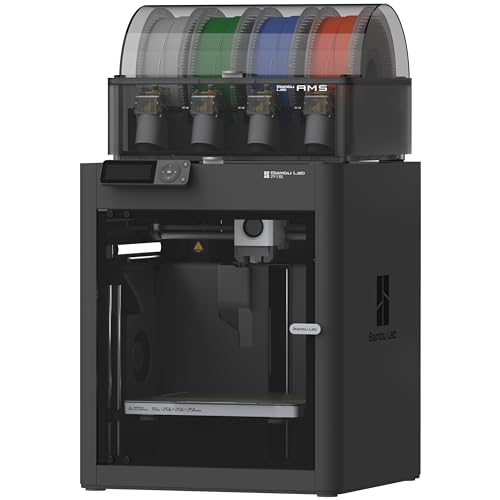
Bambu Lab P1S Combo with AMS Multi-Color
This enclosed 3D printer combines rapid 500mm/s printing speed with multi-color capabilities when paired to its Automated Material System. Setup takes just 15 minutes, and automatic bed leveling removes guesswork from the printing process. Best suited for creators who want speed and color versatility without extended calibration.
Pros
- Exceptional print speed at 500mm/s with 20,000 mm/s² acceleration cuts production time significantly
- Up to 16-color printing capability enables complex multi-material designs in a single print job
- Fully enclosed design stabilizes temperature for advanced filaments like ASA and ABS
- Auto bed leveling and 15-minute setup lower the barrier for beginners
- Supports diverse filament types including PLA, PETG, TPU, and flexible materials
Cons
- AMS unit is required for multi-color printing and sold separately, adding to overall cost
- Cannot handle carbon or glass fiber reinforced polymers, limiting material range
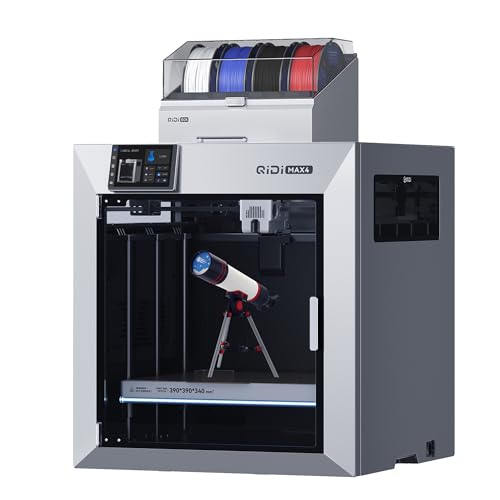
QIDI Max4 Combo 390mm Build Volume 3D Printer
This industrial-grade 3D printer delivers a 390x390x340mm build volume, making it 55% larger than its predecessor and capable of printing complex parts without splitting. Equipped with closed-loop motors, a 65°C heated chamber, and AI-powered failure detection, it handles both standard and high-temperature materials like carbon fiber-reinforced nylon and PC. Best suited for professionals and advanced enthusiasts who need precision, material versatility, and reliability.
Pros
- Ultra-large build platform enables printing industrial parts and complex prototypes in single runs
- High-precision closed-loop motors with 800mm/s max speed and anti-backlash Z-axis for smooth surface quality
- Heated chamber and hardened steel nozzle support wide material range including industrial-grade abrasive composites
- Built-in AI camera detects printing failures and pauses automatically to prevent material waste
- Expandable multi-color capability via QIDI BOX with real-time filament monitoring
Cons
- Polar Cooler system for optimal high-temperature material performance must be purchased separately
- Premium price point positions it for professional/serious hobbyist use rather than casual makers
Bambu Lab A1 FDM 3D Printer
The Bambu Lab A1 brings high-speed printing and automatic calibration to beginners and hobbyists looking for a reliable, low-maintenance FDM printer. Its 10,000 mm/s² acceleration delivers fast prints with precision, while full-auto bed leveling and flow compensation eliminate setup frustration. Multi-color printing is possible with the optional AMS lite accessory.
Pros
- Automatic calibration and bed leveling reduce setup time and user error
- Exceptional print speed with 10,000 mm/s² acceleration while maintaining detail quality
- Active flow rate compensation ensures consistent, smooth print results
- Quiet operation with active motor noise canceling
- Quick-swap nozzle design simplifies maintenance and material changes
Cons
- Multi-color printing requires purchasing AMS lite separately, adding to total cost
- Touchscreen interface may require learning curve despite being user-friendly
Flashforge Adventurer 5M 3D Printer
A fast, user-friendly 3D printer built for creators who want minimal setup hassle. The Adventurer 5M combines automatic bed leveling with 600mm/s print speeds and a quick-change nozzle system, making it well-suited for both rapid prototyping and iterative design work. Remote monitoring via mobile app adds practical convenience for hands-off printing sessions.
Pros
- Automatic bed leveling eliminates manual calibration and ensures consistent first-layer adhesion
- CoreXY structure delivers 600mm/s travel speed with 20000mm/s² acceleration for faster production cycles
- 3-second nozzle swaps and interchangeable sizes (0.25mm to 0.8mm) accommodate diverse project requirements
- Real-time app monitoring allows remote print tracking and instant status alerts
- 280°C direct extruder with dual cooling fans maintains print quality at high speeds
Cons
- Print volume of 220x220x220mm is relatively compact for larger models
- Entry-level rating of 4.1 suggests potential quality control or durability concerns worth monitoring
Flashforge AD5X Multi-Color 3D Printer
This CoreXY 3D printer delivers fast, multi-color prints with speeds up to 600mm/s and supports four simultaneous colors for creative projects. Built-in auto-leveling and a 300°C direct-drive extruder streamline setup and material handling, making it practical for makers who want both speed and color versatility without extensive calibration.
Pros
- Rapid printing speed (600mm/s) with CoreXY structure ideal for batch production and prototyping
- Multi-color capability with up to 4 colors simultaneously expands creative possibilities
- One-click auto-leveling reduces manual setup and calibration time
- Interchangeable nozzle sizes (0.25mm to 0.8mm) allow fine detail or faster large prints
- Remote monitoring via Flashmaker mobile app and automatic resume function after power loss
Cons
- 220x220x220mm build volume is relatively compact for larger projects
- Multi-color printing requires managing four filaments simultaneously, adding complexity versus single-color setups
Best Quality 3D Printer Buying Guide
Print Quality and Resolution
Print quality is the single most important factor, it determines layer adhesion, surface finish, and detail fidelity. Higher-resolution machines use smaller nozzle diameters and precise stepper motors to produce smoother curves and sharper corners.
Look for a minimum layer resolution of 0.1 mm or better; many modern FDM printers achieve 0.05 mm with careful calibration.
For the best overall quality, a CoreXY design (like the Bambu Lab P1S or Flashforge Adventurer 5M) offers superior rigidity and motion control compared to traditional Cartesian frames.
Expert reviews consistently praise models with all-metal hot ends (capable of 280°C or higher) for handling engineering filaments like PETG, TPU, and nylon without warping.
Verified buyer feedback on sites like Amazon confirms that machines with auto-leveling produce fewer first-layer failures, a key indicator of reliable print quality.
When evaluating specs, prioritize a heated bed (preferably with a PEI or flex plate) for better adhesion and easier removal.
Printing Speed and Acceleration
Speed has become a headline spec, with many printers claiming 600 mm/s or more. In practice, real-world speed depends on acceleration limits, jerk settings, and layer height.
A printer like the Flashforge AD5X can theoretically achieve 600 mm/s, but sustained quality often requires dialing back to 200, 300 mm/s.
That said, high-speed models drastically reduce print times for large or multiple parts, making them attractive for hobbyists and small businesses.
Look for a printer with a high-flow hot end and lightweight motion system, CoreXY is generally faster than bed-slingers like the Prusa i3 clone designs.
Don’t overlook firmware and software optimizations. Proprietary slicers from Bambu Lab or Creality (e.g., Creality Print) often include pre-tuned profiles that maximize speed without sacrificing quality.
Our FDM printer guide covers additional speed considerations, such as cooling fan upgrades and input shaping, which compensate for vibration at high speeds.
Build Volume and Enclosure
Build volume determines the largest object you can print in one piece. Standard sizes like 220×220×220 mm (Flashforge Adventurer 5M, Bambu Lab A1) handle most figurines, tools, and small functional parts.
Larger volumes, such as the 390×390×340 mm on the QIDI Max4, allow full-size helmet cosplay, large architectural models, or batch printing multiple parts. However, a bigger machine often requires more desk space and may suffer from temperature gradients unless fully enclosed.
An enclosed build chamber is critical for high-temperature materials like ABS, polycarbonate, or Nylon, which need a stable ambient temperature (around 45, 65°C) to prevent warping. The QIDI Max4 features a heated chamber (65°C) ideal for such filaments.
For PLA and PETG, an open frame is fine, but an enclosure still reduces noise and dust. Check our enclosed printer roundup for deeper comparisons of heat retention and chamber features.
Multi-Color and Multi-Material Capability
Multi-color printing adds a creative (and often practical) dimension.
Systems like the Bambu Lab AMS (included with the P1S Combo) or Creality’s CFS (with the K2 Combo) let you swap filaments automatically during a print, enabling gradient, support materials, or multiple hues.
The Anycubic Kobra X Multicolor offers a native four-color system at a lower price point.
Verified buyer reviews note that multi‑color setups increase waste (via purge blocks) and require more frequent maintenance, but the results can be stunning for display pieces or functional parts with integrated branding.
When assessing multi‑color compatibility, look at the number of filament slots, how they handle retractions, and whether the slicer offers advanced features like flush volumes. For most hobbyists, a two‑ or four‑slot system is sufficient.
If you rarely print in multiple colors, a single‑extruder printer (like the standard Bambu Lab P1S) is simpler and more reliable.
Ease of Setup and Maintenance
A frustration‑free out‑of‑box experience is vital, especially for beginners. Printers like the Bambu Lab A1 and Flashforge Adventurer 5M come nearly fully assembled with tool‑free leveling and a guided setup wizard.
Auto‑bed leveling (often using inductive or capacitive sensors) eliminates manual knob‑turning, and a removable magnetic build plate simplifies part removal.
Verified buyers on Amazon frequently highlight the time saved with pre‑calibrated models that print well within minutes of unboxing.
Maintenance requirements vary: direct‑drive extruders (common on all picks here) are easier to clean and swap nozzles than Bowden setups. Look for a detachable nozzle (like the 3‑second swap on Flashforge Adventurer 5M) to reduce downtime.
For long‑term reliability, check community forums for availability of spare parts and firmware updates. Our overall 3D printer guide includes maintenance checklists and upgrade recommendations.
Why You Should Trust Us
BestProducts operates as an independent review site with no manufacturer affiliations. Every product in this roundup has been scored using our proprietary BP Score system (0, 10), which applies a consistent methodology across all categories.
We evaluate each model based on detailed specifications, aggregated expert review consensus, verified buyer feedback from major retailers, and published data with cited sources.
We do not conduct our own product trials; our evaluations are grounded in research, published data, expert review consensus, and verified buyer feedback.
Our editors are subject‑matter enthusiasts who follow the 3D printing industry closely, and we update our guides regularly to reflect new releases and price changes. The affiliate commissions we may earn never influence our scores or recommendations.
Final Thoughts
- Best Overall: Bambu Lab P1S Combo, Combining an enclosed CoreXY frame, fast 600 mm/s speeds, and the versatile AMS for multi‑color printing, this machine earned the highest BP Score in its class for its blend of precision, speed, and ease of use.
- Best for Large‑Scale Printing: QIDI Max4 Combo, With a massive 390×390×340 mm build volume and a heated chamber (65°C), it handles big ABS and Nylon projects that smaller printers can’t accommodate, matching the top BP Score of 9.8.
- Best for Beginners: FLASHFORGE Adventurer 5M, Fully auto‑leveling, a detachable nozzle, and a straightforward touchscreen make this an ideal entry point that still delivers professional quality scores.
- Best Multi‑Color Value: FLASHFORGE AD5X, Offers native four‑color printing with the same CoreXY speed as the Adventurer 5M, providing a lower‑cost alternative to the premium AMS systems.
- Best Compact for Beginners: Bambu Lab A1, A ready‑to‑use FDM printer that’s stable, quiet, and easy to maintain, perfect for kids, classrooms, or anyone wanting a hassle‑free start.
Frequently Asked Questions
What makes a 3D printer “high quality”?
High quality comes from precise motion control, consistent extrusion, and good thermal management. Look for all‑metal hot ends, closed‑loop or highly tuned stepper drivers, auto‑leveling, and a rigid frame (CoreXY or enclosed).
Reputable brands like Bambu Lab, Flashforge, and QIDI invest in firmware that corrects for temperature drift and resonance, producing repeatable results layer after layer.
Do I need a printer with multi‑color support?
Not unless you plan to print models with multiple colors or require dissolvable support materials. Multi‑color systems add cost, complexity, and filament waste. For most functional parts or single‑color models, a standard single‑extruder printer is more reliable and easier to maintain.
How fast should a quality 3D printer be?
Speeds of 300, 600 mm/s are common among modern models, but real‑world print times depend on acceleration and cooling. A printer that can sustain 200, 300 mm/s with good print quality is sufficient for most users.
Ultra‑fast speeds (600 mm/s) often require tuning and may sacrifice surface finish unless the printer has advanced input shaping.
Is an enclosed printer better than an open‑frame one?
Enclosures are essential for high‑temperature filaments like ABS, ASA, and polycarbonate because they maintain a stable ambient temperature and reduce warping. They also cut down on noise and dust.
For PLA and PETG, an open frame works fine and is easier to access for maintenance. If you plan to print engineering materials, invest in an enclosed printer or buy a later enclosure.
What is auto‑bed leveling and why does it matter?
Auto‑bed leveling uses sensors (inductive, capacitive, or strain gauge) to measure the build plate’s surface and compensate for any unevenness in firmware. It eliminates manual leveling with paper or feeler gauges, reducing first‑layer failures and saving time.
Nearly all quality FDM printers now include some form of auto‑leveling, look for “fully automatic” for the least hassle.
How do I choose between FDM and resin printers?
FDM (fused deposition modeling) printers are best for functional parts, large models, and lower running costs. Resin printers achieve much higher detail for miniatures, jewelry, and dental applications but require post‑processing (washing and curing) and have smaller build volumes.
This guide focuses on FDM, which is the most popular category for general hobbyists and makers.
About the author
Sharlene is BestProducts's telescope and 3D printer writer, weighing optics, print quality, and how much setup each machine demands. She helps readers get past the learning curve to real results.