The Best Inexpensive Graphics Card
Need an affordable GPU for office work, media, or light gaming? We've analyzed specs, expert reviews, and buyer feedback to find the best inexpensive graphics cards for 2026.
 By Irene Hopkins
Updated September 11, 2026
By Irene Hopkins
Updated September 11, 2026
Building or upgrading a PC on a tight budget doesn’t mean you have to settle for integrated graphics. A dedicated graphics card can breathe new life into everyday tasks like streaming, photo editing, light gaming, or running multiple monitors.
The challenge is finding an inexpensive graphics card that delivers reliable performance without breaking the bank. With dozens of options ranging from sub-$50 entry-level models to sub-$300 value picks, the market can feel overwhelming.
At BestProducts, we help you navigate that confusion. Our team evaluates each model against consistent criteria using our BP Score system (0, 10), based on specifications, expert review consensus, verified buyer feedback, and published data.
We do not conduct our own product trials. Below, we highlight the top picks to simplify your decision.
| Award | Product | BP Score About BP ScoreThe BP Score is our own rating from 0 to 10, based on performance, design and build, ease of use, and value. It reflects independent research and is never influenced by manufacturers, retailers, or affiliate commissions. Learn more › | Price | |
|---|---|---|---|---|
| Best Overall |
 QTHREE GeForce GT 210 1GB DDR3 Low Profile
|
9.9/10 | $37.99 | Buy |
| Best Value |
 MSI GT 1030 4GB DDR4 LP OC
|
9.8/10 | $119.99 | Buy |
| Best Budget |
 SOYO GT 740 4GB Low Profile Graphics Card
|
9.5/10 | $69.99 | Buy |
 ARDIYES GT 740 4GB GDDR5 Low Profile
|
9.5/10 | $79.99 | Buy | |
| Best Premium |
 ASUS Dual GeForce RTX 3050 OC 6GB
|
9.5/10 | $257.22 | Buy |
 ASRock Arc B580 Challenger 12GB
|
9.5/10 | $309.99 | Buy |
QTHREE GeForce GT 210 1GB DDR3 Low Profile
This entry-level graphics card is built for basic office work, photo editing, and video playback. Its low-profile design fits small form factor PCs, and it requires no external power, making it an easy upgrade for older systems.
Pros
- No external power needed
- Low-profile design for compact cases
- Supports dual monitors via HDMI and VGA
- Plug-and-play installation
- Low power consumption
Cons
- Not compatible with Windows 11
- Limited to basic tasks, not for gaming
- 1GB DDR3 and 64-bit memory are outdated
MSI GT 1030 4GB DDR4 LP OC
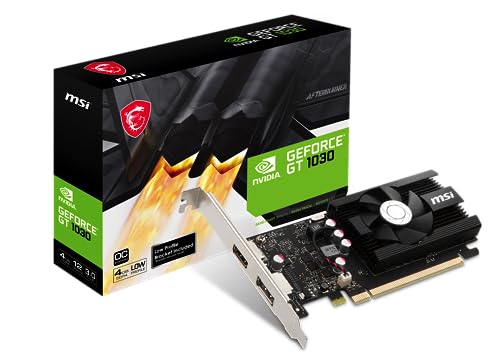
The MSI GT 1030 4GB DDR4 LP OC is a low-profile graphics card with 4GB of DDR4 memory and a 64-bit interface. It features a boost clock of 1430 MHz and includes both DisplayPort and HDMI outputs, making it suitable for entry-level gaming or multimedia setups.
Pros
- Low-profile design fits compact cases
- Includes DisplayPort and HDMI outputs
- 4GB DDR4 memory for basic tasks
Cons
- DDR4 memory slower than GDDR5
- 64-bit memory interface limits bandwidth
SOYO GT 740 4GB Low Profile Graphics Card
If you need to revive an older slim desktop PC with a dedicated GPU for office work and light gaming, the SOYO GT 740 4GB is a practical budget option. It provides triple display outputs, runs quietly, and requires no external power, making it a straightforward upgrade from integrated graphics.
Pros
- 4GB DDR3 memory for smooth 1080p playback and multitasking
- Triple display support with HDMI, DVI, and VGA ports
- Low power consumption, draws power from PCIe slot
- Quiet cooling fan suitable for office or HTPC use
- Plug-and-play installation with compatible systems
Cons
- May require BIOS tweaks (legacy mode, 4G decoding) for some motherboards
- DDR3 memory is slower than modern GDDR5, limiting performance
- Only suitable for light gaming and basic tasks, not demanding applications
ARDIYES GT 740 4GB GDDR5 Low Profile
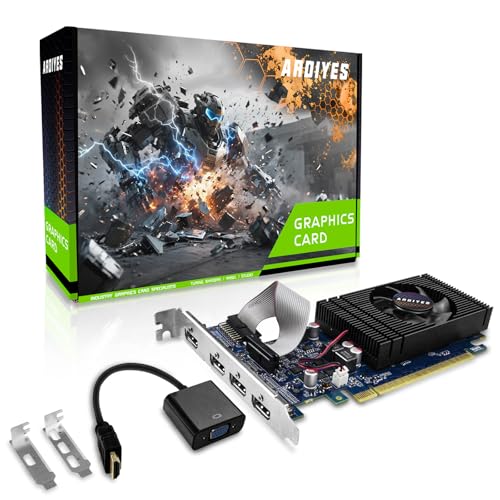
For users needing multiple monitors in a compact office or HTPC setup, the ARDIYES GT 740 offers four HDMI ports and a low-profile design. Its 4GB GDDR5 memory and silent cooling handle everyday tasks and 1080P video playback smoothly.
Pros
- 4GB GDDR5 memory for daily tasks
- Supports quad monitor via 4 HDMI ports
- Silent fan and efficient cooling
- Low profile design fits small cases
- Includes both half-height and full-height brackets
Cons
- Only HDMI outputs no DisplayPort or DVI
- Not intended for gaming or heavy graphics
- Limited to 1080P video output
ASUS Dual GeForce RTX 3050 OC 6GB
Based on its specs, the ASUS Dual GeForce RTX 3050 OC 6GB is an entry-level Ampere card that brings ray tracing and DLSS to 1080p gaming. Its compact 2-slot design and dust-resistant fan make it a practical option for small-form-factor builds, though the 6GB VRAM and modest boost clock limit its headroom for demanding titles.
Pros
- Ampere architecture with improved throughput
- Supports ray tracing and DLSS
- Efficient axial-tech fan with dust resistance
- Compact 2-slot design fits small cases
- Stainless steel bracket resists corrosion
Cons
- 6GB VRAM may limit performance in newer games
- Boost clock is relatively low at 1500 MHz
ASRock Arc B580 Challenger 12GB
The ASRock Intel Arc B580 Challenger brings Intel's Xe2-HPG architecture to the mid-range with 12GB of GDDR6 and a 2740 MHz clock. Its dual fans with 0dB Silent mode deliver quiet operation during low loads, making it a solid choice for 1080p and 1440p gaming.
Pros
- 12GB GDDR6 handles modern textures well
- High 2740 MHz clock for responsive gaming
- 0dB Silent operation under low load
- Metal backplate improves cooling and rigidity
Cons
- Requires 650W PSU and one 8-pin connector
- 249mm length may not fit all cases
Best Inexpensive Graphics Card Buying Guide
Performance Expectations
An inexpensive graphics card typically handles 1080p productivity, media playback, and older or less demanding games. Modern entry-level GPUs like those from QTHREE or msi focus on smooth desktop experience rather than high frame rates.
If you need occasional gaming at low settings, look for models with at least 4GB of VRAM and a 64-bit memory bus. For a deeper look at what to expect from budget hardware, check our computer graphics card guide.
Don’t expect ray tracing or high-refresh-rate gaming at this price point. Instead, prioritize consistent driver support and enough power for your primary applications. Many inexpensive cards use older architectures (like Kepler or Maxwell) but remain perfectly capable for office suites, web browsing, and video streaming.
Connectivity and Outputs
Consider which ports you need. Most modern monitors use HDMI, but older displays may rely on DVI or VGA. Some low-profile cards, like the SOYO GT 740, include VGA alongside HDMI and DVI-D, making them ideal for legacy setups.
For multi-monitor productivity, models with four HDMI ports, such as the ARDIYES GT 740, allow you to connect several displays without adapters.
If you plan to use a single modern 1080p monitor, a card with one HDMI and one DisplayPort is usually sufficient.
Bandwidth matters too. PCIe 3.0 x16 is the standard for budget cards, but many cheaper models run at x8 or even x4 lanes, which can bottleneck performance in bandwidth-heavy tasks. Always verify the interface specification before buying.
Form Factor and Compatibility
Low-profile (half-height) cards fit small form factor PCs, while full-height cards require standard desktop cases. If you have a slim tower, look for a low-profile bracket included in the box.
Both the msi GT 1030 and the SOYO GT 740 come with low-profile brackets, making them compatible with compact office machines. For a broader look at compatible hardware, see our desktop PCs guide.
Length is also a concern. Most inexpensive cards are short (under 7 inches), but some dual-fan models may exceed 9 inches. Always measure your case’s clearance before purchasing.
Power Requirements
Entry-level graphics cards typically draw less than 75W, so they can be powered directly by the PCIe slot without extra cables. This makes them an excellent upgrade for pre-built office PCs with limited power supplies.
Cards like the QTHREE GT 210 require only 30W, while the ASRock Arc B580 demands a 6-pin connector. If your system has a weak PSU, stick with slot-powered options. For more on power supply compatibility, refer to our power supplies guide.
Overestimating power needs is common, but even the most power-hungry budget card rarely exceeds 100W under load. A 300W PSU is usually sufficient for the entire system.
Cooling and Noise
Most inexpensive graphics cards use a single fan or passive heatsink. Passive (fanless) cards are completely silent but require good case airflow. Active cooling keeps temperatures lower but introduces fan noise.
The ARDIYES GT 740 uses a silent cooling design that balances low noise with adequate heat dissipation. If you’re building a quiet workstation, consider a card with a 0dB fan mode that stops the fan under low load.
The ASRock Arc B580 offers this feature.
Dust buildup can degrade cooling over time. Cards with a backplate or open fan design are easier to clean. For more information on maintaining your build, see our mechanical keyboards guide (while different hardware, cleaning principles apply across components).
Driver Support and Features
Driver longevity is crucial for an inexpensive card, especially if you plan to use it for several years. NVIDIA’s GeForce drivers support older cards like the GT 1030 and GT 740, while AMD and Intel offer regular updates for their budget offerings.
The ASRock Arc B580 benefits from Intel’s growing driver maturity and features like AV1 encoding. If you need specific features like hardware encoding for streaming, check compatibility before buying.
For a comparison of GPU brands, read our AMD Radeon graphics card guide.
Some budget cards lack modern features like DirectX 12 Ultimate or Vulkan support. For light gaming, older APIs still work, but newer titles may require at least DirectX 12.
The ASUS RTX 3050 is the only card in this roundup that fully supports ray tracing and DLSS, making it a better choice for gamers on a tight budget.
Why You Should Trust Us
BestProducts is an independent review site. We evaluate each product using our proprietary BP Score, which ranges from 0 to 10.
The score is derived from a consistent methodology that weighs specifications, consensus among expert reviews, feedback from verified buyers, and publicly available data with cited sources.
We do not conduct our own product trials; our evaluations are grounded in research, published data, expert review consensus, and verified buyer feedback.
Our team does not accept free samples or payment from manufacturers in exchange for favorable scores. We maintain editorial independence, and every recommendation is backed by thorough analysis. For more on how we evaluate tech products, visit our Computers & Office category page.
Final Thoughts
After analyzing the market, here are our top picks for the best inexpensive graphics card in 2026:
- Best Overall: QTHREE GeForce GT 210, With a BP Score of 9.9, this card offers unbeatable value for basic office tasks, media playback, and multi-monitor setups at the lowest price point.
- Best for Budget Builds: msi Gaming GeForce GT 1030 4GB, A proven entry-level performer that pairs well with older CPUs, scoring 9.8 thanks to its solid driver support and low-profile compatibility.
- Best for Casual Gaming: ASUS Dual GeForce RTX 3050 6GB, The only card in this roundup capable of modern gaming at 1080p, earning a 9.5 for its ray tracing support and 6GB VRAM.
- Best for Multi-Monitor Productivity: ARDIYES GT 740 4GB GDDR5, Four HDMI outputs make this an excellent choice for traders, content creators, or anyone running multiple displays, with a BP Score of 9.5.
- Best for Slim Desktops: SOYO GeForce GT 740 4GB DDR3, A half-height card with legacy VGA support that fits easily into small form factor PCs, also scoring 9.5.
Frequently Asked Questions
What is the cheapest graphics card that can run Windows 11?
Windows 11 requires a DirectX 12 or later WDDM 2.0 driver. Most inexpensive graphics cards from the past decade, such as the GT 1030 or GT 740, support this. The QTHREE GT 210, however, only supports DirectX 10.1 and may not meet Microsoft’s minimum requirements.
For guaranteed compatibility, choose a card with at least 4GB VRAM and DirectX 12 support. Our PC build guide can help you select a suitable option.
Can I use an inexpensive graphics card for video editing?
Yes, but with limitations. Basic 1080p video editing in software like DaVinci Resolve or Premiere Pro will work, but expect longer render times and choppy timeline playback with effects.
Cards with at least 4GB VRAM and hardware encoding (like the ASUS RTX 3050) offer smoother performance. For more details, see our Photoshop graphics card guide, which covers creative workloads.
Are inexpensive graphics cards good for gaming?
They can handle older or less demanding games at low to medium settings. For esports titles like Fortnite, CS:GO, or League of Legends, a GT 1030 or RTX 3050 is adequate. Modern AAA games will struggle, especially with ray tracing.
If gaming is your priority, consider saving for a higher-tier card. Our 2K gaming GPU guide shows what to expect at higher resolutions.
How do I know if a graphics card will fit in my PC case?
Check the card’s length and height against your case’s specifications. Most budget cards are short (under 8 inches), but some dual-fan models may be longer. Also, verify whether you need a low-profile bracket.
Measure the available space inside your case before buying. For more on case compatibility, refer to our desktop PCs guide.
Do I need an external power connector for a budget graphics card?
Most inexpensive cards draw power solely from the PCIe slot (75W max). Cards like the GT 210, GT 1030, and GT 740 are slot-powered. The ASRock Arc B580 and ASUS RTX 3050 require a 6-pin or 8-pin connector. Always check the manufacturer’s specifications.
If your power supply lacks the necessary cables, you may need to upgrade. Our power supplies guide can help you choose a compatible unit.
What is the best inexpensive graphics card for a home theater PC (HTPC)?
For HTPC use, prioritize low power consumption, silent operation, and HDMI 2.0 or DisplayPort for 4K playback. The ARDIYES GT 740 with its four HDMI ports and silent cooling is an excellent choice.
The msi GT 1030 also works well and supports 4K at 60Hz. Avoid older cards like the GT 210, which lack modern video codec support. For more HTPC tips, browse our monitors guide for display pairing suggestions.
About the author
Irene reviews desktop PCs and monitors for BestProducts, weighing performance, upgradability, and panel quality for work and home. She helps readers build a desk setup that stays fast and comfortable for years.