The Best Tent Air Conditioner
Find the best Tent Air Conditioner with our comprehensive buying guide.
 By Catherine Arnold
Updated September 12, 2026
By Catherine Arnold
Updated September 12, 2026
Camping in the heat can quickly turn a relaxing getaway into an uncomfortable experience. A dedicated tent air conditioner makes a significant difference, allowing you to sleep soundly and enjoy your outdoor adventure even during the hottest months.
Whether you are car camping with the whole family or setting up a bivouac tent for a solo trip, a portable AC unit can transform your tent into a cool sanctuary.
In this guide, we have researched and evaluated the best tent air conditioners on the market, focusing on cooling power, power source flexibility, portability, and real-world user feedback.
We do not conduct our own product trials; our evaluations are grounded in research, published data, expert review consensus, and verified buyer feedback.
After comparing top models, we have selected the ones that offer the best performance and value for different camping styles.
From compact units perfect for a single tent to powerful options that can cool a large family shelter, the right air conditioner depends on your specific needs.
Below, you will find our top picks, each scored using our 0, 10 BP Score based on specs, expert consensus, and buyer satisfaction. Keep reading for a detailed buying guide and answers to common questions about tent ACs.
| Award | Product | BP Score About BP ScoreThe BP Score is our own rating from 0 to 10, based on performance, design and build, ease of use, and value. It reflects independent research and is never influenced by manufacturers, retailers, or affiliate commissions. Learn more › | Price | |
|---|---|---|---|---|
| Best Overall |
 GETUHAND 5200BTU Portable Tent AC
|
9.8/10 | $299.00 | Buy |
| Best Budget |
 BAYKUL 5000 BTU Portable Camping AC
|
9.8/10 | $299.99 | Buy |
| Best Value |
 Wszrfozn 7000 BTU Portable Camping AC
|
9.8/10 | $429.99 | Buy |
 Outohome 5200 BTU Portable AC
|
9.6/10 | $399.99 | Buy | |
| Best Premium |
 FO-KOKO 6800 BTU Dual Hose Portable AC
|
9.6/10 | $469.99 | Buy |
 OUTOHOME 5100 BTU Tent AC
|
9.5/10 | $369.99 | Buy | |
 Cybertake S2 Pro Portable 5100 BTU AC
|
9.5/10 | $779.00 | Buy |
GETUHAND 5200BTU Portable Tent AC
This portable air conditioner from GETUHAND uses dual-loop water cooling to produce airflow 3.6°F colder than standard units, and its 5200BTU compressor can cool 130 square feet quickly. It runs quietly in sleep mode at just 45dB, requires no drainage under 70% humidity, and is designed to work directly from its carry bag, making it a solid choice for tents, RVs, and small spaces.
Pros
- Dual-loop water cooling for colder airflow
- 5200BTU cools 130 sq.ft quickly
- Ultra-quiet sleep mode at 45dB
- Drain-free under 70% humidity
- Compact, works in carry bag
Cons
- Relatively heavy at 35.8 pounds for a portable unit
- Manual drainage may be needed in humidity over 70%
BAYKUL 5000 BTU Portable Camping AC
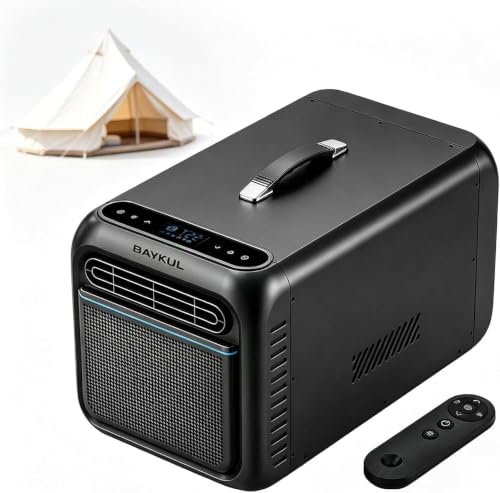
This 5000 BTU portable air conditioner provides rapid cooling for tents, RVs, and small rooms, with a claimed temperature drop of up to 60°F. It offers multiple modes including dehumidification and a quiet sleep mode, and its compact size and handle make it easy to move. Best suited for campers or those needing spot cooling without permanent installation.
Pros
- Rapid cooling performance
- Compact and portable with handle
- Quiet operation in sleep mode
- Built-in dehumidification
- Multiple operating modes
Cons
- Heavy at 27.3 pounds
- Requires AC power outlet
- Large for very small tents
Wszrfozn 7000 BTU Portable Camping AC
This compact 33-pound portable AC brings 7000 BTU of cooling to tents, RVs, and small rooms with a 4-in-1 design including Cool, Dry, Sleep, and Fan modes. Its ultra-low 58dB sleep mode and quick 5-minute temperature drop make it a practical choice for campers seeking quiet, efficient relief in hot climates.
Pros
- Ultra-compact and lightweight at 33 lbs
- 7000 BTU cools tent in 5 minutes
- 58dB noise level in sleep mode
- Drain-free auto dehumidifying below 70% humidity
- 4 versatile modes plus remote control
Cons
- Rated power under 550W may limit cooling in large spaces
Outohome 5200 BTU Portable AC
This portable air conditioner delivers fast cooling with a 5200 BTU compressor that can lower room temperature by 18°F in five minutes. Its compact 31-pound design and four modes make it suitable for camping, RVs, and small indoor spaces.
Pros
- Fast cooling performance
- Energy efficient under 400W
- Compact and portable
- Quiet sleep mode at 46-50dB
- Drainage-free in low humidity
Cons
- Requires drain pipe above 70% humidity
- Cooling mode noise level not specified
FO-KOKO 6800 BTU Dual Hose Portable AC
This dual hose portable AC offers faster cooling and heating in a compact 34lb package, ideal for tents, RVs, and vans. Its 45dB sleep mode and multi-power compatibility make it a versatile choice for off-grid adventures.
Pros
- Dual hose design cools 50% faster
- Rapid cooling in 30 seconds, heating in 60 seconds
- Ultra-quiet 45dB operation in sleep mode
- Lightweight 34lb with carry bag for portability
- Works with AC, power stations, and EV V2L
Cons
- Requires external power source or adapter for EV
- 6800 BTU cooling limited to small enclosed spaces
OUTOHOME 5100 BTU Tent AC
This portable air conditioner from OUTOHOME is built for camping and outdoor spaces up to 200 sq ft, delivering 5100 BTU of cooling power. It offers four modes (cool, dehumidify, fan, sleep) with an ultra-quiet 46dB sleep setting, a 24-hour timer, and auto-evaporation that eliminates manual draining. At 35 pounds with a carrying handle, it’s easy to move between tent, RV, or home.
Pros
- Fast cooling for tents up to 200 sq ft
- Hushed 46dB sleep mode for quiet nights
- Multiple modes for versatile comfort
- No manual water emptying needed
- Portable with easy-carry handle
Cons
- Weighs 35 lbs, not the lightest portable AC
- Requires 110V AC power, no battery option
- Bulky dimensions for very small tents
Cybertake S2 Pro Portable 5100 BTU AC
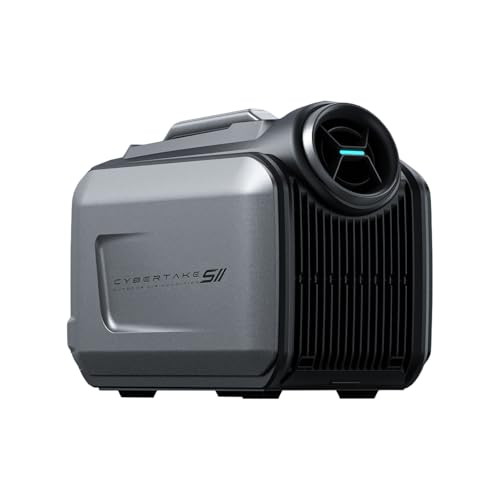
This portable unit delivers both cooling and heating for spaces up to 130 square feet. Its 3-way power compatibility with AC wall outlets, vehicle ports, or DC power stations makes it ideal for off-grid camping or RV use.
Pros
- Versatile power options for any setup
- Effective heating and cooling for tents or RVs
- Energy-efficient Eco+ mode
- Weather-resistant IPX4 rated construction
- Compact and lightweight at 25.6 pounds
Cons
- Requires separate purchase of remote control and boost converter
- 5-10 minute startup delay for cooling
Best Tent Air Conditioner Buying Guide
Cooling Capacity (BTU)
The cooling power of a tent air conditioner is measured in BTUs (British Thermal Units). For most camping tents, a unit between 5,000 and 7,000 BTU is sufficient.
A 5,000 BTU model can cool a small to medium tent (up to about 150 square feet), while a 7,000 BTU unit is better for larger family tents or RVs.
Keep in mind that tents are not as insulated as homes, so you may need a slightly higher BTU rating if you camp in extremely hot climates or use a heavy duty tent that traps more heat.
Overly powerful units can cycle on and off too quickly, wasting energy, so match the BTU to your tent size.
When choosing a BTU rating, also consider the ambient temperature. If you often camp in places where temperatures exceed 95°F, a 6,000, 7,000 BTU model will provide more consistent cooling. For mild summer nights, a 5,000 BTU unit may be plenty.
Check the product specifications for the recommended room size, and remember that tents with dark fabric absorb more heat.
Power Source and Battery Options
Tent air conditioners come with different power options: AC wall outlets, DC vehicle ports, or built-in batteries. If you camp at sites with electrical hookups, a standard AC unit is fine.
For boondocking or off-grid camping, look for a model that can run on a 12V or 48V battery, such as the Cybertake S2 Pro, which offers three-way power.
Battery-powered units are more portable but have limited runtime, typically 4, 8 hours on a full charge. If you plan to use a solar generator, ensure the AC’s wattage is compatible.
For example, a 400W unit like the GETUHAND can run on a small portable power station.
When camping in remote areas, a battery-powered AC can be a game-changer. However, consider the weight: units with built-in batteries are heavier.
If you hike to your campsite, a lighter unit that runs on a separate power bank might be better. For car camping, weight is less of a concern. Always verify the battery capacity and recharge time before purchasing.
Portability and Size
A tent air conditioner should be easy to transport and set up. Most portable units weigh between 20 and 40 pounds. Compact models like the BAYKUL 5000 BTU are ideal for small tents and can be placed on a table or the ground.
Larger units with dual hoses may take up more space but offer better efficiency. Look for models with handles or wheels for easy movement.
If you frequently switch campsites, a lightweight, drain-free unit (like the GETUHAND) saves you from dealing with water collection.
For a 10-person instant tent, you will likely need a larger unit, but consider how you will transport it in your vehicle.
Also consider the footprint inside the tent. Some ACs are designed to sit partially outside, with an exhaust hose venting out a window or door flap. This saves interior space. Others are fully self-contained.
For tents with limited floor area, a split design or a unit with a separate exhaust hose is preferable. Check the tent’s window size to ensure compatibility.
Noise Level
Noise can be a major factor when sleeping. Most tent ACs produce between 45 and 55 decibels, comparable to a quiet conversation or a fan. Some models, like the OUTOHOME 5100 BTU, are advertised as quiet and include a sleep mode.
If you are sensitive to noise, look for units with a low decibel rating or variable fan speeds. Keep in mind that dual-hose units often run slightly louder due to two fans.
Reading verified buyer feedback can give you a realistic idea of how loud a unit is inside a tent.
For a family tent for cold weather where you might use the AC in summer, noise is less of an issue because the larger space disperses sound.
If you need absolute silence, consider using a portable AC with a separate compressor that can be placed outside the tent, though these are less common.
Many campers find that a constant hum is preferable to the sounds of nature when trying to sleep. Always check the product specifications for noise levels.
Additional Features: Heating, Drain-Free, and Timer
Some tent air conditioners also offer heating, making them usable in cooler weather. Models like the FO-KOKO 6800 BTU and Cybertake S2 Pro include both cooling and heating functions, which is great for shoulder-season camping.
Drain-free operation is another convenient feature, units that evaporate condensate internally save you from emptying a water tank. The GETUHAND and OUTOHOME models are drain-free, reducing maintenance.
A programmable timer allows you to set the AC to turn off after a few hours, saving battery or energy.
For lightweight backpacking tents, any extra weight from these features might not be worth it, but for car camping, they add comfort.
Other features to consider include remote control, LED display, and compatibility with smart plugs. Some units have a 24-hour timer, which is handy for overnight use.
If you camp in humid areas, a drain-free model prevents water spills inside the tent. Always check if the unit requires a dedicated exhaust hose or if it can be used with a window adapter.
The best tent air conditioner for you will balance these features with your camping habits.
Why You Should Trust Us
BestProducts is an independent review site that does not accept free products or payments from manufacturers for favorable reviews. We score every product using our proprietary BP Score, which ranges from 0 to 10.
This score is based on a consistent set of criteria: technical specifications, consensus from expert reviews, verified buyer feedback, and published data from reliable sources.
We do not conduct our own product trials; our evaluations are grounded in research, published data, expert review consensus, and verified buyer feedback. Our goal is to provide transparent, trustworthy recommendations that help you make an informed purchase.
When you buy through links on our site, we may earn a small commission, but this does not affect our editorial independence.
Final Thoughts
- Best Overall: GETUHAND Portable Tent Air Conditioner, With a 5200 BTU cooling capacity, drain-free design, and an excellent balance of price and performance, this model earned one of the highest BP Scores in our analysis. It is quiet, efficient, and easy to set up, making it suitable for most camping trips.
- Best for Large Tents: Wszrfozn 7000 BTU Portable Camping Air Conditioner, If you need extra cooling power for a spacious family tent or RV, this 4-in-1 unit delivers fast cooling and covers up to 200 square feet. Its high BP Score reflects strong user satisfaction and expert consensus.
- Best Value: BAYKUL Portable Camping Air Conditioner 5000 BTU, At a lower price point, this compact unit still offers solid performance and a 9.8 BP Score. It is ideal for small to medium tents and provides great value for budget-conscious campers.
- Best Dual-Hose System: FO-KOKO Dual Hose 6800 BTU Portable Tent Air Conditioner & Heating, For those who want efficient cooling and heating, this dual-hose model minimizes heat loss and offers powerful performance. Its BP Score of 9.6 makes it a top contender for all-season camping.
Remember to consider your tent size, power source availability, and portability needs when choosing. All of our picks have been vetted through rigorous research and buyer feedback, ensuring you get a reliable tent air conditioner for your next adventure.
For more outdoor gear recommendations, explore our Sports & Outdoors category.
Frequently Asked Questions
What size tent air conditioner do I need?
The required BTU depends on your tent’s square footage. For tents under 100 sq ft, a 5,000 BTU unit is sufficient. For 100, 200 sq ft, consider 6,000, 7,000 BTU. If you camp in extreme heat or use a dark-colored tent, you may need more power.
Always check the manufacturer’s recommended room size. If you are using a waterproof 2-man tent, a smaller unit will work well.
Can I run a tent AC with a battery or generator?
Yes, many tent ACs can run on a battery (12V, 48V) or a portable generator. Some models, like the Cybertake S2 Pro, offer three-way power options.
Battery runtime varies; for example, a 1 kWh battery can power a 400W unit for about 2.5 hours. For longer use, consider a solar generator or a larger battery bank. Always check the AC’s power draw and your battery’s capacity.
Is a dual-hose tent AC better than a single-hose?
Dual-hose models are generally more efficient because they use one hose to bring in outside air for cooling the compressor and another to exhaust hot air. This reduces negative pressure inside the tent and improves cooling performance.
Single-hose units are simpler and lighter but may draw cool air from the tent, creating a slight vacuum. For larger tents or hot climates, dual-hose is recommended. For small tents, a single-hose can be sufficient.
How do I exhaust hot air from a tent AC?
Most portable tent ACs come with an exhaust hose that must be vented outside through a window, door flap, or a specially designed tent port. Some tents have a zippered vent for this purpose.
If your tent lacks a port, you can use a window adapter or simply open a small flap and seal around the hose. Ensure the hose is not kinked to maintain airflow.
For tents with mesh windows, a piece of foam or fabric can help create a seal. If you are using a tent for beach camping, be mindful of sand getting into the exhaust.
Are tent air conditioners noisy?
Most tent ACs produce between 45 and 55 dB, which is similar to a household fan or a quiet conversation. Some models have a sleep mode that reduces fan speed and noise.
If you are a light sleeper, look for units specifically advertised as quiet (e.g., the OUTOHOME 5100 BTU). You can also place the AC on a soft surface to dampen vibrations.
Keep in mind that any mechanical device will make some sound, but many campers find it helps mask outdoor noises.
Do I need a drain-free tent AC?
Drain-free models evaporate condensation automatically, so you do not have to empty a water tank. This is convenient for camping, as you may not have a drain location. However, in very humid conditions, some moisture may still accumulate.
Drain-free units are typically more expensive but reduce maintenance. If you camp in dry climates, a standard drain model is fine; just be prepared to empty the tank regularly.
About the author
Catherine writes about tents and sleeping bags for BestProducts, weighing weather protection, packed weight, and honest temperature ratings. She helps campers stay dry and warm from the backyard to the backcountry.