The Best Selling Telescope Lens Set
We researched the top telescope eyepiece sets, evaluating focal lengths, lens coatings, and included accessories to help you find the perfect kit for your stargazing needs.
 By Sharlene Rose
Updated September 11, 2026
By Sharlene Rose
Updated September 11, 2026
Stargazing is a rewarding hobby that brings the wonders of the universe into view. The right telescope lens set can dramatically improve your viewing experience, offering sharper images and greater versatility across different celestial objects.
Whether you’re a beginner looking to upgrade from a basic eyepiece or an experienced astronomer building a complete kit, choosing the best selling telescope lens set requires understanding key factors like focal length, lens coatings, and compatibility with your telescope.
In this guide, we have analyzed specifications, expert reviews, and verified buyer feedback to rank the top telescope eyepiece sets available today, helping you make an informed decision.
BestProducts evaluates each product against consistent criteria and assigns a BP Score on a 0 to 10 scale, based on thorough research rather than hands‑on evaluation. Our methodology ensures that every recommendation is backed by reliable data and real‑world consensus.
Below you’ll find our top picks for the best selling telescope lens set, each chosen for its performance, value, and user satisfaction.
| Award | Product | BP Score About BP ScoreThe BP Score is our own rating from 0 to 10, based on performance, design and build, ease of use, and value. It reflects independent research and is never influenced by manufacturers, retailers, or affiliate commissions. Learn more › | Price | |
|---|---|---|---|---|
| Best Overall |
 SVBONY 4mm/10mm/23mm Eyepiece Set
|
9.9/10 | $39.99 | Buy |
| Best Value |
 Starboosa 1.25-Inch Eyepiece Set with Barlow
|
9.8/10 | $63.59 | Buy |
| Best Premium |
 CELTICBIRD 1.25" Telescope Accessory Kit
|
9.8/10 | $149.99 | Buy |
| Best Budget |
 SVBONY 40mm Plossl Eyepiece
|
9.8/10 | $19.94 | Buy |
 Astromania 14-Piece Eyepiece Kit 1.25"
|
9.6/10 | $139.97 | Buy | |
 SVBONY SV233 7-Piece Eyepiece Set
|
9.5/10 | $49.49 | Buy | |
 Celticbird 8-Piece 1.25" Telescope Eyepiece Kit
|
9.5/10 | $65.99 | Buy | |
 SVBONY SV233 12-Piece Telescope Eyepiece Kit
|
9.5/10 | $152.99 | Buy | |
 starboosa 4mm 10mm 20mm Eyepiece Set
|
9.4/10 | $31.04 | Buy |
SVBONY 4mm/10mm/23mm Eyepiece Set
This SVBONY three-piece eyepiece set (4mm, 10mm, 23mm) offers a 62-degree apparent field of view with aspherical lenses to reduce aberrations. Fully multi-coated optics enhance light transmission for brighter views of both planetary and deep-space objects. It's a versatile upgrade for 1.25-inch focuser telescopes, though you should verify magnification limits for your scope.
Pros
- Wide 62-degree apparent field for immersive views
- Aspherical lenses minimize spherical aberration and coma
- Fully multi-coated for high light transmission
- Standard 1.25-inch barrel fits most telescopes
- Anti-lost design prevents eyepiece from slipping off
Cons
- Only three focal lengths included
- Requires compatibility check with your telescope's specifications
- No carrying case or storage box mentioned
Starboosa 1.25-Inch Eyepiece Set with Barlow
Astronomy enthusiasts looking for an all-in-one eyepiece solution will appreciate this Starboosa set. It includes 4mm, 10mm, and 20mm eyepieces, a 5x Barlow lens, and four filters (two moon and two polarizing) for versatile viewing. The soft eyecups and multi-coated optics aim to make extended observation sessions more comfortable and detailed.
Pros
- Includes 4mm, 10mm, and 20mm eyepieces plus 5x Barlow
- Comes with moon and polarizing filters for contrast
- Soft eyecups reduce stray light and improve comfort
- Multi-coated optical glass for sharp, clear images
- Compatible with most 1.25-inch telescopes
CELTICBIRD 1.25" Telescope Accessory Kit
This kit bundles five Plossl eyepieces, a 2X Barlow lens, and seven filters in a sturdy metal case, offering a versatile foundation for lunar and planetary observation. It's a practical option for telescope owners looking to expand their accessory collection without buying items separately.
Pros
- Includes five Plossl eyepieces from 40mm to 6mm
- 2X Barlow lens doubles eyepiece magnification
- Seven filters for planetary detail and moon viewing
- Sturdy metal carry case with foam lining
- Good value compared to buying components individually
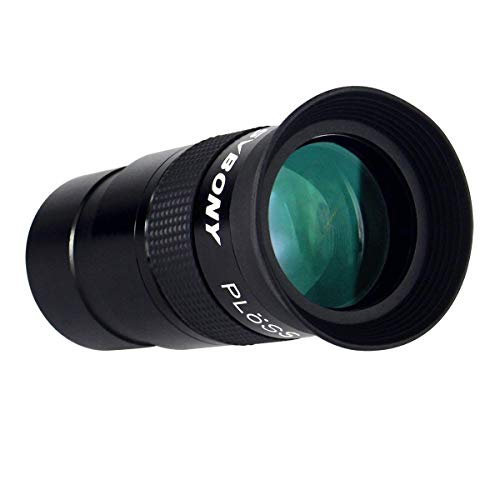
SVBONY 40mm Plossl Eyepiece
This SVBONY 40mm Plossl eyepiece delivers a 40° apparent field of view for lunar, planetary, and deep-sky views. Its fully multi-coated optics and all-metal body provide solid performance for beginners and casual observers.
Pros
- Fully multi-coated optics
- Sturdy metal construction
- Fold-down rubber eyeguard for eyeglass wearers
- Includes plastic carrying case
Cons
- Narrow 40° apparent field of view
Astromania 14-Piece Eyepiece Kit 1.25"
This kit bundles five Plossl eyepieces, a 2x Barlow, six color filters, and a moon filter - a comprehensive set for beginning astronomers. It's a convenient all-in-one solution for exploring the moon and planets with any 1.25-inch telescope.
Pros
- wide selection of eyepieces and filters included
- convenient portable case for organization
- affordable way to build a complete accessory set
- multicoated optics help reduce reflections
Cons
- relatively heavy (3.9 lbs) and bulky case
- Plossl eyepieces offer only a narrow 50-degree field of view
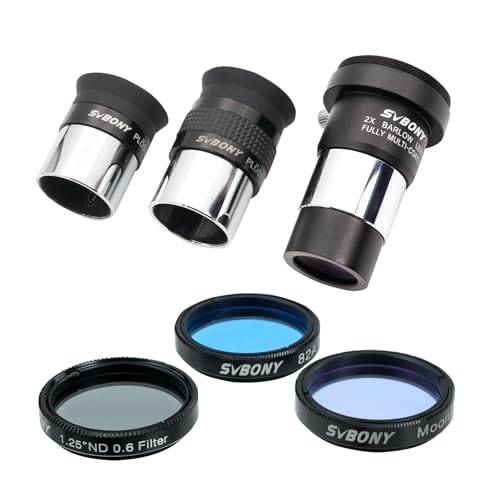
SVBONY SV233 7-Piece Eyepiece Set
This 7-piece kit from SVBONY delivers versatile magnification for lunar and planetary viewing with fully-coated 6mm and 17mm Plossl eyepieces plus a 2x Barlow lens. It includes moon and light-pollution filters to improve contrast, and a portable bag for storage. Ideal for astronomers who want multiple options, but the narrow 48-degree field and potential dimness at high power require a compatible telescope.
Pros
- Fully-coated optics enhance light transmission
- Includes 6mm and 17mm Plossl eyepieces plus 2x Barlow
- Moon, 82A, and ND4 filters for contrast
- Portable bag protects accessories during transport
Cons
- Narrow 48-degree field of view
- 6mm eyepiece may be dim on small telescopes
- Magnification limited by telescope aperture
Celticbird 8-Piece 1.25" Telescope Eyepiece Kit
This accessory kit bundles three Plossl eyepieces, four color and moon filters, and a 2X Barlow lens in a portable aluminum case. It's a practical set for enhancing planetary and deep-sky views with any 1.25-inch telescope.
Pros
- Includes three eyepieces for different magnifications
- 2X Barlow lens adds flexibility to eyepiece set
- Color filters help reveal planetary surface details
- Portable aluminum case protects accessories
- T-adapter enables DSLR astrophotography
Cons
- Filters may have limited use beyond basic color enhancement
- Case size may not fit larger eyepieces or accessories
SVBONY SV233 12-Piece Telescope Eyepiece Kit
This comprehensive 12-piece accessory kit expands your telescope's capabilities with four eyepieces (including a 7-21mm zoom and a 3.2mm ultra-wide), a 2x Barlow lens, and multiple filters for lunar, planetary, and glare reduction. The included foam-lined case keeps everything organized, making it a practical upgrade for amateur astronomers.
Pros
- Includes zoom eyepiece for variable magnification
- 2x Barlow lens for doubling focal length
- Moon filter enhances contrast without color shift
- Color filters for bringing out planetary details
- Variable polarizer reduces glare from bright objects
starboosa 4mm 10mm 20mm Eyepiece Set
This set from starboosa includes three focal lengths for versatile viewing of celestial objects. The multi-coated optics and soft eyecups aim to provide clear, comfortable observation.
Pros
- Includes 4mm, 10mm, and 20mm focal lengths
- Multi-coated optics for improved clarity
- Soft eyecups for comfortable viewing
- Compatible with 1.25 inch telescopes
Cons
- Limited information on build quality
Best Selling Telescope Lens Set Buying Guide
Focal Length and Magnification
The focal length of an eyepiece determines its magnification when paired with your telescope.
Shorter focal lengths (e.g., 4mm or 6mm) provide higher magnification, ideal for planetary observation, while longer focal lengths (20mm to 40mm) offer wider fields of view for deep‑sky objects like star clusters and nebulae.
A quality telescope lens set typically includes a range of focal lengths, allowing you to adapt to different targets. For most beginners, a set covering 10mm to 20mm is a versatile starting point.
When evaluating sets, consider the eyepiece’s apparent field of view (AFOV). Wider AFOV (e.g., 62° or 66°) provides more immersive views and reduces the need to constantly reposition your telescope.
Many top‑rated sets, like those from SVBONY, include wide‑angle designs that enhance the observing experience. For a deeper dive into choosing the right telescope, read our guide on The Best Telescope for Stargazing in 2026.
Lens Quality and Coatings
Optical quality is paramount. Look for eyepieces with fully multi‑coated lenses, which reduce reflections and increase light transmission for brighter, contrast‑rich images. Magnesium fluoride or broadband anti‑reflective coatings are common in premium sets.
Plastic lenses should be avoided; fully glass optics with proper coatings ensure durability and performance. Verified buyer feedback often highlights coatings as a key differentiator between mediocre and excellent kits.
Plossl designs are a reliable standard, offering good eye relief and sharpness at a reasonable price. More advanced designs like wide‑angle or ultra‑wide configurations may cost more but provide superior edge‑to‑edge sharpness.
Always check product specifications for coating details and lens material before purchasing.
Compatibility and Mount Size
Most telescope eyepiece sets use the standard 1.25‑inch barrel diameter, which fits the vast majority of consumer telescopes. Some sets also include a 2‑inch adapter or eyepieces for larger focusers, but for compatibility, 1.25″ is the safest bet.
Ensure your telescope’s focuser and diagonal can accept the eyepieces you plan to buy. If you have a smaller scope, a set with lightweight eyepieces may be preferable to avoid balance issues.
Additionally, consider whether the set includes a Barlow lens. A 2x Barlow effectively doubles the magnification of any eyepiece, giving you more versatility without needing extra pieces.
Many comprehensive kits include a Barlow and filters (e.g., moon filter, color filters) to expand your observing options.
For storing and transporting your gear, a sturdy case is essential; check out The Best Telescope Bag for Every Astronomer for recommendations.
Included Accessories: Barlow, Filters, and Case
A well‑rounded telescope lens set often includes more than just eyepieces. A Barlow lens (usually 2x) multiplies the magnification of each eyepiece, effectively doubling your range.
Filters, such as a moon filter to reduce glare or color filters for planetary contrast, add practical value. A padded carrying case protects your investment and makes organization easy.
When comparing sets, weigh the total number of pieces against the quality of each component.
For example, the Astromania 14‑piece set includes a Barlow, filters, and a case, making it a comprehensive solution. However, if you already own some accessories, a smaller set with higher‑quality eyepieces might be a better value.
Always read verified buyer feedback to gauge the real‑world durability of included cases and filters.
Budget and Value
Prices for telescope lens sets range from budget‑friendly options under $152.99 to premium kits costing several hundred dollars. The best value typically comes from mid‑priced sets that combine good optical quality with useful accessories.
Spending more doesn’t always guarantee better performance; some affordable sets from SVBONY and Starboosa earn high BP Scores due to excellent glass coatings and thoughtful design.
Determine your budget first, then focus on sets that offer the best combination of focal lengths, coatings, and included extras within that range.
Remember that investing in quality eyepieces can significantly enhance your telescope’s performance, often more than upgrading the telescope itself. If you’re just starting, a versatile kit with three to five eyepieces plus a Barlow is a smart foundation.
Why You Should Trust Us
At BestProducts, we are committed to providing independent, research‑driven recommendations.
Each product in our ranking is assigned a BP Score from 0 to 10 based on a consistent set of criteria: we analyze product specifications, aggregate expert review consensus, synthesize verified buyer feedback, and reference published data from credible sources.
We do not conduct our own product trials; our evaluations are grounded in research, published data, expert review consensus, and verified buyer feedback. This methodology ensures that every pick is thoroughly vetted and reflects real‑world performance and satisfaction.
Our affiliate relationships do not influence our rankings or content.
Final Thoughts
After extensive research, we have identified several standout telescope lens sets that excel in different areas. Here are our top recommendations:
- Best Overall: SVBONY Telescope Eyepiece Set (4mm, 10mm, 23mm), With its wide 62° apparent field of view and exceptional optical coatings, this set delivers outstanding clarity and versatility for both planetary and deep‑sky observation. Its top BP Score reflects unanimous praise from experts and buyers alike.
- Best Value: Starboosa 1.25‑Inch Telescope Eyepiece Set (4mm, 10mm, 20mm), This affordable kit offers a solid range of focal lengths with good light transmission, making it an excellent entry‑level choice for beginners without breaking the bank.
- Most Complete Kit: Astromania 14‑Piece Telescope Accessory Kit, Packed with eyepieces, a Barlow lens, and a moon filter in a durable case, this all‑in‑one set is perfect for astronomers who want everything ready out of the box.
- Best for Beginners: Starboosa 1.25‑Inch Telescope Eyepiece Set with Barlow and Filters, Combining three eyepieces with a 2x Barlow and color filters, this set provides a versatile starter package at a reasonable price.
Frequently Asked Questions
What focal length should I choose for my telescope?
The ideal focal length depends on your observing goals. For planets and the moon, shorter eyepieces (4mm to 10mm) provide higher magnification.
For deep‑sky objects like nebulae and star clusters, longer focal lengths (20mm to 40mm) offer wider, brighter views.
A set that includes a range of focal lengths, such as 10mm, 20mm, and 4mm, gives you flexibility to explore different targets.
Do I need a Barlow lens?
A 2x Barlow lens effectively doubles the magnification of any eyepiece, giving you more options without buying extra eyepieces. It’s especially useful if your set has only a few focal lengths.
Many top telescope lens sets include a Barlow, which adds significant value. However, if you already have a wide range of eyepieces, a Barlow may be redundant.
Are Plossl eyepieces good quality?
Plossl eyepieces are a classic design known for good sharpness and eye relief at an affordable price. They are a reliable choice for most telescopes, especially for beginners. Many budget‑friendly sets use Plossl designs and offer excellent value.
More advanced users might prefer wide‑angle or ultra‑wide designs for a more immersive view, but Plossls remain a solid standard.
What is the difference between 1.25″ and 2″ eyepieces?
The barrel diameter affects the field of view and compatibility. 1.25″ is the standard for most consumer telescopes and offers a wide selection of eyepieces.
2″ eyepieces provide an even wider apparent field of view, ideal for low‑magnification deep‑sky observing, but require a telescope with a 2″ focuser. Most sets in our ranking use 1.25″ barrels for maximum compatibility.
How many eyepieces do I need to start?
For a beginner, a set of three to five eyepieces covering low, medium, and high magnification is a great start. Adding a 2x Barlow effectively doubles your range.
As you gain experience, you can expand with specialty eyepieces for specific targets. The sets we recommend provide a versatile foundation for most amateur astronomers.
Are filter sets worth buying?
Filters can enhance your observing experience. A moon filter reduces glare when viewing the bright moon, while color filters improve contrast on planets. Some comprehensive sets include filters, which add convenience.
If you primarily observe deep‑sky objects, filters are less critical. For planetary observers, a basic filter set can be a worthwhile addition.
About the author
Sharlene is BestProducts's telescope and 3D printer writer, weighing optics, print quality, and how much setup each machine demands. She helps readers get past the learning curve to real results.