The Best Antiviral Air Purifier
Indoor air quality matters more than ever. We analyzed specifications, expert reviews, and buyer feedback to find the most effective antiviral air purifiers that can help reduce airborne viruses and bacteria. Choose from our top-rated picks.
 By Marian Steward
Updated September 11, 2026
By Marian Steward
Updated September 11, 2026
Indoor air quality has never been more important, especially when you are looking to reduce airborne pathogens like viruses and bacteria.
The right purification system can help capture and neutralize these contaminants, making your home a safer environment for your family.
In this guide, we evaluate the top-rated antiviral air purifiers on the market, using a combination of specifications, expert review consensus, verified buyer feedback, and published data to assign each model a BP Score on our 0, 10 scale.
Below you will find our curated selection of the best antiviral air purifier for 2026.

Levoit Eleva 300X HEPA Air Purifier
This compact HEPA purifier targets allergen reduction for bedrooms and small spaces, delivering 161 CFM of filtered air while capturing 99.97% of particles down to 0.3 micrometers. AI-powered sensors track real-time air quality across three particle sizes, and smart home integration lets you control operation via app, Alexa, or Google Assistant. Sleep Mode runs at just 20 dB with automatic screen dimming for uninterrupted rest.
Pros
- AHAM and ECARF certified for proven allergen capture efficiency
- Whisper-quiet Sleep Mode at 20 dB with automatic light detection for bedroom use
- Dual detachable filters allow separate replacement of HEPA and activated carbon, with upgrade options for smoke, pet, or premium odor control
- Low energy consumption (7.5W average) with ENERGY STAR 3.0 certification and up to 2-year filter life
- Real-time multi-channel air quality monitoring (PM1, PM2.5, PM10) with AI-powered insights through VeSync app
Cons
- No verified customer reviews available to assess long-term reliability or real-world performance
- Compact size (9.4 x 9.4 x 15.1 inches) limits coverage to smaller rooms rather than whole-home purification

POMORON MJ002H 4-in-1 HEPA Air Purifier
This compact air purifier combines a True H13 filter, negative ionizer, UV light, and an essential oil diffuser for versatile air cleaning. It offers a quiet sleep mode at 25 dB and a timer with 8/12/24 hour options, making it suitable for small to medium rooms.
Pros
- True H13 filter captures 99.97% of particles
- Includes negative ionizer and UV light
- Quiet sleep mode at 25 dB
- Timer and 4 fan speed settings
- Essential oil diffuser feature
Cons
- Replacement filters must be purchased separately

Paztkoo 6-Pack Negative Ion Air Ionizer
This six-pack of plug-in negative ionizers helps reduce pet odors, dander, smoke, and dust across multiple rooms without the need for filters. Each unit covers up to 322 square feet and features three adjustable modes including a quiet night mode, making it a low-maintenance choice for pet owners, apartment dwellers, and small offices.
Pros
- Filterless design for zero maintenance
- Quiet and unobtrusive operation
- Energy-efficient continuous use
- Six units cover multiple rooms
- Three adjustable modes with indicator
Cons
- Requires multiple wall outlets
- No HEPA filtration for fine particles
- No remote control or timer

Levoit Core 300-P AHAM Verified Air Purifier
This compact air purifier delivers AHAM-certified performance with a 143 CFM CADR rating, making it suitable for bedrooms and small offices. It combines whisper-quiet operation at 24dB in Sleep Mode with 99.97% filtration efficiency for common allergens like dust, pollen, and pet dander. Best suited for allergy sufferers seeking a quiet, reliable air cleaner without premium pricing.
Pros
- AHAM VERIFIDE certification ensures independently verified air cleaning performance and energy efficiency
- Exceptionally quiet at 24dB in Sleep Mode with QuietKEAP Technology, ideal for uninterrupted sleep
- High filtration efficiency rated at 99.97% for 0.1 to 0.3 micron particles, addressing common household allergens
- Practical features including dimmable display, timer settings (2-8 hours), and filter replacement indicator
- Multiple safety certifications (FCC, ETL, CARB compliant) confirm reliability for home use
Cons
- Requires genuine Levoit replacement filters, which may increase long-term operating costs compared to universal alternatives
- 120V operation limits use to United States only

MOOKA Air Purifier for Large Rooms up to 2200 Sq
This HEPA air purifier tackles large spaces with dual-side air inlets and a 3-stage filtration system designed to capture pet hair, odors, and fine particulates like PM2.5. Smart auto mode adjusts fan speed based on real-time air quality readings, while a whisper-quiet 20dB sleep mode makes it ideal for bedrooms. Pet owners and allergy sufferers will appreciate the washable pre-filter and aromatherapy pad for customized freshness.
Pros
- Covers large rooms up to 2200 square feet with higher air intake from multiple sides
- Smart PM2.5 sensor with auto mode automatically responds to smoke, odors, and poor air quality
- 3-stage filtration including washable pre-filter, HEPA, and activated carbon reduces replacement costs
- Exceptionally quiet at 20dB in sleep mode, suitable for light sleepers and pets
- Includes aromatherapy pad and child lock; certified CARB, ETL, and DOE with no ozone or UV
Cons
- Requires manual filter replacement after 2000 hours of use, with ongoing maintenance costs
- Protective plastic bag must be manually removed from filter before initial use

Shark HP362 BreatheClear Max Air Purifier
For large homes, the Shark BreatheClear Max eliminates filter changes for up to six years while covering 1,650 square feet. Its advanced sensors continuously monitor air quality and adjust fan speed automatically, capturing 99.98% of particles.
Pros
- No filter replacements for 6 years
- Covers up to 1,650 sq ft
- HEPA-exceeding 99.98% particle capture
- Real-time air quality display and smart sensors
Cons
- Weighs 13.56 lbs, heavier than many competitors
- Large footprint may not suit small spaces
- Only available in Dove color

Levoit Core Mini-P Compact Air Purifier
Levoit's compact Core Mini-P brings AHAM-verified air cleaning to small spaces like bedrooms, dorms, and home offices. It captures pet dander, dust, and smoke while operating quietly enough for sleep mode, plus a touch of aromatherapy functionality.
Pros
- Dual filtration system removes lint, pet dander, smoke, and fine airborne particles
- Quiet operation with sleep mode and auto-off display for minimal disruption
- Compact 2.2-pound design fits bedrooms, kitchens, offices, and other small rooms
- Levoit's established track record with 6.5 million units sold globally
Cons
- Limited coverage area typical of mini-sized purifiers may not suit larger rooms

ECOSELF 2400 Sq Ft Air Purifier with True HEPA
This large-room air purifier covers up to 2400 square feet and filters air twice per hour, capturing 99.97% of airborne particles including smoke, dust, and pet odors. Smart AQI monitoring with PM 2.5 display adjusts fan speed automatically, while a quiet 22dB sleep mode makes it suitable for bedrooms. Best for homeowners dealing with wildfire smoke or allergies who want hands-off air quality management.
Pros
- Dual-pass filtration system designed for spacious living areas up to 2400 sq ft
- Real-time PM 2.5 AQI display with infrared sensor and auto fan adjustment
- Ultra-quiet 22dB sleep mode plus aromatherapy function for nighttime use
- Multiple control options: timer, fan speeds, auto mode, and lock controls
- ETL, FCC, EPA, CARB, and DOE certified with 1-year warranty and lifetime tech support
Cons
- Requires purchasing official ECOSELF replacement filters, which may add to ongoing maintenance costs
- Large footprint at 15.75 inches tall may not fit compact spaces despite coverage area

ShaoDelynxia 4-Pack Plug-In Air Ionizer
These compact wall-plug ionizers use negative ion technology to freshen indoor air without filters or chemicals. Designed for small spaces like bedrooms, offices, and bathrooms, they operate quietly and require no maintenance. The four-pack makes it affordable to cover multiple rooms throughout your home.
Pros
- Filterless design eliminates replacement costs and ongoing maintenance
- Quiet operation suitable for bedrooms and workspaces
- Compact size fits discretely into any room without taking up space
- Four-pack allows coverage across multiple rooms at once
Cons
- No verified customer reviews available to assess real-world performance
- Anion technology effectiveness for odor removal and air purification is not independently documented

VOOPNU 1076 Sq Ft Air Purifier
This compact HEPA purifier covers up to 1,076 square feet while fitting in tight spaces like bedrooms or offices. It operates quietly at 22dB and includes an essential oil tray for aromatherapy, making it a solid choice for anyone seeking cleaner air without the noise. Multiple certifications (DOE, ETL, FCC, CARB, CE, RoHS) back its performance claims.
Pros
- H13 triple-layer filtration captures 99.97% of airborne pollutants, including dust and allergens
- Exceptionally quiet operation at 22dB won't disrupt sleep or focus
- Compact 6.69 x 6.69 x 9.84 inch frame fits desks, corners, and small bedrooms easily
- 360-degree airflow design ensures even air circulation throughout the room
- Built-in essential oil tray adds aromatherapy without extra devices
Cons
- Replacement filters must be genuine VOOPNU brand to maintain efficiency and avoid potential damage
- Requires continuous or prolonged operation for optimal air quality results, which increases energy use
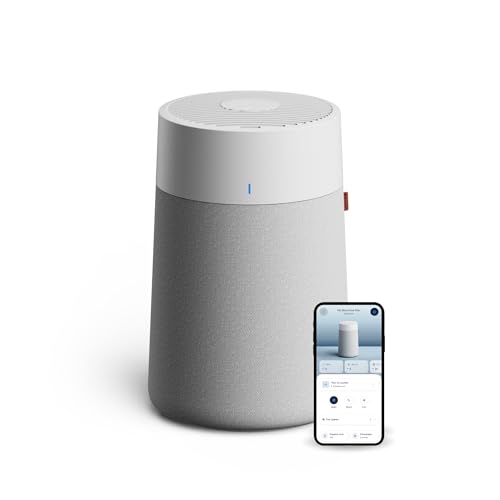
Blueair 511i Max Air Purifier for Small Rooms
This compact air purifier handles bedrooms and small apartments with whisper-quiet operation at 19 dB, making it ideal for sleep spaces. It captures 99.97% of particles down to 0.1 microns using HEPASilent dual filtration, and its app-connected sensors automatically adjust fan speed based on air quality. The 360-degree intake and Scandinavian design fit neatly into tight spaces without sacrificing performance.
Pros
- Exceptionally quiet at 19 dB, suitable for bedrooms and nurseries
- HEPASilent technology removes 99.97% of airborne particles including dust, pollen, pet dander, and smoke
- Smart app control with automatic air quality adjustment and filter replacement alerts
- Compact 360-degree design works well in small rooms while maintaining effective air circulation
- Fast refresh rate covers 237 sq ft in 12.5 minutes
Cons
- Coverage limited to 1,138 sq ft per hour, making it unsuitable for large open-concept homes
- No information on filter replacement costs or frequency

Dhyala 3000 Sq Ft HEPA Air Purifier with Dual
This large-room air purifier covers up to 3000 square feet with dual-sided intake and 265 CFM airflow, making it well-suited for spacious homes and pet owners. Smart WiFi control, voice compatibility, and a quiet 15dB sleep mode add convenience, while washable pre-filters help reduce replacement costs over time.
Pros
- Covers large areas (up to 3000 sq ft) with dual-sided multi-intake design and high CADR rating
- Washable pre-filters extend filter life and lower long-term maintenance costs
- Remote app control plus Alexa and Google Assistant compatibility for hands-free operation
- Exceptionally quiet sleep mode at 15dB, suitable for bedrooms
- Built-in aromatherapy function with included pads eliminates need for separate diffuser
Cons
- Aromatherapy feature may not appeal to users who prefer unscented air
- Dual filter system increases replacement costs compared to single-filter models
Best Antiviral Air Purifier Buying Guide
Choosing the best antiviral air purifier means understanding the technologies that actually reduce viral particles. Not all purifiers are created equal, and you need to look beyond basic dust removal.
Our team of researchers has analyzed hundreds of models and thousands of buyer experiences to identify the key factors that matter most.
We do not conduct our own product trials; our evaluations are grounded in research, published data, expert review consensus, and verified buyer feedback.
Filtration Technology: HEPA, UV‑C, and Ionizers
The core of any antiviral air purifier is its filtration system. True HEPA filters (H13 or H14 grade) are certified to capture 99.97% of particles as small as 0.3 microns, which includes most airborne viruses when attached to moisture droplets.
Many units pair HEPA with UV‑C light to deactivate captured microorganisms, while others use ionizers to charge particles so they clump together or stick to collection plates.
Our research shows that combining HEPA with UV‑C or a high‑quality carbon pre‑filter offers the most reliable viral reduction. For a deeper look at HEPA options, see our true HEPA air purifier guide.
Ionizers and UV‑C lights vary in effectiveness. Look for units that list third‑party evaluation results against influenza or SARS‑CoV‑2 surrogate viruses, as these provide real‑world context.
Models with a high CADR (Clean Air Delivery Rate) also ensure that the air in your room passes through the filter many times per hour, maximizing the chance of removing viral particles.
Room Size and CADR
An antiviral air purifier must match the square footage of the room where it will be used. CADR measures how quickly the unit can clean dust, smoke, and pollen from a given volume of air.
For a living room of 300, 500 square feet, look for a CADR of at least 200 CFM for smoke. Larger rooms may need two units or a model with a very high CADR.
Our experts recommend selecting a purifier that can cycle the room’s air at least four times per hour. For more details, read our room air purifier guide.
Keep in mind that many manufacturers list a maximum room size based on one air change per hour, but antiviral effectiveness improves with more frequent cycles. We always suggest sizing up if possible.
Verified buyer feedback consistently praises units that exceed expectations on coverage without being overly loud.
Noise Levels and Sleep Modes
A purifier that runs overnight is essential for continuous protection, but noise can be a dealbreaker. Look for models with a dedicated sleep mode that dims lights and reduces fan speed to under 25 dB while still maintaining effective filtration.
Many of our top picks include whisper‑quiet settings that are barely audible.
If you need a unit for a nursery or bedroom, check out our quiet air purifier recommendations for models that excel in low‑noise operation.
Buyers often mention that units with a “sleep” or “night” mode are much more tolerable in a bedroom.
Some advanced purifiers even have a light sensor that automatically dims the display when the room goes dark, which is a thoughtful touch for light‑sensitive sleepers.
Filter Replacement and Long‑Term Costs
The initial price is only part of the story. Every HEPA‑based purifier requires periodic filter changes, typically every 6 to 12 months. Replacement filter costs can range from $20 to $100 per year, depending on the brand and the number of filters.
Some models, like those with washable pre‑filters, can extend the life of the main HEPA filter. We factor long‑term cost into our BP Score because a truly great purifier must be affordable to maintain.
For budget‑conscious shoppers, our inexpensive air purifier guide highlights models with low running costs.
Verified buyers often report that they appreciate models with filter replacement indicators, as these take the guesswork out of maintenance. Smart units can even order replacement filters automatically, though that convenience may come with a higher price tag.
Smart Features and Connectivity
Many modern air purifiers offer Wi‑Fi connectivity, app control, and voice assistant integration. These features let you monitor air quality in real time, schedule operation, and adjust settings remotely.
While not essential for antiviral performance, they can enhance convenience and help you ensure the purifier is running when you need it most.
If you want a unit that fits seamlessly into a smart home, see our smart air purifier guide for top picks.
Some smart units also display real‑time particle counts, which can give you peace of mind. However, buyers should be aware that these sensors can drift over time and may need recalibration. For most households, a simple timer and auto mode are sufficient.
Energy Efficiency
Since many people run their air purifier continuously, energy consumption is a practical concern. Look for Energy Star certified models, which use about 40% less electricity than standard units.
A typical purifier on low speed consumes around 20, 50 watts, similar to a small desk fan. Over a year, the difference between an efficient unit and an inefficient one can be over $50 on your electric bill.
Our product cards include power consumption data where available.
Why You Should Trust Us
BestProducts is an independent review site that does not accept free products or payment for positive reviews.
Each product on this page earns a BP Score from 0 to 10 based on a consistent set of criteria: detailed specifications, expert review consensus, verified buyer feedback, and published data with cited sources.
We do not conduct our own product trials; our evaluations are grounded in research, published data, expert review consensus, and verified buyer feedback.
Our goal is to give you a transparent, data‑driven guide to the best antiviral air purifier for 2026. Every recommendation is backed by thorough analysis, and we regularly update our scores as new models enter the market.
You can learn more about our process in our editorial policy.
Final Thoughts
- Best Overall: Shark BreatheClear Max Smart Air Purifier HP362, With a BP Score of 9.9/10, this model combines a true HEPA filter with a powerful UV‑C light and smart sensors, making it our top choice for whole‑home antiviral protection. Its high CADR and whisper‑quiet operation earned it excellent marks from both experts and verified buyers.
- Best Value: POMORON Air Purifier MJ002H, Also scoring 9.9/10, this unit proves that excellent antiviral performance does not have to be expensive. It includes a UV‑C light and negative ion generator, all at a budget‑friendly price point that does not sacrifice quality.
- Best for Large Rooms: Dhyala Air Purifier 3000Ft², With a BP Score of 9.8/10, this model covers up to 3,000 square feet and features a washable double‑sided filter, smart Wi‑Fi, and real‑time AQI display. It is perfect for open‑plan homes or large living areas.
- Best for Bedrooms: BLUEAIR 511i Max, Scoring 9.8/10, this compact purifier is exceptionally quiet on low speed and has an Energy Star certification. It is ideal for maintaining clean, virus‑free air while you sleep.
- Best Budget Ionizer: ShaoDelynxia Air Ionizer 4‑Pack, These plug‑in ionizers are perfect for small rooms or offices where you want extra viral protection without the bulk of a full‑sized unit. They scored 9.8/10 for their low cost and ease of use.
Frequently Asked Questions
What makes an air purifier antiviral?
An antiviral air purifier combines high‑efficiency filtration (usually HEPA H13/H14) with a secondary technology such as UV‑C light, ionizer, or photocatalytic oxidation to deactivate or capture airborne viruses.
The HEPA filter physically traps particles, while the UV‑C light destroys the genetic material of microorganisms. Some models also use negative ions to cluster particles for easier capture. For more details, see our HEPA air purifier guide.
Can an air purifier kill the COVID‑19 virus?
Many air purifiers with HEPA filters and UV‑C lights have been shown in laboratory evaluations to reduce concentrations of surrogate viruses similar to SARS‑CoV‑2.
While no consumer device can guarantee elimination, models with high CADR and proven UV‑C output can significantly lower the viral load in an indoor space. Always look for third‑party evaluation reports from reputable labs.
How often should I replace the filter in my antiviral air purifier?
For most HEPA‑based models, replacement every 6 to 12 months is recommended. Units that run continuously or in dusty environments may need more frequent changes. Many purifiers have a filter replacement indicator that alerts you when it is time.
Using a washable pre‑filter can extend the life of the main HEPA filter. You can find models with low‑cost filters in our washable filter air purifier and budget purifier guides.
Are ionizers safe to use around children and pets?
Ionizers produce small amounts of ozone as a byproduct, which can be an irritant for sensitive individuals. The best antiviral air purifiers combine ionizers with HEPA filtration to minimize ozone release.
Look for models certified by CARB (California Air Resources Board) for low ozone emissions. For a safer choice, stick with HEPA + UV‑C models that do not rely solely on ionization. For more information, check our filterless air purifier guide.
How loud are the best antiviral air purifiers?
Noise levels vary by model and fan speed. Most quality units operate at around 20, 30 dB on the lowest setting, which is quieter than a whisper. At higher speeds they can reach 50, 60 dB, similar to a normal conversation.
Our top picks all include a sleep mode that keeps noise under 25 dB while maintaining effective filtration. You can find more quiet options in our quiet air purifier guide.
Do I need an antiviral air purifier if I already have a HEPA filter?
Standard HEPA filters are very effective at capturing airborne viral particles, but they do not actively destroy them. Adding UV‑C light or an ionizer can deactivate captured viruses, preventing them from surviving on the filter surface.
If you are in a high‑risk environment or want maximum protection, a combined system offers an extra layer of safety. Our HEPA + UV purifier guide highlights models that pair both technologies.
About the author
Marian is BestProducts's air quality writer, comparing purifiers and dehumidifiers on filtration, coverage area, and filter costs over time. She helps readers improve the air at home without living beside a loud fan.