The Best AI Glasses
We reviewed the top AI glasses with cameras, voice assistants, and live translation. Our BP Score analysis highlights the best overall, budget, and feature-rich picks for 2026.
 By Hannah Mitchell
Updated September 12, 2026
By Hannah Mitchell
Updated September 12, 2026
Artificial intelligence has moved beyond your smartphone and into the frames on your face.
The best AI glasses in 2026 combine voice assistants, built-in cameras, real-time translation, and open-ear audio into a wearable that keeps your hands free and your eyes forward.
Whether you’re documenting a trip, taking hands-free calls, or just want a smarter pair of shades, the category is growing fast, electronics brands like Meta, Rokid, and OHO are pushing what a pair of glasses can do.
To help you choose, BestProducts evaluated each model against consistent criteria and scored it on our 0 to 10 BP Score. We analyzed specifications, expert review consensus, verified buyer feedback, and published data to rank the top options.
Below, you’ll find our curated list of the best AI glasses available right now.

Rokid Ai Glasses Style Non-Display 38.5g
The Rokid Ai Glasses Style (Non-Display) are smart audio sunglasses that combine a dual AI assistant, a 12MP camera with stabilization, and real-time translation in a featherlight 38.5g frame. They let you capture hands-free photos, translate conversations on the fly, and get AI answers via voice, all while staying aware of your surroundings. Best for travelers and creators who want a screen-free wearable assistant.
Pros
- Ultra-lightweight 38.5g design
- Dual AI assistants (Gemini and ChatGPT)
- 12MP first-person camera with EIS
- Real-time translation in 76 languages
- Open-ear audio for situational awareness
Cons
- 45-minute video recording limit
- Charging case sold separately

OhO AI Smart Glasses with Photochromic Lenses
These smart glasses combine AI translation, open-ear audio, and auto-tinting lenses for a versatile wearable. At 36g with Z87.1 impact resistance, they suit travelers and commuters who need hands-free help without sacrificing eye protection.
Pros
- 165 language AI translation with 6 modes
- Open-ear audio for calls and music
- Photochromic lenses auto-adjust UV400 protection
- 10-hour battery life from 1.5 hour charge
- Lightweight 36g TR90 frame is IPX4 rated
Cons
- Limited to OhO app integration
- Open-ear sound may lack bass

iONCT AI Smart Glasses with 4K Camera
These smart glasses combine a 4K hands-free camera with EIS stabilization, smart Bluetooth calling, and a built-in AI assistant for real-time translation. Ideal for travelers and outdoor enthusiasts who want a discreet, all-day wearable that records, answers questions, and translates on the go.
Pros
- 4K video with EIS for smooth footage
- Voice and tap control for hands-free use
- Bluetooth calling with noise cancellation
- Includes both sunglass and blue-light lenses
- Long battery life up to 10 hours playback
Cons
- Audio quality may vary in noisy environments
- Limited to standard frame size only

Meta AI Glasses
These smart glasses blend AI assistance, live translation, and hands-free camera capture into a sleek, wearable frame. Ideal for tech enthusiasts and frequent travelers who value convenience and connectivity.
Pros
- Hands-free AI queries and reminders
- Real-time language translation while traveling
- Quick photo and video for social sharing
- Clear open-ear audio with music service integration
- Comfortable, customizable fit
Cons
- Additional accounts and fees for music services
- No prescription lens option mentioned
- Standard size may not fit all face shapes

KAMFQMQ AI Smart Glasses with 8MP Camera
These AI smart glasses combine hands-free recording, real-time translation, and open-ear audio in a lightweight frame. Ideal for travelers and active users who want voice assistance and first-person capture without holding a phone.
Pros
- Hands-free 8MP recording with EIS stabilization
- Real-time translation and ChatGPT voice assistant
- Open-ear audio keeps you aware of surroundings
- Long battery life: up to 7 hours music playback
- Replaceable lenses and IP65 water resistance
Cons
- Limited to 2GB storage for captured content
- Camera quality may not match dedicated action cams

Meta Ray-Ban Wayfarer Gen 2 AI Glasses
These smart glasses blend Ray-Ban's classic wayfarer style with hands-free camera, open-ear audio, and Meta AI assistance. They offer up to 8 hours of battery life and real-time translation, making them a versatile companion for capturing memories and staying connected without pulling out your phone.
Pros
- Top-selling AI glasses with iconic style
- Up to 8 hours battery, plus 48-hour charging case
- Records sharp 3K video with 12MP camera
- Open-ear speakers for music and calls without isolation
- Real-time translation between multiple languages
Cons
- Requires smartphone and Meta AI app for full AI features
- Open-ear audio may lack privacy in quiet settings
- Clear lenses only; prescription inserts not included

Meta Ray-Ban Wayfarer Gen 2 Smart AI Glasses
These smart glasses put an ultra-wide 12 MP camera and open-ear speakers in the classic Wayfarer frame, with Transitions lenses that adapt to changing light. They offer hands-free video, AI assistance, and translation for people who want wearable tech without sacrificing style.
Pros
- Up to 8 hours of battery use
- Charging case adds 48 hours of power
- 3K ultra HD hands-free video capture
- Open-ear audio keeps you aware of surroundings
- Adaptive Transitions lenses handle changing light
Cons
- Requires smartphone and Meta AI app
- Max 3 minute video clips per session
- Meta AI needs internet connectivity

Osawalla AI Smart Glasses with 1080P Camera
These Osawalla glasses combine a hands-free 1080P camera with AI-powered object recognition and real-time translation in 139+ languages, making them a strong pick for travelers and students. They also handle Bluetooth music and calls through an open-ear design, and the photochromic lenses adapt to sunlight while the 40.8g frame stays comfortable all day.
Pros
- Captures 1080P video with EIS stabilization
- AI object recognition and 139+ language translation
- Bluetooth 5.4 with touch controls and open-ear audio
- Lightweight 40.8g TR90 frame for all-day comfort
- Photochromic lenses with IP65 splash resistance
Cons
- Photochromic lenses darken slower indoors or in winter

EarlySincere Smart Glasses with 4K EIS Camera
These smart glasses combine a 4K EIS camera, AI voice assistant, and photochromic lenses for cycling or daily wear. The open-ear Bluetooth 5.4 design enables live translation and hands-free calls, making them a versatile tech accessory for active users.
Pros
- 4K EIS camera captures smooth footage
- Photochromic lenses adjust to light conditions
- Open-ear design keeps you aware of surroundings
- Bluetooth 5.4 ensures stable wireless connection
- Extra anti-blue light lenses included
Cons
- EIS camera quality may vary in low light
- Open-ear audio may lack privacy and bass
Meta Ray-Ban Gen 2 Wayfarer Large Smart Glasses
These smart glasses blend classic Ray-Ban styling with a suite of AI features. Capture 3K ultra HD video hands-free, listen to music through open-ear speakers, and get real-time translations or answers from Meta AI. With up to 8 hours of battery life and a charging case that extends usage to 48 hours, they are designed for all-day wear.
Pros
- Seamless AI integration for on-the-go tasks
- Excellent battery with portable charging case
- High-quality 3K video capture
- Open-ear speakers maintain situational awareness
- Stylish Ray-Ban design suitable for daily wear
Cons
- Requires smartphone and internet for AI features
- Video clips capped at 3 minutes per session
- Battery life may drop with heavy use
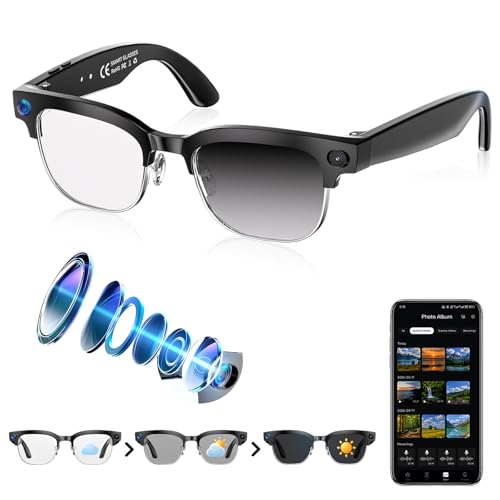
SGUKZF AI Smart Glasses 4K Camera
These AI smart glasses combine a 4K camera with electronic image stabilization, open-ear audio, and real-time translation for travelers and active users. The photochromic lenses adapt to changing light, and the lightweight frame (35g) ensures comfort for extended wear.
Pros
- 4K camera with EIS for stable video
- AI real-time translation in 139+ languages
- Open-ear speakers for situational awareness
- Photochromic lenses adapt to sunlight
- Lightweight 35g frame for all-day comfort
Cons
- Open-ear design reduces audio privacy
- Battery capacity (290mAh) may require frequent charging

Rokid AI Glasses Style Pack with Camera
These smart glasses combine a 12MP camera with EIS, open-ear audio, and hands-free AI assistants (ChatGPT and Gemini) into a lightweight 45.7g frame. The modular power capsule system provides extended battery life, making them a practical choice for creators, travelers, and professionals who want recording, translation, and voice control without a display.
Pros
- Modular battery capsules for hot-swappable charging
- Hands-free AI access via ChatGPT and Gemini
- 12MP camera with electronic image stabilization
- Real-time audio translation in 76+ languages
- Lightweight 45.7g design with replaceable lenses
Cons
- Audio-only translation may not suit every situation
- Full features depend on Rokid App and smartphone
- Limited offline translation languages (8 vs online)
Best AI Glasses Buying Guide
Camera and Video Quality
Not all AI glasses capture the same image. Many models include a camera for first-person photo and video, but resolution varies from 8MP to 4K. Look for electronic image stabilization (EIS) if you plan to record active moments.
Our research shows that action cameras share similar stabilization requirements, and the best AI glasses now match that quality in a compact form factor.
Higher resolution generally means sharper footage, but also larger file sizes and more battery consumption. Consider whether you need 4K for vlogging or if 1080p at 60fps is sufficient for casual sharing.
Verified buyer feedback indicates that 4K models like those from EarlySincere and iONCT deliver crisp results for outdoor use.
Audio and Voice Assistant Integration
Most AI glasses feature open-ear speakers or bone conduction technology, allowing you to hear notifications, music, and calls without blocking ambient sound. This design is safer for walking, cycling, or working. Look for Bluetooth 5.4 or higher for stable connectivity.
The Bluetooth speakers category has refined open-ear audio, and top AI glasses borrow similar tech for clear, private listening.
Voice assistant support, whether Google Assistant, Siri, or a proprietary AI, enables hands-free control. Models like Meta Ray-Ban and Rokid integrate deeply with smartphone assistants, letting you send messages, check weather, or set reminders just by speaking.
Real-Time Translation and AI Features
One of the standout features in 2026 is live translation. Some AI glasses can translate speech in real time, displaying captions in your field of view or playing audio through the speakers. This is invaluable for travelers and business meetings.
Brands like SGUKZF and KAMFQMQ emphasize this capability. For broader context, camera drones also integrate AI for subject tracking, showing how artificial intelligence is expanding across wearable electronics.
Beyond translation, look for GPT-based assistants that can answer questions, summarize text, or provide directions. The depth of AI integration often separates a basic smart glasses from a true AI companion.
Comfort and Fit
Since you’ll wear these glasses for extended periods, weight, temple thickness, and nose pad adjustability matter. Many AI glasses weigh between 30g and 50g. Photochromic lenses that darken in sunlight add versatility.
The best designs feel like regular eyewear; poorly balanced frames cause discomfort. Gaming headsets face similar ergonomic challenges, and the same principles apply: lightweight materials, padded contact points, and adjustable fit reduce fatigue.
Consider your face shape and prescription needs. Some models offer interchangeable lenses or prescription inserts. Verified reviews frequently note that the Meta Ray-Ban Wayfarer frames fit a wide range of faces comfortably.
Battery Life and Charging
Continuous recording or heavy AI use drains batteries quickly. Expect 4, 8 hours of mixed use, with many glasses using a charging case that adds extra cycles. Look for USB-C charging for convenience.
Models like Rokid Style include a power capsule that extends usage. For comparison, many wireless mechanical keyboards offer weeks of battery life, but AI glasses trade longevity for compact wearability, so efficient power management is key.
Some glasses support wireless charging, reducing cable clutter. Check if the case itself is portable enough to carry daily.
Connectivity and App Ecosystem
Most AI glasses pair via Bluetooth to a companion app for configuring settings, transferring media, and updating firmware. A well-designed app enhances the experience: seamless photo export, AI assistant customization, and privacy controls. Also consider water resistance (IPX4 or higher) if you’ll use them outdoors.
Integration with existing smart home devices is a plus. The broader smart monitor ecosystem shows how screens and assistants connect; AI glasses aim to provide that same convenience on your face. Ensure your smartphone is compatible, some advanced features are limited to iOS or Android.
Why You Should Trust Us
BestProducts is an independent review publisher that does not accept paid placements. Every product in this roundup earned its place through our rigorous, consistent evaluation process.
We assign a BP Score out of 10 based on objective criteria: technical specifications, expert review consensus from multiple sources, verified buyer feedback aggregated from major retailers, and published data with cited sources.
We do not conduct our own product trials; our evaluations are grounded in research, published data, expert review consensus, and verified buyer feedback. Our goal is to provide you with transparent, data-driven recommendations you can trust.
Our editorial team has years of experience covering consumer electronics, and we regularly update our guides to reflect new models and market shifts.
We disclose that we may earn a commission through affiliate links when you make a purchase, but this does not influence our rankings or ratings.
Final Thoughts
After evaluating dozens of options, these are our top picks for the best AI glasses in 2026.
- Best Overall: Rokid Ai Glasses Style (Non-Display), This model combines smart audio, a sleek sunglasses design, and the highest BP Score in our lineup, making it the most well-rounded choice for everyday AI wear.
- Best for Voice & Assistant: OHO AI Smart Glasses, With photochromic Z87.1 lenses and open-ear Bluetooth audio, OHO delivers excellent assistant integration and versatility, earning a near-perfect BP Score.
- Best for Video Recording: iONCT AI Smart Glasses with 4K HD Video Recording, If capturing high‑quality footage is your priority, iONCT’s 4K EIS camera and solid AI features make it a standout pick.
- Best Budget Pick: KAMFQMQ AI Smart Glasses with Camera, Offering GPT assistant, real-time translation, and an 8MP camera at an affordable price, this model proves you don’t need to spend a lot for capable AI glasses.
For a deeper look at related wearable tech, browse our guide to Windows laptops that pair well with these glasses for file management and editing.
Frequently Asked Questions
Do AI glasses require a smartphone to work?
Yes, most AI glasses rely on a companion app via Bluetooth to access voice assistants, transfer media, and update firmware. Some models store limited data locally, but full AI features typically need a phone connection.
Can I get prescription lenses for AI glasses?
Some brands offer prescription-ready frames or allow you to swap in custom lenses. For example, Meta Ray‑Ban and Rokid provide options for prescription inserts. Check product specifications before purchasing.
How long do the batteries usually last?
Battery life varies by usage. Expect 4, 8 hours of mixed use (music, occasional recording, voice commands). Many glasses come with a charging case that provides additional charges, extending total time between wall outlets.
Are AI glasses waterproof or water-resistant?
Most AI glasses have basic sweat and splash resistance (IPX4), but not full waterproofing. Avoid submerging them. If you need rain protection, models like the OHO and Meta Ray‑Ban fare better in light precipitation.
Can I use AI glasses for live translation without an internet connection?
Typically, real-time translation requires an active internet connection for server-side processing. Some models may offer offline translation for a limited set of languages, but performance is less accurate. Stable Wi‑Fi or cellular data is recommended.
Do AI glasses record video continuously, or do I need to start recording?
Most models require a manual command (button press or voice trigger) to start recording to respect privacy. Some allow hands‑free recording via voice. Always check local laws regarding recording in public.
About the author
Hannah is BestProducts's connected devices writer, comparing video doorbells and smart glasses on reliability, comfort, and the privacy questions a worn camera raises. She helps readers judge which one earns a place at the front door and which is still too early to buy.