The Best Air Compressor for Truck Air Bags
We researched the top onboard air compressors for truck air bag systems, evaluating pressure output, duty cycle, and control features to help you maintain optimal ride height and load support.
 By Lucy Gardner
Updated September 12, 2026
By Lucy Gardner
Updated September 12, 2026
Maintaining proper air pressure in your truck’s air bag suspension is essential for ride comfort, load leveling, and overall vehicle stability.
An onboard air compressor system allows you to adjust pressure on the fly, whether you’re hauling heavy cargo, towing a trailer, or simply cruising unladen. Without a reliable compressor, you risk sagging, poor handling, and premature wear on suspension components.
We’ve researched the top air compressor systems specifically designed for truck air bags, analyzing specifications, expert consensus, and verified buyer feedback. Our evaluations focus on pressure output, duty cycle, control options, and ease of installation.
Below, you’ll find our top picks, each scored on our 0, 10 BP Score, followed by a detailed buying guide and answers to common questions.
| Award | Product | BP Score About BP ScoreThe BP Score is our own rating from 0 to 10, based on performance, design and build, ease of use, and value. It reflects independent research and is never influenced by manufacturers, retailers, or affiliate commissions. Learn more › | Price | |
|---|---|---|---|---|
| Best Overall |
 RETRUE 100 PSI Air Bag Compressor Kit
|
9.9/10 | $115.99 | Buy |
| Best Budget |
 DEEAGLE Air Compressor Kit with Low-Pressure
|
9.9/10 | $119.99 | Buy |
 maXpeedingrods Air Spring Compressor Kit
|
9.8/10 | $119.99 | Buy | |
 WINSBULL Air Bag Compressor Lightning
|
9.8/10 | $119.99 | Buy | |
| Best Value |
 RETRUE Onboard Air Compressor 100 PSI
|
9.6/10 | $159.99 | Buy |
| Best Premium |
 Air Lift 25804 Air Compressor & Gauge Kit
|
9.6/10 | $182.98 | Buy |
 maXpeedingrods Wireless Air Compressor System 120
|
9.6/10 | $419.99 | Buy | |
 TOPICK Onboard Air Compressor Kit (120 PSI)
|
9.5/10 | $139.99 | Buy | |
 Air Lift 25980EZ WirelessONE Compressor & EZ Mount
|
9.5/10 | $713.99 | Buy |
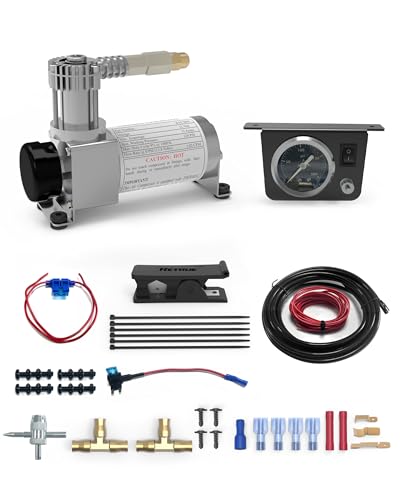
RETRUE 100 PSI Air Bag Compressor Kit
This onboard compressor setup inflates air bags quickly, reaching 50 PSI in 80 seconds. The in-cab control panel lets you adjust pressure on the fly, and the complete kit includes all necessary hardware for installation.
Pros
- Fast inflation up to 100 PSI
- In-cab control prevents over-inflation
- Complete kit with all installation parts
- Dedicated customer support available
Cons
- Must hold button continuously to inflate
DEEAGLE Air Compressor Kit with Low-Pressure
This onboard compressor kit from DEEAGLE pairs a fast-filling pump with a built-in low-pressure sensor that automatically maintains your air suspension. It operates quietly at 68 dB and includes all hardware for a straightforward installation.
Pros
- Fast inflation: 50 PSI in 44 seconds
- Quiet operation at 68 dB
- Automatic low-pressure sensor keeps suspension stable
- In-cab control panel for on-the-fly adjustments
- Includes everything needed for installation
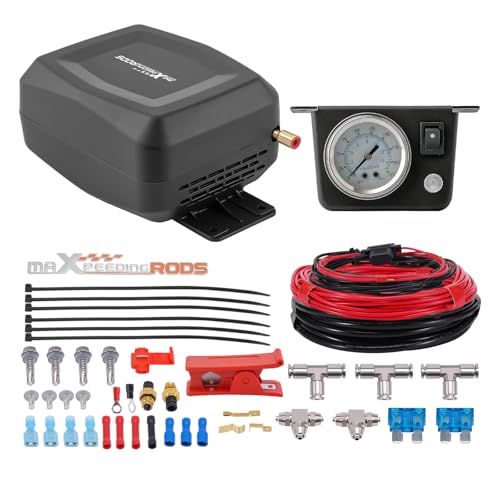
maXpeedingrods Air Spring Compressor Kit
This onboard compressor kit provides convenient in-cab control for inflating air springs. Its single-path design ensures even pressure distribution, and the system reaches 60 PSI in about 90 seconds for quick adjustments.
Pros
- Even air distribution via single-path design
- Fast inflation up to 100 PSI
- Easy DIY installation with included hardware
- In-cab control eliminates need to step outside
- Durable construction with salt spray resistance
Cons
- Press-and-hold operation, no automatic shut-off
- Analog gauge may be less precise than digital
- No mention of maximum duty cycle for continuous use
WINSBULL Air Bag Compressor Lightning
This compressor delivers fast inflation for air suspension systems, with both wireless remote and manual controls. It helps adjust ride height and improves towing stability by adding pressure to rear air bags, making it a solid choice for truck and RV owners.
Pros
- Lightning fast inflation under high pressure
- Wireless remote control for convenience
- Adjustable ride height for different loads
- Improves towing stability and reduces sag
- Protects suspension components from wear
Cons
- Remote requires CR2016 batteries (not included)
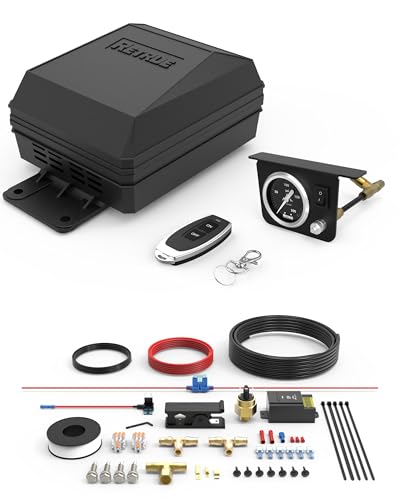
RETRUE Onboard Air Compressor 100 PSI
For truck owners with airbag suspension, this complete kit provides automatic pressure maintenance and fast inflation. Dual control options let you adjust from inside the cab or remotely, while the low pressure sensor keeps bags properly inflated without manual monitoring.
Pros
- Dual control with in-cab and wireless options
- Low pressure sensor for automatic inflation
- Fast inflation: 80 seconds to 50 PSI
- Complete kit includes all installation hardware
Cons
- T-fitting may be prone to damage or leaks
- Heavy at over 5 pounds
Air Lift 25804 Air Compressor & Gauge Kit
This air suspension controller from Air Lift puts pressure adjustments at the driver's fingertips. It includes an onboard compressor and a dash-mounted gauge panel, with a universal connector that works with most air shocks. The kit comes with all necessary hardware and a fully illustrated manual for straightforward installation.
Pros
- Driver-side pressure control from seat
- Universal connector fits most air shocks
- Includes onboard air compressor
- Complete kit with gauge panel and hardware
- Easy installation with illustrated manual
maXpeedingrods Wireless Air Compressor System 120
This wireless on-board air compressor system from maXpeedingrods offers Bluetooth app and remote control for easy adjustments. It features programmable presets and a heavy-duty waterproof compressor with up to 120 PSI output, making it a flexible option for customizing your vehicle's air suspension.
Pros
- Wireless Bluetooth app and remote control
- Programmable presets for custom ride
- Heavy-duty waterproof compressor
- 120 PSI output for fast inflation
- Flexible vertical or horizontal installation
Cons
- Specs do not include tank size or duty cycle
TOPICK Onboard Air Compressor Kit (120 PSI)
This onboard air compressor kit provides fast inflation for air bag suspensions with in-cab control and durable low-noise operation. It includes a complete installation kit and is compatible with most vehicles equipped with air bag suspension.
Pros
- Fast inflation up to 120 PSI
- In-cab control for real-time adjustment
- Low-noise operation at 68 dB
- Durable protective housing
- Complete installation kit included
Air Lift 25980EZ WirelessONE Compressor & EZ Mount
This on-board air compressor system lets you inflate or deflate air springs wirelessly from inside or outside the vehicle via a handheld controller or mobile app. It includes a powerful 12V compressor rated up to 120 PSI and a factory-assembled EZ Mount bracket that reduces installation time by up to one hour.
Pros
- Wireless control via handheld or app
- Even inflation and deflation for level ride
- 120 PSI compressor handles hauling and towing
- EZ Mount bracket cuts install time by up to an hour
- Programmable presets for convenience
Cons
- Weight listed as 0.000625 pounds likely incorrect
- Requires battery-direct wiring installation
Best Air Compressor for Truck Air Bags Buying Guide
Pressure and Flow Rate (CFM & PSI)
Air bag systems typically require 100, 150 PSI to lift heavy loads, but the flow rate (measured in CFM at a given pressure) determines how quickly you can inflate or adjust.
A compressor delivering at least 1.5 CFM at 100 PSI is a good baseline for most truck setups. Higher CFM reduces wait time, especially for dual air bag configurations.
For comparison, a typical portable air compressor for tires may not sustain the duty cycle needed for air bags.
Pay attention to the compressor’s maximum PSI rating. Systems with a cut-off pressure above 150 PSI give you headroom for heavy loads. However, exceeding your air bag’s rated pressure can damage the bag, so always match the compressor’s regulator to your suspension’s limits.
Tank Size vs. Duty Cycle
An onboard compressor with a small tank (0.5, 1 gallon) can handle quick adjustments, but larger tanks (2, 5 gallons) store enough air for multiple inflations without the pump running continuously.
The duty cycle, how long the compressor can run before needing a cool-down, is critical. Look for a duty cycle of at least 50% at 100 PSI; otherwise, you may experience overheating during extended use.
If you often adjust pressure frequently, a home-use air compressor with a larger tank might be overkill, but an onboard unit with a 100% duty cycle is ideal.
Tankless systems are lighter and easier to mount, but they rely entirely on the compressor’s duty cycle. For occasional adjustments, a tankless design works fine; for frequent towing or off-road use, a small tank provides a buffer.
Control Options: Wired, Wireless, and App-Based
Modern onboard compressors offer various control methods. Wired in-cab controllers give you direct access to pressure adjustments and system monitoring. Wireless remote controls let you adjust from outside the vehicle, useful when checking air bags while loading.
App-based systems add convenience with preset pressures and real-time diagnostics. Consider how often you’ll need to adjust pressure and whether you prefer physical buttons or smartphone control.
For a simpler setup, a inexpensive air compressor with a basic wired controller may suffice.
Wireless systems often include a pressure sensor that automatically maintains target PSI, reducing the need for manual checks. However, they rely on batteries or vehicle power, so ensure the remote has a long-range signal (at least 50 feet) and reliable connectivity.
Build Quality, Mounting, and Noise
The compressor must withstand road vibrations, moisture, and temperature extremes. Look for models with an IP rating (e.g., IP67) for dust and water resistance. Mounting brackets should be included or easily adaptable to your truck’s frame or cargo area.
Noise level is often overlooked; a loud compressor can be annoying in-cab. Units with sound-dampening enclosures or rubber isolators run quieter. If noise is a concern, consider a quiet air compressor designed for low decibel output.
Check the compressor’s material, aluminum or stainless steel components resist corrosion better than painted steel. Also, assess the ease of replacing filters and valves; maintenance should be straightforward to extend the system’s life.
Compatibility with Air Bag Kits
Not all compressors work with every air bag system. Ensure the compressor’s pressure range matches your air bag’s operating PSI (usually 5, 150 PSI). Some kits include a manifold that simplifies connection to dual air bags.
If you’re retrofitting an existing suspension, verify that the compressor supports the same fitting size (typically 1/4″ NPT). For a complete setup, you may also need an air compressor hose rated for high pressure and UV resistance.
Many aftermarket compressors come as complete kits with mounting hardware, wiring harness, and controller. These are easier to install than piecing together components. If you’re handy, a universal system can be customized, but a kit saves time and ensures compatibility.
Power Source and Wiring
Most onboard compressors run on 12V DC from your truck’s battery. Some high-output models may require a dedicated circuit or relay to prevent overloading. Check the amp draw: a compressor pulling 30+ amps may need a separate fuse and heavy-gauge wiring.
For trucks with limited battery capacity, consider a 12-volt portable air compressor that can be temporarily connected, though it won’t be as integrated.
Wiring should be protected with a fuse or circuit breaker close to the battery. Use weatherproof connectors and route the harness away from heat sources and moving parts. If you’re not confident in electrical work, professional installation is recommended.
Why You Should Trust Us
BestProducts is an independent review site. Our team evaluates each product using a consistent set of criteria and scores it on our 0, 10 BP Score.
We do not conduct our own product trials; our evaluations are grounded in research, published data, expert review consensus, and verified buyer feedback.
We analyze specifications such as maximum pressure, duty cycle, tank size, and control features, then cross-reference with professional reviews and real-world owner experiences. Our goal is to provide transparent, trustworthy recommendations that help you make an informed purchase.
We earn a commission when you buy through our links, but this does not influence our ratings or editorial content. Our rankings are based solely on the quality and value of each product relative to its category.
Final Thoughts
Choosing the right air compressor for your truck’s air bags comes down to your specific needs, whether you prioritize pressure output, control convenience, or budget. Below are our top recommendations based on our research.
- Best Overall: RETRUE Universal Air Bag Compressor Kit, With the highest BP Score in our lineup, this kit delivers excellent pressure consistency, a compact design, and reliable performance at a competitive price point. It’s a versatile choice for most truck air bag systems.
- Best for Wireless Control: DEEAGLE Air Bag Compressor Kit with Low Pressure Sensor, This system stands out for its integrated low-pressure sensor and wireless remote, allowing you to maintain precise air bag pressure without leaving the cab. Its BP Score reflects strong user satisfaction and expert approval.
- Best Budget Pick: maXpeedingrods On Board Air Compressor System, Offering a solid balance of features and affordability, this kit provides ample pressure and a 100% duty cycle at a price that won’t break the bank. It’s a great entry-level option for truck owners.
- Best for In-Cab Control: TOPICK Onboard Air Compressor Kit with In-Cab Control System, If you prefer managing air pressure from inside your truck, this kit’s wired controller with digital display makes adjustments intuitive. It also includes a pressure sensor for automatic maintenance.
Frequently Asked Questions
What size air compressor do I need for truck air bags?
Most truck air bag systems operate between 5, 150 PSI. A compressor with a maximum pressure of at least 150 PSI and a flow rate of 1.5 CFM or more at 100 PSI is sufficient for typical use.
If you have a heavy-duty truck or often carry heavy loads, consider a unit with a larger tank (2+ gallons) and a higher duty cycle. For a general reference, see our guide to small air compressors that can handle intermittent duty.
Can I use a portable tire inflator for air bags?
Portable tire inflators are typically designed for short bursts and may overheat if used continuously to adjust air bags. They lack the duty cycle and pressure regulation needed for suspension systems.
While you can use one in a pinch, an onboard compressor is more reliable and convenient. For tire inflation needs, check our portable air compressor pump guide.
How do I install an onboard air compressor system?
Installation varies by kit, but generally involves mounting the compressor in a dry location (under the hood, in the bed, or on the frame), connecting the air line to the air bags, wiring the power to the battery with a fuse, and installing the controller in the cab.
Many kits include detailed instructions. If you’re not experienced with automotive electrical work, professional installation is recommended. You may also need an air compressor water separator to keep moisture out of the system.
What is the difference between a single and dual compressor setup?
A single compressor can handle one or two air bags if it has sufficient flow and duty cycle. Dual compressor setups are used for larger systems (e.g., four-corner air suspension) or when faster inflation is needed.
Dual compressors also provide redundancy, if one fails, the other can maintain pressure. For most trucks with rear air bags, a single quality compressor is adequate.
For more details on compressor types, see our 110-volt air compressor roundup (though that’s for shop use, the principles apply).
How long does an onboard air compressor last?
With proper maintenance, a quality onboard compressor can last 5, 10 years. Key factors include duty cycle usage, environmental exposure, and regular filter cleaning. Units with sealed bearings and corrosion-resistant materials tend to have longer lifespans.
If you hear unusual noises or notice slower inflation, check for leaks or worn components. A well-maintained compressor is a long-term investment; consider adding an air compressor anti-vibration pad to reduce wear from road vibrations.
Do I need a tank for air bag suspension?
A tank is not strictly necessary, but it offers benefits: it stores compressed air for immediate use, reduces compressor cycling, and provides a reserve for multiple adjustments.
Tankless systems are lighter and simpler, but they require the compressor to run each time you adjust. For occasional use, tankless is fine; for frequent towing or off-roading, a small tank (1, 2 gallons) is recommended.
For a broader perspective, browse our tools and home improvement category for related suspension and air system guides.
About the author
Lucy writes about air compressors and shop vacuums for BestProducts, judging airflow, tank capacity, suction, and noise in a working garage. She helps readers power their tools and clean up afterward.