The Best Accuracy 3D Printer
We evaluated top filaments based on diameter tolerance, layer adhesion, and material consistency to help you achieve the most accurate prints. Our top picks include SUNLU, Creality, and ANYCUBIC.
 By Sharlene Rose
Updated September 12, 2026
By Sharlene Rose
Updated September 12, 2026
Accuracy in 3D printing depends on many factors, but the filament is often the unsung hero. Even the most calibrated consumer 3D printer can produce mediocre results if the filament lacks dimensional consistency.
In this guide, we evaluate top filaments that help you achieve precise, detailed prints.
Our team at BestProducts analyzed specifications, expert reviews, and verified buyer feedback to score each filament on our 0, 10 BP Score. We focused on diameter tolerance, material purity, and layer adhesion. Here are our top picks for accuracy.
| Award | Product | BP Score About BP ScoreThe BP Score is our own rating from 0 to 10, based on performance, design and build, ease of use, and value. It reflects independent research and is never influenced by manufacturers, retailers, or affiliate commissions. Learn more › | Price | |
|---|---|---|---|---|
| Best Overall |
 SUNLU PLA 1.75mm White 1KG
|
9.9/10 | $16.99 | Buy |
| Best Premium |
 Creality PLA+ Rainbow 1.75mm Filament 1KG
|
9.9/10 | $21.99 | Buy |
| Best Budget |
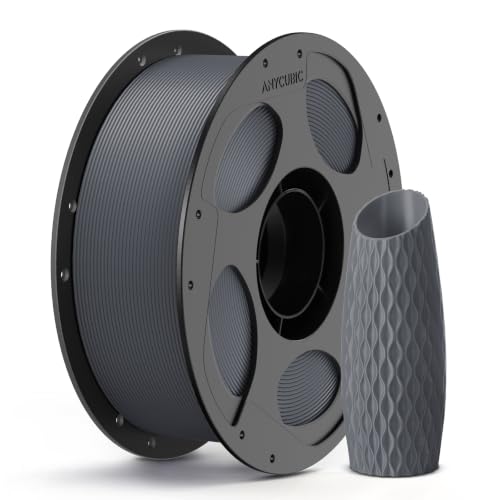 ANYCUBIC PLA 1.75mm Texture Grey
|
9.8/10 | $11.89 | Buy |
 SUNLU PLA+ 2.0 Filament 4kg Black
|
9.6/10 | $50.99 | Buy | |
| Best Value |
 ELEGOO PLA 1.75mm Black 1KG
|
9.5/10 | $13.99 | Buy |
 SUNLU PLA Filament 1.75mm 1kg
|
9.4/10 | $12.59 | Buy |
SUNLU PLA 1.75mm White 1KG
This PLA filament offers reliable, tangle-free printing with consistent 1.75mm diameter and excellent layer adhesion, making it a solid choice for both beginners and experienced 3D printing enthusiasts.
Pros
- Reliable with no clogs or tangles
- Excellent layer adhesion for quality prints
- High dimensional accuracy (+-0.02mm)
- Compatible with most 1.75mm FDM printers
- Neatly wound spool reduces jams
Cons
- Only available in white color
Creality PLA+ Rainbow 1.75mm Filament 1KG
This rainbow PLA+ filament from Creality offers enhanced toughness and easy printing for FDM 3D printers. Its high dimensional accuracy and clog-free design make it a reliable choice for hobbyists and educators creating detailed models and functional parts.
Pros
- Enhanced toughness reduces breakage
- Smooth, clog-free printing experience
- High dimensional accuracy (+/- 0.02mm)
- Wide compatibility with FDM printers
- Environmentally friendly and low odor
Cons
- Only available in 1kg spool size
- Rainbow color may not suit all projects
ANYCUBIC PLA 1.75mm Texture Grey
This PLA filament from ANYCUBIC offers a consistent 1.75mm diameter with tight +/-0.02mm tolerance and a neatly wound spool for smooth, clog-free printing. It includes an intelligent chip that automatically pairs with the ACE Pro system, and it works with most mainstream 3D printers.
Pros
- Accurate diameter with low tolerance
- Clog-free and bubble-free performance
- Neat spool winding reduces tangling
- Compatible with Anycubic ACE Pro
Cons
- Smart features require ACE Pro unit
- Available only in texture grey color
SUNLU PLA+ 2.0 Filament 4kg Black
A 4-pack bundle of upgraded PLA+ filament designed for faster, stronger prints without brittleness issues. The neatly wound spools and consistent diameter tolerance make it straightforward for both beginners and experienced users, while vacuum packaging keeps moisture at bay during storage.
Pros
- Improved durability with better resistance to brittleness and cracking compared to standard PLA+
- Fast printing capability up to 300mm/s without sacrificing print quality
- Tight dimensional tolerance of +/- 0.02mm ensures broad compatibility with 1.75mm FDM printers
- Neatly wound design eliminates tangling and reduces clogging during printing
- Vacuum-sealed packaging maintains filament quality and moisture-free storage
Cons
- Requires specific temperature settings (205-220°C nozzle, 50-60°C bed) for optimal results, which may need calibration per printer
- Black color only in this bundle offers no color variety for multi-project users
ELEGOO PLA 1.75mm Black 1KG
This ELEGOO PLA filament offers consistent 1.75mm diameter with tight tolerances for reliable FDM printing. It is designed to be tangle-free, clog-free, and bubble-free, paired with wide compatibility across common printers.
Pros
- High quality PLA with glossy finish
- Dimensional accuracy within +/-0.02mm
- Less tangled and easy feeding
- Clogging-free and bubble-free extrusion
- Wide compatibility with common FDM printers
SUNLU PLA Filament 1.75mm 1kg
This PLA filament is designed for reliable and easy 3D printing with consistent diameter accuracy and minimal tangling risk. Its neat winding and wide compatibility make it a solid choice for both beginners and experienced users.
Pros
- Reliable and easy to use with minimal clogs or tangles
- Excellent layer adhesion for high-quality prints
- Neat winding reduces risk of jams
- Dimensional accuracy of +/-0.02mm ensures compatibility
- Works with almost all 1.75mm FDM printers
Best Accuracy 3D Printer Buying Guide
Diameter Tolerance
The diameter tolerance of a filament directly affects print precision. Filaments with a tolerance of ±0.02 mm or better ensure consistent extrusion, reducing under- or over-extrusion. For high-accuracy prints, look for filaments with tight tolerances, as they minimize layer inconsistencies.
A quality 3D printer paired with such filament can achieve stunning detail.
Many top brands, including SUNLU and ANYCUBIC, advertise tolerances of ±0.02 mm. Verified buyer feedback often confirms that these filaments deliver uniform diameter throughout the spool, which is critical for intricate models.
Material Consistency
Material consistency, the absence of impurities or air bubbles, is vital for reliable printing. Consistent material ensures that each layer bonds evenly, preventing weak spots.
We found that filaments with high-quality base resins and strict quality control, such as Creality’s PLA+, maintain excellent consistency. This is especially important when using an FDM 3D printer for functional parts.
Review consensus indicates that filaments with added modifiers (like PLA+ or PLA 2.0) often improve flow and reduce clogging, contributing to more accurate prints.
Print Temperature Range
A filament’s recommended temperature range affects how it melts and adheres. Filaments that perform well across a wide range give users flexibility to fine-tune settings for precision.
For example, SUNLU PLA+2.0 offers a broad temperature window, allowing for both fast and detailed prints. Using an enclosed 3D printer can help maintain stable temperatures for consistent results.
Layer Adhesion
Strong layer adhesion is essential for durable, accurate prints. Filaments with good inter-layer bonding reduce the risk of delamination and improve surface finish.
ELEGOO’s PLA filament is noted for its excellent layer fusion, making it a solid choice for detailed models. For resin-like precision, some users pair these filaments with a SLA 3D printer for even finer details.
Moisture Sensitivity
Moisture absorption can ruin filament accuracy by causing bubbling, stringing, and weak layers. Many PLA-based filaments are hygroscopic, so proper storage is crucial.
Filaments with low moisture sensitivity, like those with added drying agents or sealed packaging, maintain their properties longer. If you are on a budget 3D printer, investing in a filament dryer can further improve consistency.
Color and Pigment Quality
While color may not affect dimensional accuracy, pigment quality can influence melting behavior and visual consistency. Uniform pigment dispersion prevents nozzle clogs and ensures even color in prints.
Brands like Creality and ANYCUBIC offer vibrant, consistent colors that do not compromise print quality. A popular selling 3D printer often works well with these filaments.
Why You Should Trust Us
BestProducts is an independent review site. We do not conduct our own product trials; our evaluations are grounded in research, published data, expert review consensus, and verified buyer feedback. Each filament is scored using our consistent BP Score system (0, 10).
We remain transparent about our affiliate relationships and prioritize accuracy in our recommendations. For more context, see our comprehensive guide to the best 3D printer for every maker.
Final Thoughts
Best Overall: SUNLU PLA 1.75mm White, With a top BP Score in our evaluation, this filament offers exceptional diameter tolerance and consistent extrusion, making it the most reliable choice for precision prints.
Best for Detail: Creality PLA+ Rainbow, Its excellent layer adhesion and smooth finish deliver intricate details without compromising strength, perfect for models with fine features.
Best Value: ANYCUBIC PLA Texture Grey, This filament combines affordability with high accuracy, offering a near-9.8 BP Score and verified buyer satisfaction.
Best Multipack: SUNLU PLA+2.0 Black 4-Pack, For users who need consistent performance across multiple spools, this pack provides great value and reliable accuracy for larger projects.
Frequently Asked Questions
What is the ideal diameter tolerance for accurate printing?
For high accuracy, look for filaments with a diameter tolerance of ±0.02 mm or better. This ensures consistent extrusion and reduces dimensional errors in your prints. Top brands like SUNLU and ANYCUBIC commonly meet this standard.
Does filament color affect print accuracy?
Color itself does not directly affect dimensional accuracy, but pigment quality can impact melting behavior. Low-quality pigments may cause clogs or inconsistent flow. Stick to reputable brands to avoid such issues.
How does moisture impact 3D printing precision?
Moisture in filament leads to bubbling, stringing, and weak layers, all of which reduce accuracy. Use a filament dryer or store filaments in airtight containers with desiccant. For beginners, a basic 3D printer setup often includes storage tips.
What is the difference between PLA and PLA+ for accuracy?
PLA+ (or PLA 2.0) typically has improved mechanical properties and better layer adhesion, which can enhance accuracy in fine details. It often has a wider temperature range and less shrinkage, making it a favorite for precision printing.
How often should I calibrate my printer when using new filament?
Even with accurate filament, recalibration is recommended when switching materials or brands. Check extrusion multiplier, temperature, and bed leveling. An entry-level 3D printer may require more frequent adjustments.
About the author
Sharlene is BestProducts's telescope and 3D printer writer, weighing optics, print quality, and how much setup each machine demands. She helps readers get past the learning curve to real results.